AUD/USD Price Forecast: Outlook shifts to bullish above the 200-day SMA
- AUD/USD came under pressure following fresh highs past 0.6500.
- The US Dollar regained composure on easing US-China trade tensions.
- The PBoC eased its monetary conditions, opening the door to extra stimulus.

The Australian Dollar (AUD) could not sustain an early move to fresh tops past the 0.6500 hurdle against the US Dollar (USD) on Wednesday.
Indeed, after reaching the 0.6510-0.6515 band for the first time since December 2024, AUD/USD succumbed to the resurgence of the selling pressure, in turn propped up by the resurgence of a mild bid bias in the Greenback.
Australia’s China exposure: Tailwind or risk?
The pair’s daily decline came on the back of auspicious signs of thawing trade tensions between Washington and Beijing, as officials of both countries are due to meet in Switzerland over the weekend.
Optimism around US-China relations has improved, but markets remain cautious. For Australia—heavily reliant on Chinese demand—any deterioration in Beijing’s growth outlook or a flare-up in political tensions could weigh heavily on the AUD, regardless of gains elsewhere.
Still around China, the People’s Bank of China (PBoC) eased monetary policy this week, cutting the 7-day reverse repo rate by 10 basis points to 1.40% and lowering the reserve requirement ratio (RRR) by 50 basis points to 9.0%. Additional steps included expanded loan quotas and targeted rate cuts for specific sectors. While modest, the moves were widely expected amid recent signs of economic softness. Attention now turns to April inflation data on Ma 10, with markets watching closely for further signs of deflationary pressure, which should keep the stimulus tap open for the time being.
Central bank divergence in focus
Recent rate decisions from both the Federal Reserve and the Reserve Bank of Australia saw no change in policy, but the messaging diverged.
Fed Chair Jerome Powell maintained a cautious, data-driven tone on rate cuts, while RBA Governor Michele Bullock pointed to lingering inflation and a robust labour market as reasons to stay put at 4.10%.
Australia’s latest inflation prints exceeded expectations, strengthening the case for holding rates steady. While markets still price in a 25 basis point cut at the RBA’s 20 May meeting, hopes for more aggressive easing have faded. Traders now anticipate up to 125 basis points of cuts over the next 12 months.
In the US, the Fed is expected to keep rates unchanged in the 4.25%–4.50% band at its May meeting.
Positioning signals a shift in sentiment
Fresh CFTC data showed that net short positions on the Aussie dropped to seven-week lows—around 50K contracts as of 29 April—while rising open interest suggests speculative sentiment may be stabilising.
Muted domestic calendar
Australia’s Ai Group Industry Index improved to -15 in April, from -22.2.
Technical outlook: Bullish signals building
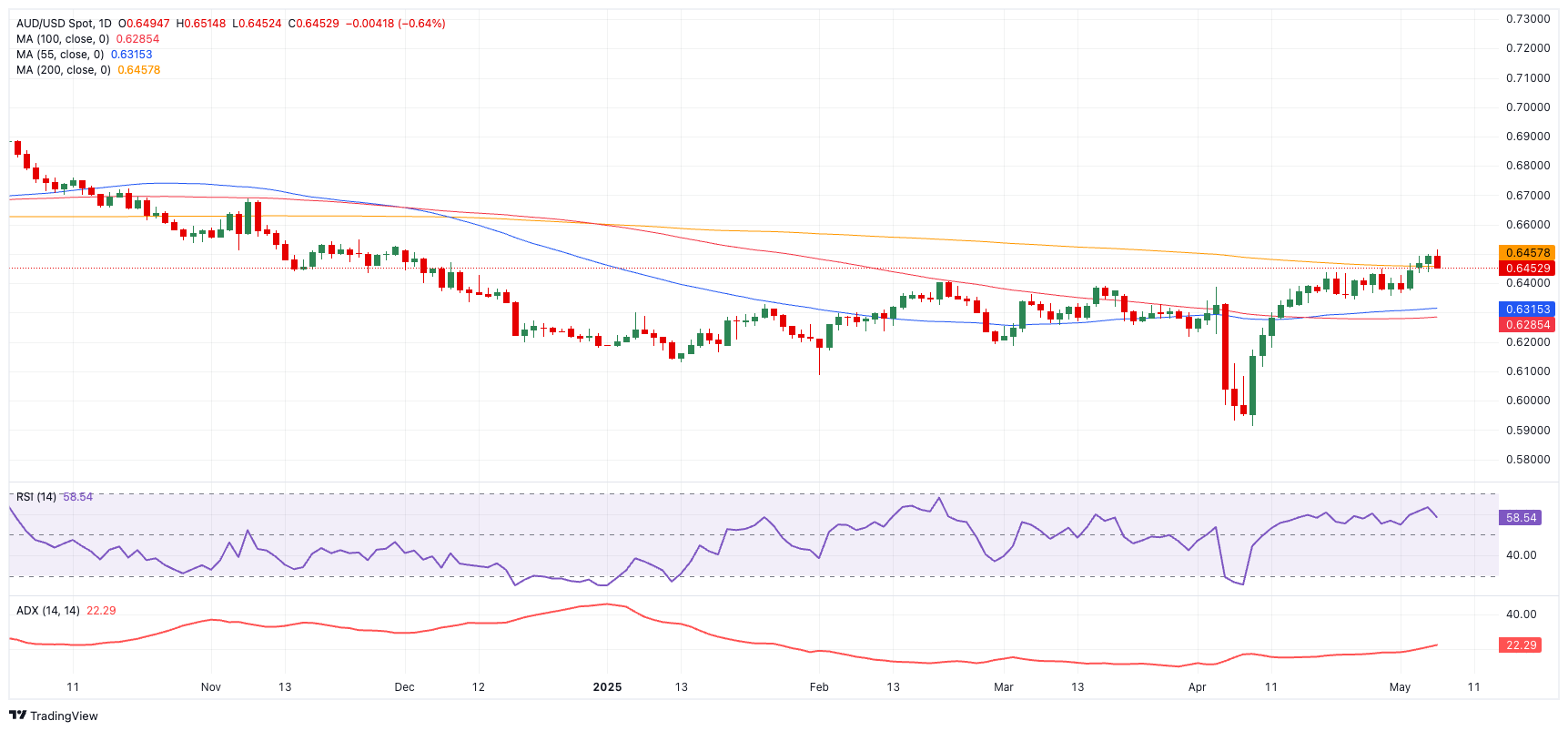
AUD/USD hit a yearly high at 0.6514 on May 7, breaking above its 200-day simple moving average (SMA) at 0.6459.
While above the latter, the door is expected to remain open to a potential retest of the November 2024 high at 0.6687.
Interim support, on the other side, lies at the 55-day and 100-day SMAs at 0.6314 and 0.6285, respectively. A sustained breach of those levels could put the 2025 bottom at 0.5913—and even the pandemic-era trough near 0.5506—back on the radar.
Momentum indicators support the move: the Relative Strength Index (RSI) sits near 59, while the Average Directional Index (ADX) is strengthening near 23—both pointing to growing upside traction.
AUD/USD daily chart
Outlook: Constructive but cautious
Despite recent gains, the outlook for AUD/USD remains clouded by structural headwinds. Sticky domestic inflation, fragile Chinese demand, and persistent geopolitical uncertainties mean the currency’s upside may prove fragile without a strong catalyst from either data or policy.
Author

Pablo Piovano
FXStreet
Born and bred in Argentina, Pablo has been carrying on with his passion for FX markets and trading since his first college years.