AUD/USD Price Forecast: No changes to the sidelined theme
- AUD/USD reclaimed the 0.6500 barrier and beyond, adding to Friday’s gains.
- The US Dollar succumbed to the renewed selling pressure amid trade jitters.
- Investors will now shift their attention to the release of the RBA Minutes on Tuesday.

The optimism for the Australian Dollar (AUD) remained in place on Monday, with AUD/USD advancing north of the key 0.6500 hurdle amid the continuation of the downward momentum in the US Dollar (USD).
Back in Oz, a lukewarm jobs report last week did little to cheer the market. Australia’s unemployment rate crept up to 4.3%, while employment grew by a meagre 2K positions. Even the participation rate edged only slightly higher, to 67.1%. Inflation expectations among consumers cooled a touch in July, slipping to 4.7% from June’s 5.0%.
RBA’s dilemma
The Reserve Bank of Australia (RBA) surprised many by holding its cash rate at 3.85% in early July. Though six of its board members voted for patience, three dissented—arguing for an immediate 25‑basis‑point cut. Governor Michele Bullock downplayed the split as “timing, not direction” and hinted that a slide in second‑quarter inflation toward forecasts would clear the way for rate cuts.
Futures markets have run with that signal: traders now see almost a 90% probability of an August rate cut, even as they nudge the likely endpoint for borrowing costs a touch higher—from about 2.85% to roughly 3.10%.
Meanwhile, the RBA Minutes due on Tuesday are expected to shed further detail on the split vote at that meeting.
China’s mixed signals
Developments in Australia’s biggest trading partner offer a mixed picture. Second‑quarter growth matched Beijing’s expectations, expanding at a 1.1% quarterly pace and 5.2% YoY. Factory output remains a bright spot, up nearly 7%, but retail sales growth has slowed to under 5%, reflecting stubbornly high savings and mounting household debt.
A June trade surplus of $114.8 billion further underscores that China’s economy is treading water rather than charging ahead.
Earlier on Monday, the People’s Bank of China (PboC), as expected, left its 1Y-Loan Prime Rate (LPR) and 5Y-LPR at 3.00% and 3.50%, respectively.
Diverging central banks
Monetary policy paths appear to be diverging. The RBA’s pause mirrors the Fed’s June decision, yet US policymakers worry that renewed tariffs could fan the flames of inflation.
Indeed, a slight uptick in US inflationary pressure in June underscores that threat and hints at a potential split if either side sees another price surge.
Bearish bets build
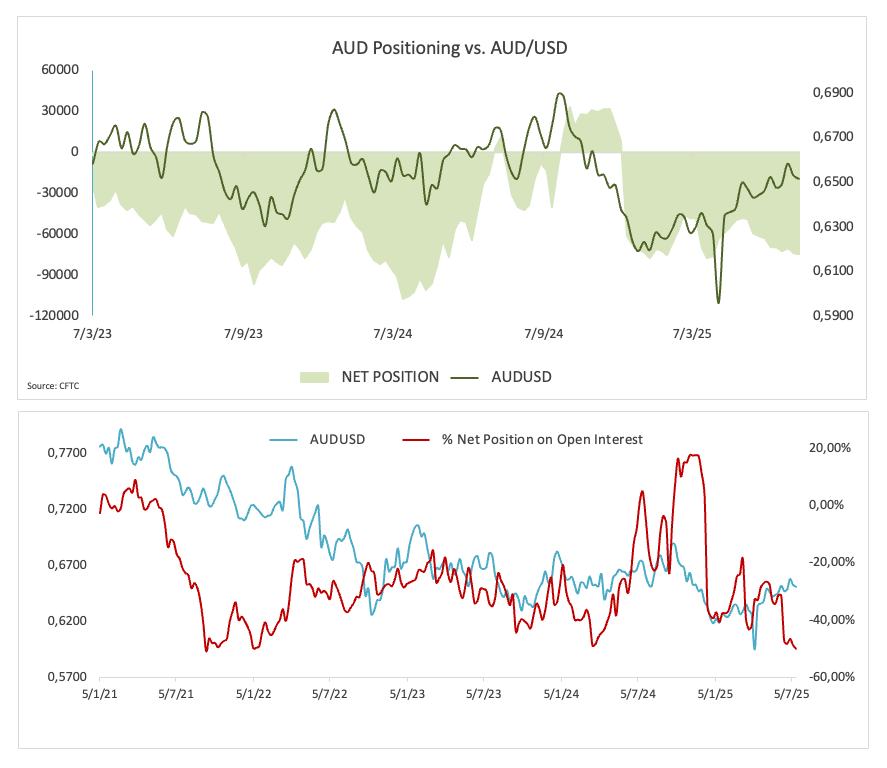
Investor sentiment toward the Aussie has worsened. As of the week ending July 15, speculators ramped up their bearish wagers after net short positions climbed to around 75K contracts, with overall open interest shrinking to nearly 150.5K contracts, marking a four‑week trough.
Technical outlook
AUD/USD faces a tough climb. The pair must clear its 2025 peak of 0.6590 before eyeing the November 2024 high of 0.6687 (November 7) and the psychologically potent 0.7000 mark.
To the downside, immediate support lies around July’s low of 0.6454, followed by the 200‑day simple moving average (SMA) at 0.6399.
Momentum indicators offer little solace: the Relative Strength Index (RSI) advances to nearly 52, while the Average Directional Index (ADX) near 17 suggests the current trend lacks conviction.
AUD/USD daily chart

Conclusion
With China’s recovery patchy and the potential for fresh trade skirmishes looming both in Beijing and Washington, the Aussie may remain range-bound until a clear catalyst emerges. For now, the RBA seems inclined to proceed with caution, signaling measured nudges rather than dramatic moves.
RBA FAQs
The Reserve Bank of Australia (RBA) sets interest rates and manages monetary policy for Australia. Decisions are made by a board of governors at 11 meetings a year and ad hoc emergency meetings as required. The RBA’s primary mandate is to maintain price stability, which means an inflation rate of 2-3%, but also “..to contribute to the stability of the currency, full employment, and the economic prosperity and welfare of the Australian people.” Its main tool for achieving this is by raising or lowering interest rates. Relatively high interest rates will strengthen the Australian Dollar (AUD) and vice versa. Other RBA tools include quantitative easing and tightening.
While inflation had always traditionally been thought of as a negative factor for currencies since it lowers the value of money in general, the opposite has actually been the case in modern times with the relaxation of cross-border capital controls. Moderately higher inflation now tends to lead central banks to put up their interest rates, which in turn has the effect of attracting more capital inflows from global investors seeking a lucrative place to keep their money. This increases demand for the local currency, which in the case of Australia is the Aussie Dollar.
Macroeconomic data gauges the health of an economy and can have an impact on the value of its currency. Investors prefer to invest their capital in economies that are safe and growing rather than precarious and shrinking. Greater capital inflows increase the aggregate demand and value of the domestic currency. Classic indicators, such as GDP, Manufacturing and Services PMIs, employment, and consumer sentiment surveys can influence AUD. A strong economy may encourage the Reserve Bank of Australia to put up interest rates, also supporting AUD.
Quantitative Easing (QE) is a tool used in extreme situations when lowering interest rates is not enough to restore the flow of credit in the economy. QE is the process by which the Reserve Bank of Australia (RBA) prints Australian Dollars (AUD) for the purpose of buying assets – usually government or corporate bonds – from financial institutions, thereby providing them with much-needed liquidity. QE usually results in a weaker AUD.
Quantitative tightening (QT) is the reverse of QE. It is undertaken after QE when an economic recovery is underway and inflation starts rising. Whilst in QE the Reserve Bank of Australia (RBA) purchases government and corporate bonds from financial institutions to provide them with liquidity, in QT the RBA stops buying more assets, and stops reinvesting the principal maturing on the bonds it already holds. It would be positive (or bullish) for the Australian Dollar.
Premium
You have reached your limit of 3 free articles for this month.
Start your subscription and get access to all our original articles.
Author
Pablo Piovano
FXStreet
Born and bred in Argentina, Pablo has been carrying on with his passion for FX markets and trading since his first college years.