AUD/USD Price Forecast: Looks past hotter Australian CPI amid fresh USD buying
- AUD/USD jumps to a fresh weekly high in reaction to the hotter Australian monthly CPI print.
- The emergence of some USD dip-buying keeps a lid on any meaningful upside for the major.
- Traders also seem reluctant to place aggressive bets ahead of this week’s key US macro data.


The AUD/USD pair catches fresh bids on Wednesday following the previous day's two-way directionless price moves and rises beyond the 0.6600 mark, or a fresh weekly top during the early part of the European session. The Australian Dollar (AUD) gets a strong boost after the Australian Bureau of Statistics (ABS) reported that the headline Consumer Price Index (CPI) rose 3.0% in the year to August, compared to a 2.8% increase reported in the previous month. Moreover, the reading was slightly higher than the 2.9% expected and reaffirmed bets that the Reserve Bank of Australia (RBA) will leave interest rates unchanged next week. This, along with easing US-China trade tensions, underpins the Aussie and acts as a tailwind for the currency pair.
The US Dollar (USD), on the other hand, regains positive traction and snaps a two-day losing streak amid Federal Reserve (Fed) Chair Jerome Powell's cautious remarks on Tuesday. Powell tried to push back against expectations of more interest rate cuts and said that the central bank needs to continue balancing the competing risks of high inflation and a weakening job market in the upcoming rate decisions. Powell added that easing too aggressively could leave the inflation job unfinished and would need to reverse course. Traders, however, still expect the Fed to lower borrowing costs again in October and December following the 25-basis-point rate cut earlier this month. This could keep a lid on further USD appreciation and favors the AUD/USD bulls.
Meanwhile, odds for an RBA rate cut in November stand at 70%. This, in turn, warrants some caution before positioning for an extension of the AUD/USD pair's recovery move from the 0.6575 region, or a two-week low touched on Monday. Traders now look forward to important US macro releases, which will play a key role in influencing the near-term USD price dynamics and provide some meaningful impetus to the currency pair during the latter part of the week. The final version of the US Q2 GDP print and Durable Goods Orders will be published on Thursday, followed by the US Personal Consumption Expenditure (PCE) Price Index on Friday. The latter is seen as the Fed's preferred inflation gauge and should infuse volatility in the markets.
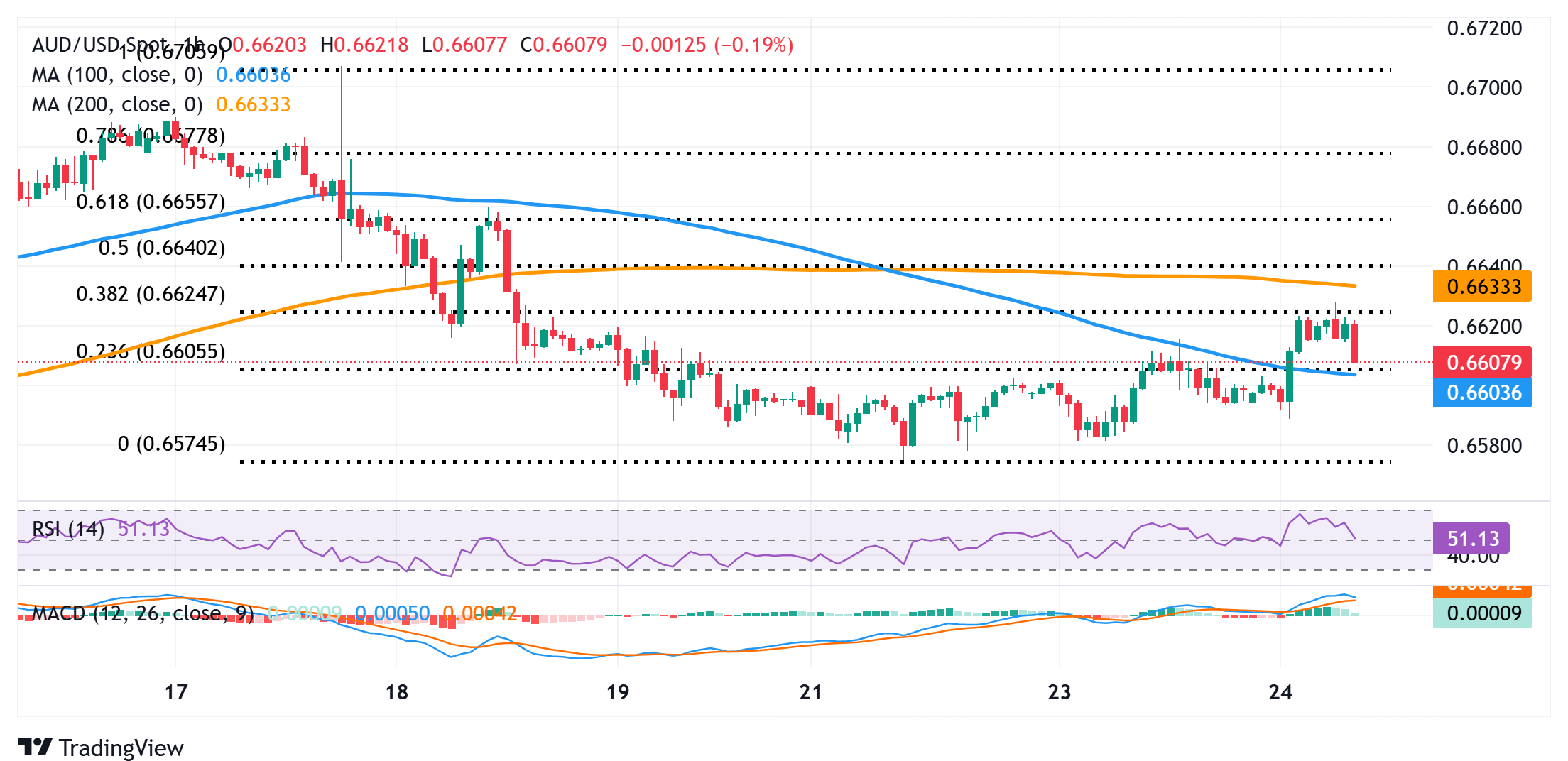
AUD/USD 1-hour chart
Technical outlook
The intraday move beyond the 0.6600 confluence – comprising the 23.6% Fibonacci retracement level of the recent pullback from the year-to-date high and the 100-hour Simple Moving Average (SMA) – was seen as a key trigger for bullish traders. The subsequent move up, however, struggles to find acceptance above the 38.2% Fibo. level and falters near the 0.6625-0.6630 region. The latter nears the 200-hour SMA, which, if cleared, could lift the AUD/USD pair to the 0.6655 region, or the 61.8% Fibo. level. Some follow-through buying should allow spot prices to retest the YTD peak and make a fresh attempt to conquer the 0.6700 round figure.
On the flip side, the 0.6580 zone might protect the immediate downside, below which the AUD/USD pair could resume a one-week-old downtrend and test the 0.6550 intermediate support before eventually dropping to the 0.6500 psychological mark. A convincing break below the latter will be seen as a fresh trigger for bearish traders and expose the August monthly swing low, around the 0.6415 region.
Author
Haresh Menghani
FXStreet
Haresh Menghani is a detail-oriented professional with 10+ years of extensive experience in analysing the global financial markets.