AUD/USD Price Forecast: Further gains hinge on data releases
- AUD/USD receded from YTD peaks, still above 0.6300.
- The US Dollar regained some balance on the back of tariffs chatter.
- The RBA kept the cautious stance following a 25 bps rate cut.


The US Dollar (USD) gained some momentum on turnaround Tuesday as United States (US) traders returned to their desks following the Presidents’ Day holiday. In doing so, the Dollar Index (DXY) managed to shake off three consecutive days of losses and retest the 107.00 threshold, supported by a rebound in US yields and renewed concerns over tariffs.
Meanwhile, the Australian Dollar (AUD) gave up a bit of ground to the Greenback’s mild advance, motivating AUD/USD to pull back slightly from Monday’s yearly highs around 0.6370. Even so, it continued to trade comfortably above the 0.6300 mark.
Trade worries and tariffs
Trade tensions remain a big driver of currency moves. The Aussie Dollar, like other risk-sensitive currencies, has benefitted from the US Dollar’s recent soft patch and the market’s uneasy mood about Washington’s latest tariff plans.
President Trump postponed a 25% tariff on Canadian and Mexican goods for a month, offering a brief ray of optimism. However, new tariff threats quickly wiped out any feel-good factor. The US also slapped a 10% tariff on Chinese imports, sparking fears of Chinese retaliation.
Because China is Australia’s largest export market, any tit-for-tat measures could dampen demand for Australian commodities. China has hinted it might challenge the US at the World Trade Organization (WTO), creating more uncertainty for resource-focused economies like Australia.
Inflation, the Fed and what comes next
Even though the US Dollar has bounced back a bit, investors are still worried that trade tensions might flare up again. If that happens, inflation could climb, possibly encouraging the Federal Reserve (Fed) to keep its policies tighter for longer.
Back in Australia, the Reserve Bank of Australia (RBA) reduced its policy rate by 25 bps to 4.10%—a move that had been widely anticipated—but stressed that it did not signal a broader easing of policy. While underlying inflation is projected to remain slightly above target at 2.7%, the central bank has revised its unemployment forecast downward to 4.2% in light of strong labour market indicators.
In her subsequent press conference, RBA Governor Michele Bullock clarified that the decision did not imply further cuts, with future policy hinging on the evolution of the labour market.
That said, it is worth recalling Australia’s recent inflation numbers: Q4 Consumer Price Index (CPI) rose 2.5% YoY. Trimmed mean CPI—a key RBA gauge—slipped to a three-year low of 3.2%.
Commodities not helping much
Australia’s economic outlook also depends heavily on commodity exports. If Chinese demand takes a hit, the knock-on effect could be significant. Iron ore and copper prices—both critical to Australia’s economy—traded slightly on the defensive on Tuesday, collaborating with the downtick in the Aussie Dollar.
Technical view: Levels to keep an eye on
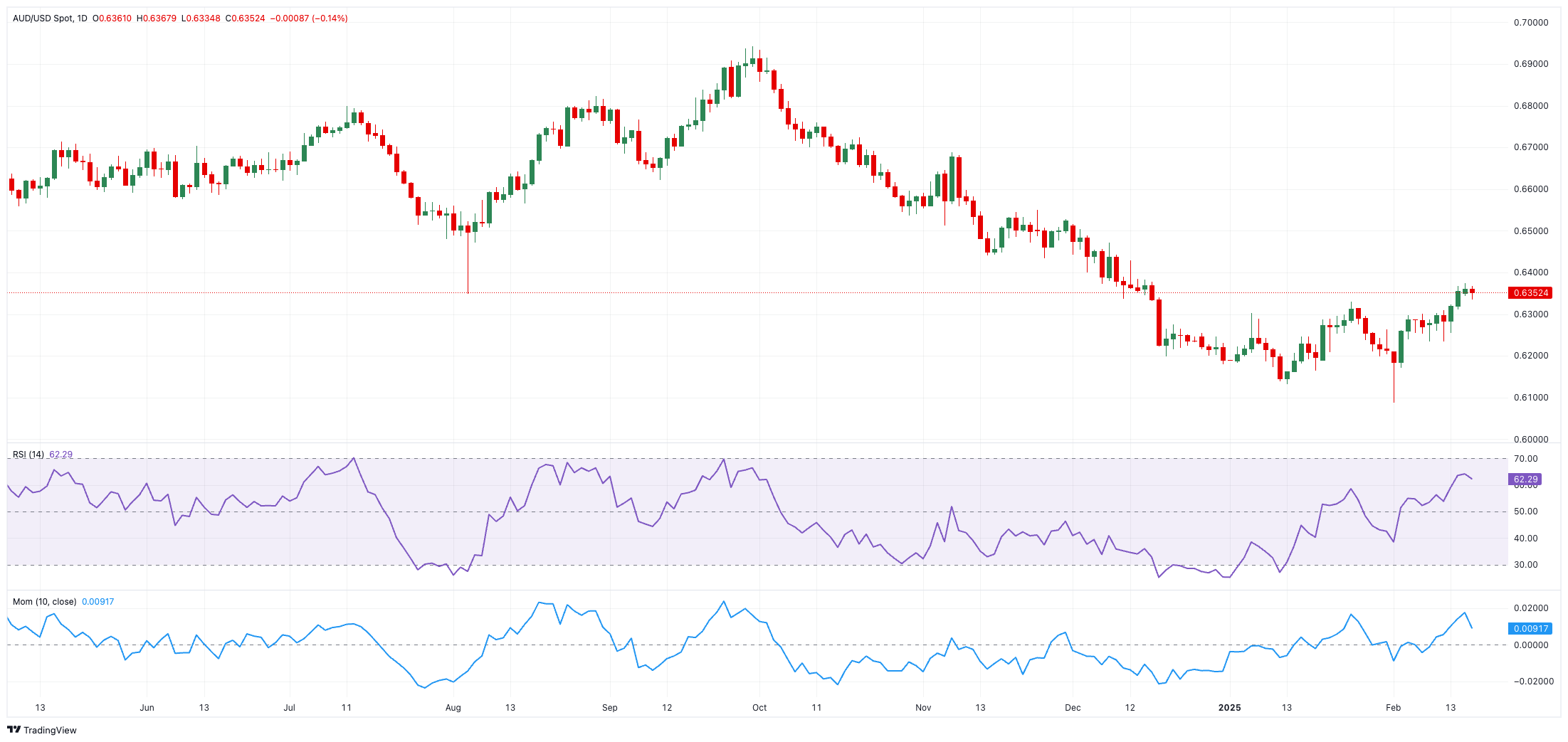
On the upside, the 2025 top of 0.6373 (February 17) comes first, closely followed by the interim 100-day Simple Moving Average (SMA) at 0.6435. Beyond that, watch the November 25 peak at 0.6549, seconded by the key 200-day SMA at 0.6556.
On the downside, the 55-day SMA at 0.6280 serves as provisional support, ahead of the 2025 bottom at 0.6087, and then the psychological 0.6000 level.
Technical indicators are sending mixed signals: The Relative Strength Index (RSI) hovers around 62, suggesting bullish momentum, while the Average Directional Index (ADX) near 14 indicates a relatively weak trend overall.
AUD/USD daily chart
What’s next?
Investors are gearing up for a busy week in Australia. Wednesday brings the Q4 Wage Price Index, while the labour market report is due on Thursday.
Premium
You have reached your limit of 3 free articles for this month.
Start your subscription and get access to all our original articles.
Author
Pablo Piovano
FXStreet
Born and bred in Argentina, Pablo has been carrying on with his passion for FX markets and trading since his first college years.