AUD/USD Price Forecast: Bulls need to wait for move beyond 0.6535-0.6540 supply zone
- AUD/USD struggles to capitalize on modest intraday gains amid a combination of negative factors.
- Softer monthly Australian CPI print lifts July RBA rate cut bets and acts as a headwind for the Aussie.
- A modest USD uptick contributes to capping the pair and warrants some caution for bullish traders.


The AUD/USD pair trades with a positive bias for the third straight day on Wednesday, though it lacks bullish conviction and remains below the weekly high touched the previous day amid mixed cues. The US Dollar (USD) languishes near a one-week low amid bets that the Federal Reserve (Fed) will resume its rate-cutting cycle soon. The Australian Dollar (AUD), on the other hand, struggles to attract any meaningful buyers on the back of softer domestic consumer inflation figures, which gives the Reserve Bank of Australia (RBA) more headroom to cut interest rates.
In fact, the Australian Bureau of Statistics showed that the monthly Consumer Price Index (CPI) rose by 2.1% in the year to May. This marked a notable slowdown from the 2.4% seen in April and fell short of the market forecast for a 2.3% increase. Furthermore, the annual trimmed mean CPI grew 2.4%, down from 2.8% in April, representing the softest level since November 2021. Adding to this, CPI excluding volatile items and holiday travel rose 2.7% in May compared to 2.8% in the previous month. This points to a sustained downturn in inflation as consumer spending remains pressured amid heightened uncertainty stemming from US President Donald Trump's trade tariffs.
This, along with signs of weakness in the Australian labour market, backs the case for the next interest rate cut by the RBA in July and fails to assist the AUD/USD pair in building on this week's recovery from its lowest level since May 13. The USD bulls, on the other hand, remain on the defensive amid the growing acceptance that the US Federal Reserve (Fed) will cut interest rates further this year. Traders ramped up their bets that the Fed will lower rates by at least 50 basis points before the end of the year and are also pricing in a roughly 20% chance of a reduction in July. The bets were lifted by recent comments from Fed Governors Michelle Bowman and Christopher Waller.
Echoing the dovish view, Fed Chair Jerome Powell said on Tuesday that lower inflation and weaker labor hiring could lead to an earlier rate cut. Meanwhile, the Israel-Iran ceasefire came into effect on Tuesday and appeared to hold for now, despite an Israeli attack on Tehran and an Iranian missile strike shortly after the announcement of the truce. This remains supportive of the upbeat market mood, which turns out to be another factor undermining the safe-haven Greenback and contributing to the bid tone surrounding the risk-sensitive Aussie. However, the fundamental backdrop warrants some caution before positioning for any further near-term appreciating move.
AUD/USD daily chart
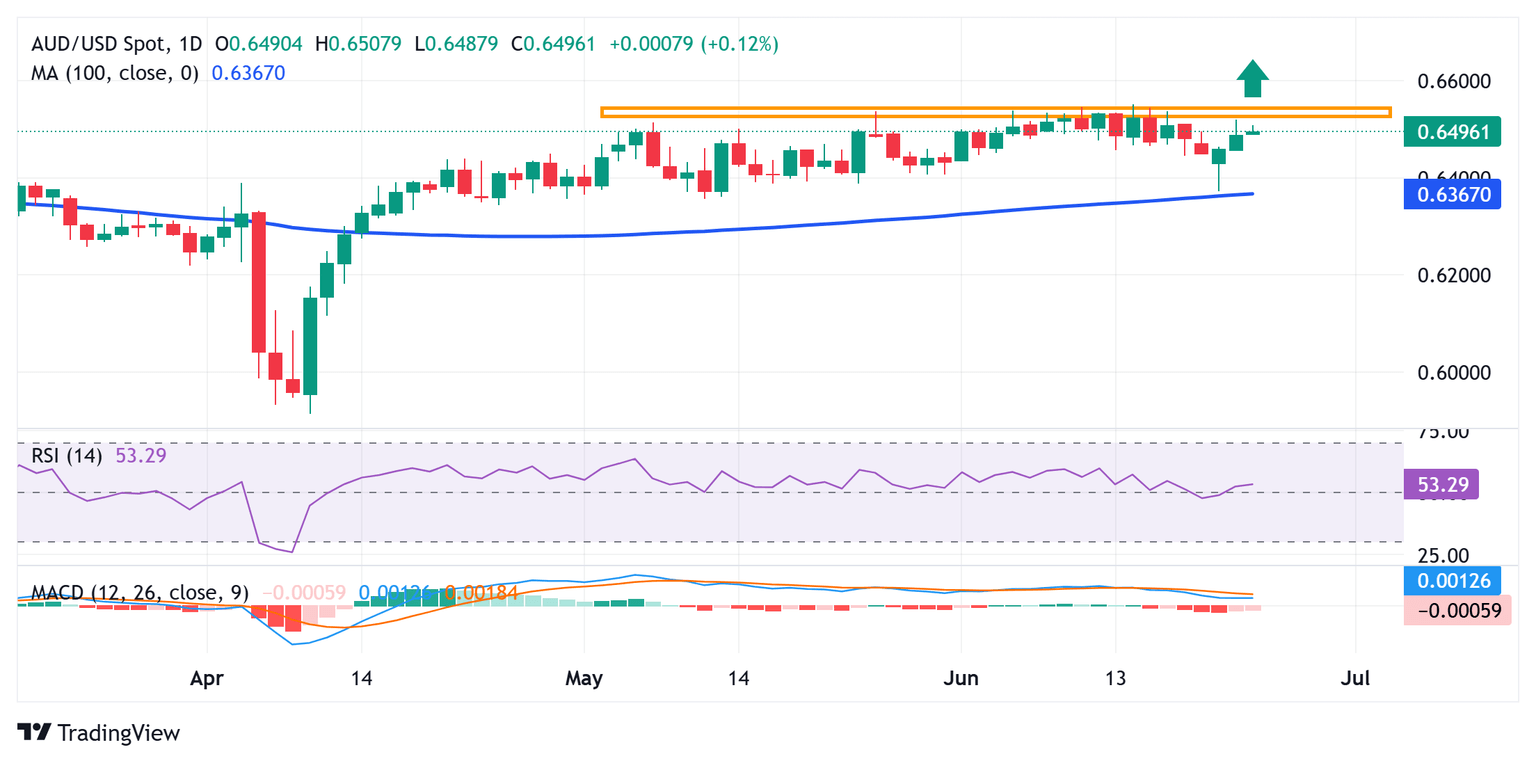
Technical Outlook
The AUD/USD pair earlier this week bounced from the vicinity of the 100-day Simple Moving Average (SMA) pivotal support. The subsequent move up and still positive oscillators on the daily chart favor bullish traders. However, it will still be prudent to wait for a sustained strength beyond the 0.6530-0.6540 heavy supply zone before positioning for any further gains. Spot prices might then aim to conquer the 0.6600 round figure and extend the positive momentum towards the 0.6640 hurdle en route to the 0.6680 region, or November 2024 swing high.
On the flip side, weakness below the 0.6465-0.6460 horizontal zone could find some support ahead of the 0.6400 round figure. This is followed by the 100-day SMA, around the 0.6375-0.6370 region. A convincing break below the latter would shift the bias in favor of bearish traders and drag the AUD/USD pair to the next relevant support near the 0.6300 round figure. The downfall could extend further towards the 0.6245 intermediate support before spot prices eventually drop to sub-0.6200 levels.
Premium
You have reached your limit of 3 free articles for this month.
Start your subscription and get access to all our original articles.
Author
Haresh Menghani
FXStreet
Haresh Menghani is a detail-oriented professional with 10+ years of extensive experience in analysing the global financial markets.