AUD/USD Price Forecast: Bulls at the mercy of USD price dynamics amid US-China trade war
- AUD/USD attracts some buyers amid optimism of China’s stimulus measures.
- Fed rate cut bets prompt fresh USD selling and also lend support to the pair.
- Escalating the US-China trade war might cap any further gains for the Aussie.

The AUD/USD pair builds on the previous day's late recovery from the 0.5930 area, or the lowest level since March 2020, and gains strong follow-through positive traction on Tuesday. The momentum lifts spot prices beyond mid-0.6000s during the first half of the European session and is sponsored by a combination of factors. Following the tariff-induced slump witnessed over the past three days, global equity markets registered strong gains amid reports that China is considering frontloading stimulus to mitigate the effects of US President Donald Trump's trade tariffs. This, in turn, offers some support to the perceived riskier Australian Dollar (AUD).
The US Dollar (USD), on the other hand, struggles to capitalize on its recent bounce from a multi-month low touched last week amid bets for multiple interest rate cuts by the Federal Reserve (Fed) in 2025. In fact, investors are now pricing in the possibility that the US central bank might resume its rate-cutting cycle in May and lower borrowing costs at least four times by the end of this year. This, in turn, prompts fresh USD selling and turns out to be another factor supporting the AUD/USD pair. However, a further escalation of trade tensions between the US and China – the world's two largest economies – could act as a headwind for the China-proxy Aussie.
Trump unveiled reciprocal tariffs of at least 10% on all imported goods last Wednesday, with China facing 54% levies under this new regime. Trump upped the ante further and threatened an additional 50% tariff on China if it doesn't withdraw a retaliatory 34% import fee on American products announced on Friday. The developments fuel worries that steep trade barriers around the world's largest consumer market could lead to a global recession, which might keep a lid on any optimism and cap the upside for the AUD/USD pair. This makes it prudent to wait for strong follow-through buying before confirming that spot prices have formed a near-term bottom.
Moving ahead, the market focus now shifts to the release of FOMC meeting minutes on Wednesday. Apart from this, traders this week will confront the US Consumer Price Index (CPI) and the Producer Price Index (PPI) on Thursday and Friday, respectively. The crucial inflation data will influence market expectations about the Fed's rate-cut path, which, in turn, will drive the USD demand and provide some meaningful impetus to the AUD/USD pair. Nevertheless, the aforementioned mixed fundamental backdrop warrants caution for aggressive traders and before positioning for a firm near-term direction.
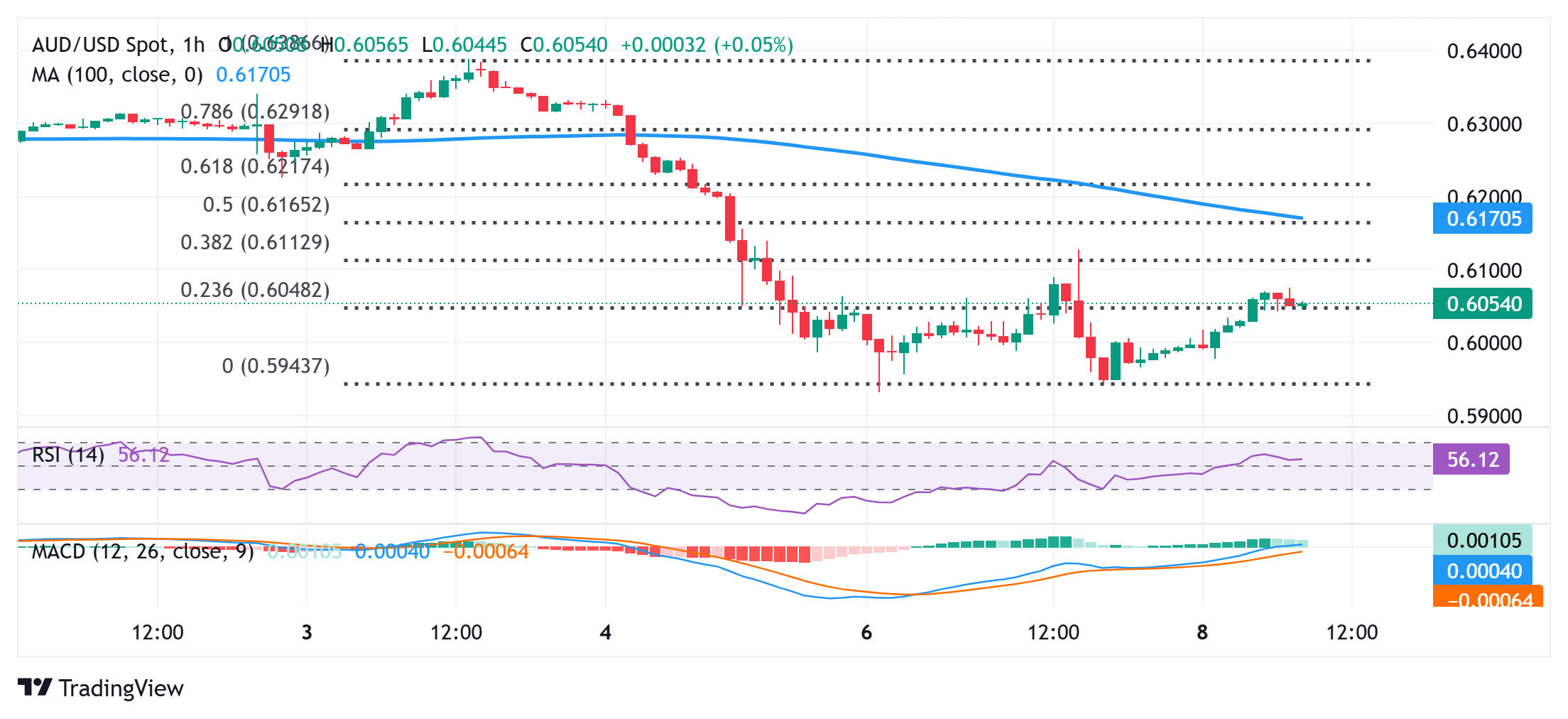
AUD/USD 1-hour chart
Technical Outlook
From a technical perspective, the intraday move up lifts the AUD/USD pair back above the 23.6% Fibonacci retracement level of the recent downfall from the vicinity of the 0.6400 mark, or a multi-week high touched last Thursday. However, the lack of any follow-through buying warrants some caution for bullish traders. Moreover, oscillators on the daily chart are holding deep in negative territory, suggesting that any subsequent move up is more likely to attract fresh sellers near the 0.6100 mark. The latter coincides with the 38.2% Fibo. level and is followed by the overnight swing high, around the 0.6125 region, which if cleared might trigger a short-covering rally. Spot prices might then climb to the next relevant hurdle near the 0.6165 area, or the 50% Fibo. level.
On the flip side, the 0.6025-0.6020 area could offer immediate support ahead of the 0.6000 psychological mark, below which the AUD/USD pair could aim to retest the multi-year low, around the 0.5930 region touched on Monday. The subsequent slide could drag spot prices below the 0.5900 round figure, towards the next relevant support near the 0.5820-0.5815 zone en route to the 0.5755-0.5750 intermediate support and eventually to the 0.5700 mark.
Author

Haresh Menghani
FXStreet
Haresh Menghani is a detail-oriented professional with 10+ years of extensive experience in analysing the global financial markets.
















