AUD/USD Price Forecast: Bears look to seize control near 0.6500 despite RBA’s hawkish tone
- AUD/USD attracts sellers for the fifth consecutive day as the risk-off mood undermines the Aussie.
- The lack of a major hawkish surprise from the RBA does little to impress bulls or lend any support.
- Reduced December Fed rate cut bets could underpin the USD and back the case for further losses.

The AUD/USD pair prolongs its downtrend for the fifth consecutive day and drops to the 0.6500 psychological mark, or a one-and-a-half-week low during the first half of the European session on Tuesday. In the absence of any major hawkish surprise from the Reserve Bank of Australia (RBA), a turnaround in the global risk sentiment and concerns over China's economy turn out to be key factors weighing on the Australian Dollar (AUD).
The RBA, as was anticipated, kept its cash rate unchanged at 3.60% for a second straight policy meeting, saying that inflation remains materially higher. In fact, the RBA's Trimmed Mean Consumer Price Index (CPI) rose 1.0% during the July-September quarter, and the year rate stood at 3.0%. Furthermore, the central bank revised its forecasts for inflation sharply higher, and does not see core inflation returning to the 2%-3% target band until after mid-2026. This suggests that interest rates are unlikely to move lower in the near term. The current market pricing, however, implies that the RBA's easing cycle may be over already. Hence, the hawkish outlook fails to impress the Aussie bulls or support the AUD/USD pair
Meanwhile, data released on Monday showed that China’s RatingDog Manufacturing Purchasing Managers Index (PMI) dipped to 50.6 in October, marking a notable slowdown from 51.2 in the previous month. This comes on top of the official Manufacturing PMI published last week, which signaled the steepest decline in industrial activity in six months and unexpectedly plummeted to 49.0 in October. Adding to this, China called on the US to avoid crossing red lines so that a trade truce sealed between Presidents Donald Trump and Xi Jinping can hold. This highlights the broad array of disagreements between the world's two largest economies and further seems to undermine the China-proxy AUD.
The US Dollar (USD), on the other hand, retreats slightly as bulls opt to take some profits off the table following the post-FOMC rally to the highest level since early August. Any meaningful USD fall, however, seems limited amid the US Federal Reserve's (Fed) hawkish tilt. In fact, Fed Chair Jerome Powell pushed back against market expectations for further policy easing this year and said last week that a further reduction in the policy rate at the December meeting is not a foregone conclusion. This, in turn, act as a tailwind for the USD and backs the case for an extension of the AUD/USD pair's recent retracement slide from the 0.6515-0.6520 region, or an over three-week high touched last Wednesday.
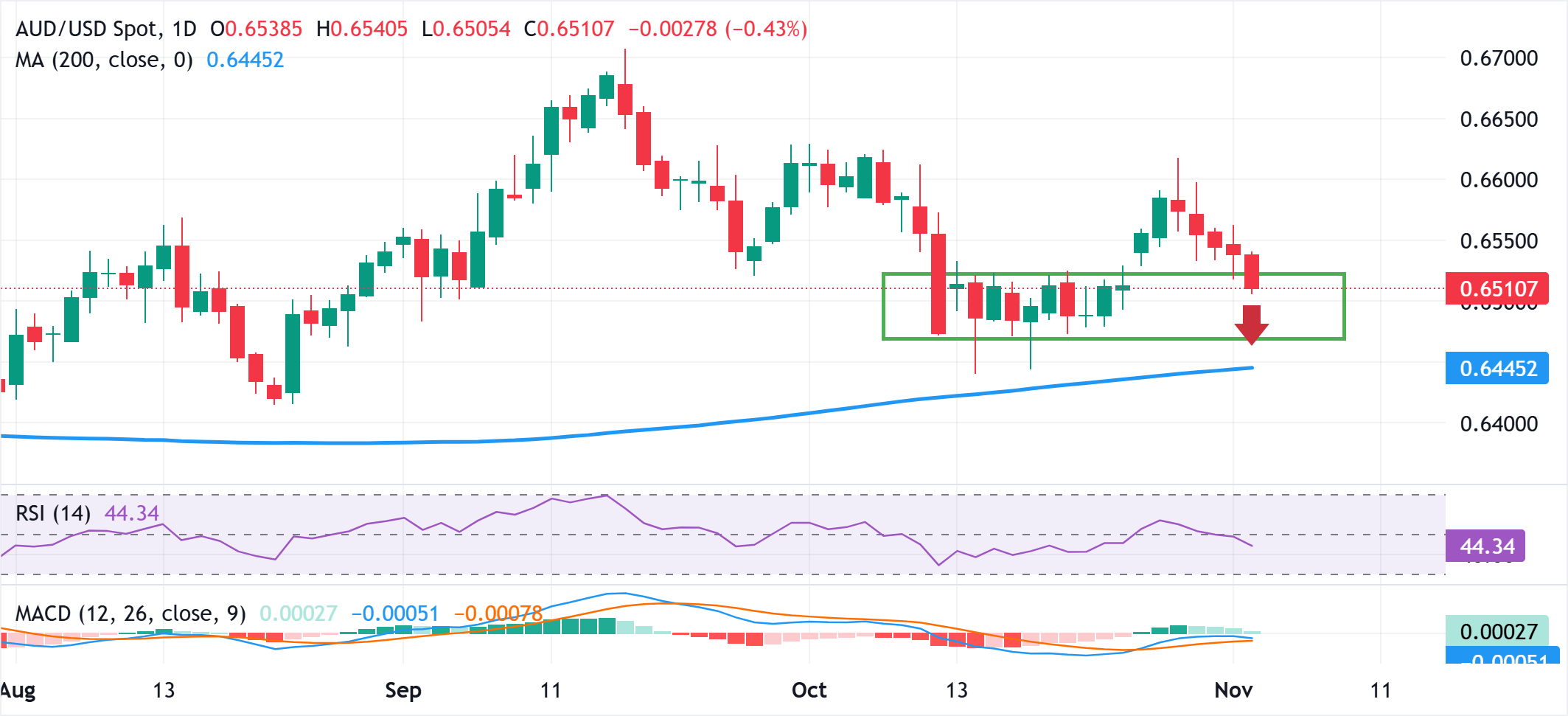
AUD/USD daily chart
Technical Outlook
From a technical perspective, weakness back below the 0.6525-0.6520 trading range resistance breakpoint, now turned support, could be seen as a trigger for the AUD/USD bears. Moreover, oscillators on the daily chart have again started gaining negative traction and back the case for deeper losses. Some follow-through selling below the 0.6500 psychological mark will reaffirm the outlook and make spot prices vulnerable to weaken below the 0.6480-0.6475 horizontal support, towards testing the 200-day Simple Moving Average (SMA), around the 0.6445 region. The latter nears October swing lows, which, if broken decisively, should pave the way for a fall towards the 0.6400 mark.
On the flip side, the 0.6535-0.6540 region now seems to act as an immediate hurdle ahead of the overnight swing high, around the 0.6560-0.6565 zone. A sustained strength beyond the latter should allow the AUD/USD pair to reclaim the 0.6600 round figure and climb further towards last week’s swing high, around the 0.6615-0.6620 region. Some follow-through buying would negate any near-term negative outlook and lift spot prices to the 0.6700 round figure.
Author

Haresh Menghani
FXStreet
Haresh Menghani is a detail-oriented professional with 10+ years of extensive experience in analysing the global financial markets.