AUD/USD Price Forecast: Approaches YTD top, around 0.6600 as bearish USD offsets dovish RBA
- AUD/USD attracts strong follow-through buying for the fourth consecutive day on Wednesday.
- The US-Japan deal boosts investors’ confidence and benefits the Aussie amid a weaker USD.
- The AUD bulls seem rather unaffected by dovish RBA meeting minutes released on Tuesday.


The AUD/USD pair is seen building on last week's goodish rebound from the vicinity of mid-0.6400s, or the monthly low, and gaining positive traction for the fourth consecutive day on Wednesday. The momentum remains uninterrupted through the early European session and lifts spot prices to over a one-week high, around the 0.6580 area. US President Donald Trump announced in a social media post that his administration had completed a massive trade deal with Japan. The optimism remains supportive of the upbeat market mood, which, in turn, benefits the risk-sensitive Aussie.
The US Dollar (USD), on the other hand, struggles near a two-week low set on Tuesday and turns out to be another factor acting as a tailwind for the AUD/USD pair. Against the backdrop of the risk-on environment, concerns about the Federal Reserve's (Fed) independence fail to assist the safe-haven Greenback to attract any meaningful buyers. In fact, Trump continues to push for lower interest rates and has publicly called for Fed Chair Jerome Powell’s resignation. Moreover, US Treasury Secretary Scott Bessent renewed calls for a sweeping internal review of the Fed’s operations.
Adding to this, the uncertainty over the likely timing and the pace of rate cuts by the Fed keeps the USD bulls on the defensive. This, to a larger extent, overshadows the Reserve Bank of Australia's (RBA) dovish tilt and continues to support the AUD/USD pair. According to the minutes from the July RBA meeting published on Tuesday, board members acknowledged that inflation is within target and is likely to stay there, while monetary policy is modestly restrictive. Moreover, policymakers remain inclined to ease further, with discussions centering on when rather than if another cut should occur.
Meanwhile, traders have become increasingly confident that the RBA will cut interest rates in August amid signs of easing labor market conditions. This might hold back traders from placing aggressive bullish bets around the Australian Dollar (AUD), warranting some caution before positioning for any further appreciating move for the AUD/USD pair. Wednesday's release of US Existing Home Sales will be looked upon for some impetus later during the North American session. The focus, however, will remain glued to the flash PMIs from Australia and the US on Thursday.
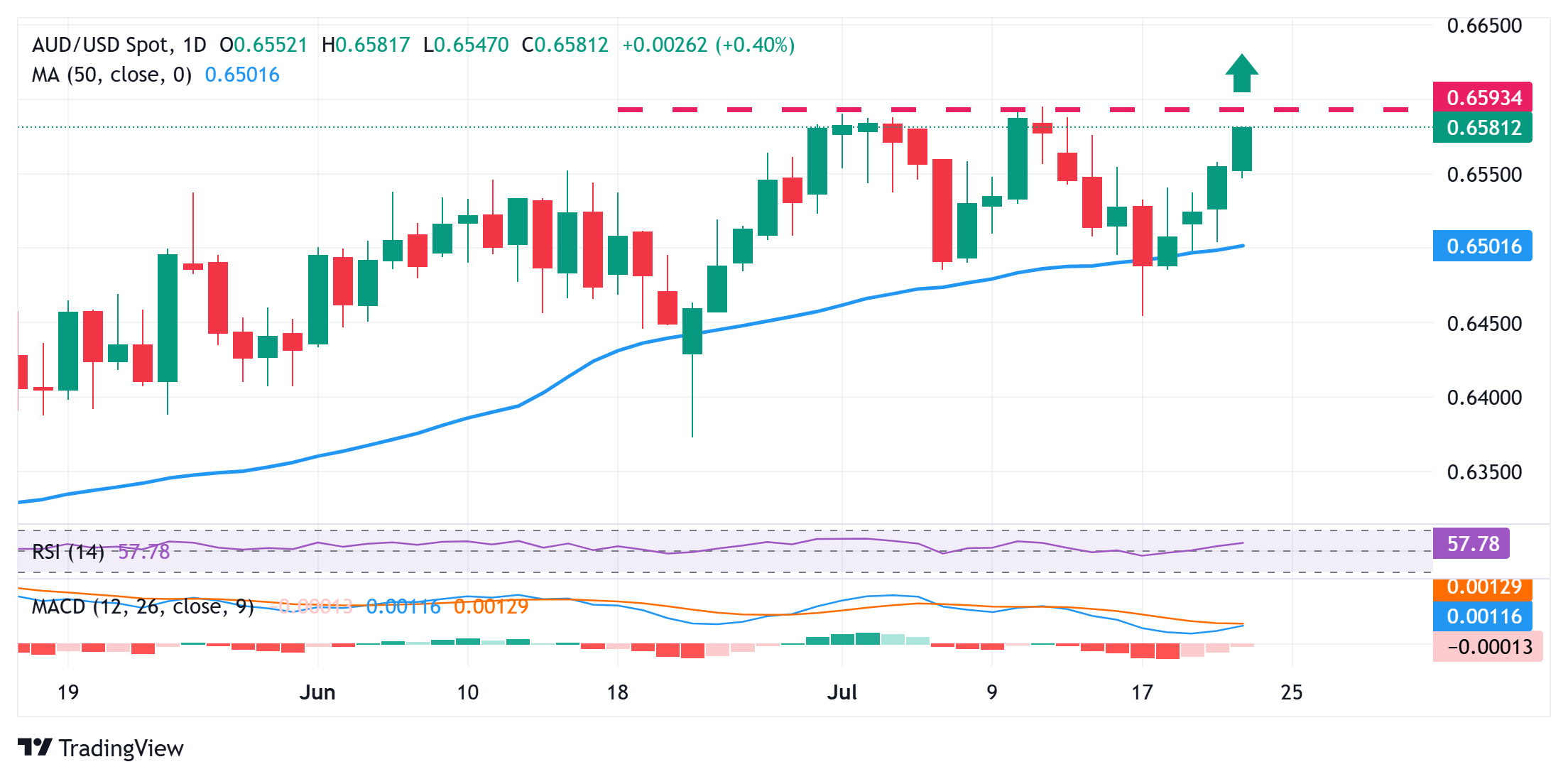
AUD/USD daily chart
Technical Outlook
From a technical perspective, any subsequent move up is likely to confront stiff resistance ahead of the 0.6600 mark, or the year-to-date peak touched earlier this month. A sustained strength beyond the latter will be seen as a fresh trigger for bullish traders amid positive oscillators on the daily chart and pave the way for additional gains. The AUD/USD pair might then climb to the next relevant hurdle near the 0.6640 region before extending the upward trajectory further to the 0.6680 intermediate hurdle, or November 2024 swing high, en route to the 0.6700 mark.
On the flip side, weakness back below mid-0.6500s might now be seen as a buying opportunity near the 0.6500 psychological mark and remain limited. Some follow-through selling would expose last week's swing low, around the 0.6455 region, below which the AUD/USD pair might accelerate the fall towards the 0.6420-0.6415 region, or the 200-day SMA, and eventually drop to the June monthly swing low, around the 0.6375-0.6370 area.
Author
Haresh Menghani
FXStreet
Haresh Menghani is a detail-oriented professional with 10+ years of extensive experience in analysing the global financial markets.

















