AUD/USD Outlook: Bulls losing traction below 0.7800 amid risk-off mood, US CPI in focus
- A combination of factors prompted some aggressive selling around AUD/USD on Wednesday.
- Strained relations between China and Australia, risk-off mood weighed heavily on the aussie.
- A modest USD short-covering move added to the selling bias ahead of the key US CPI report.

The AUD/USD pair witnessed some aggressive selling during the Asian session on Wednesday and extended this week's retracement slide from the highest level since February 25. China’s decision last week to halt all high-level economic dialogue with Australia pointed to strained relations between the two countries, which acted as a headwind for the Australian dollar. Apart from this, the prevalent risk-off mood was seen as another factor driving flows away from the perceived riskier aussie.
Markets have been speculating that the recent surge in commodity prices would fuel inflationary pressure in the US and force the Fed to hike rates earlier than anticipated. The worry triggered a selloff in rate-sensitive tech shares this week. Adding to this, escalating conflict between Israeli and Palestinian further dented investors' confidence. In fact, the UN Special Envoy to the Middle East Peace Process Tor Wennesland said that Israel and Palestine are heading towards full-scale war.
The global flight to safety prompted some short-covering around the safe-haven US dollar and further contributed to the pair's sharp intraday decline to sub-0.7800 levels or fresh weekly lows. The market focus will be squarely on the latest US consumer inflation figures, due later during the early North American session. The headline CPI is expected to accelerate to 3.6% YoY in April, well above the Fed’s 2% target. This will add to worries that maybe inflation is something more than transitory.
Meanwhile, the ongoing rally in copper prices to a fresh record high might extend some support to the commodity-linked currencies. Stimulus measures rolled by major economies is expected to significantly raise demand for copper. This, along with issues in major copper producers, especially Chile and Peru, has intensified the supply outlook and propelled copper price higher. Hence, it will be interesting to see if the pair is able to attract any dip-buying at lower levels or the decline suggests that the recent positive move has run out of steam.
Short-term technical outlook
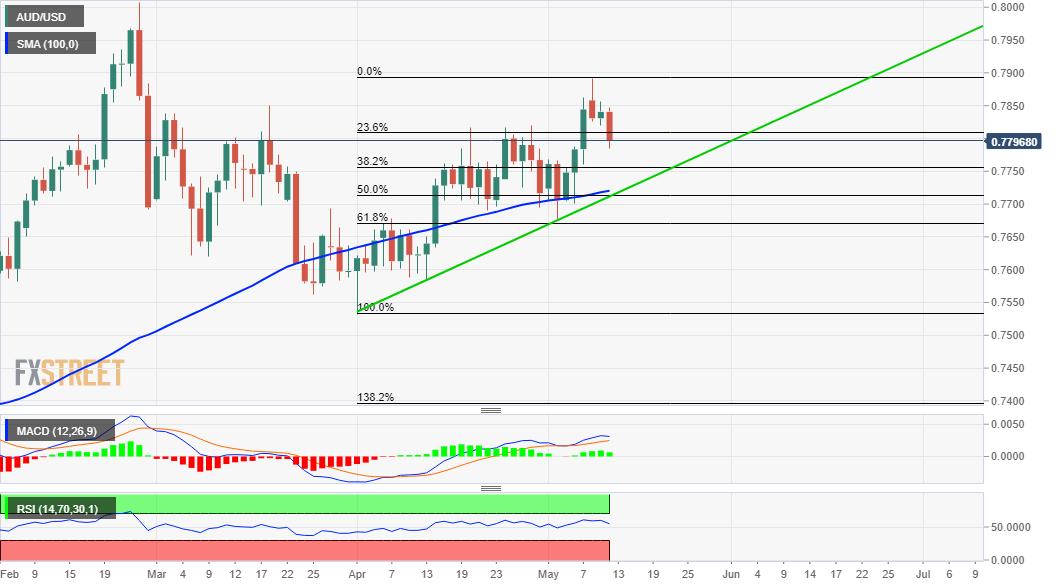
From a technical perspective, acceptance below the 0.7800 mark, which coincided with the 23.6% Fibonacci level of the 0.7531-0.7892 move up, supports prospects for further intraday losses. Hence, a subsequent fall towards the 38.2% Fibo. level, around the 0.7760-55 congestion zone, now looks a distinct possibility. Some follow-through selling has the potential to drag the pair towards the 0.7715 confluence support, comprising of the 50% Fibo. level and over one-month-old ascending trend-line. Sustained weakness below will shift the near-term bias in favour of bearish traders and prompt some aggressive technical selling.
On the flip side, the immediate hurdle is pegged near the 0.7825 region. This is followed by the overnight swing highs, around the 0.7855 region, which if cleared decisively should assist bulls to aim to reclaim the 0.7900 mark. The subsequent positive move could get extended towards the 0.7965-70 intermediate resistance before the pair eventually climbs back to the key 0.8000 psychological mark.
Author

Haresh Menghani
FXStreet
Haresh Menghani is a detail-oriented professional with 10+ years of extensive experience in analysing the global financial markets.