AUD/USD Outlook: Bulls look to seize back control on RBA’s hawkish outlook
- AUD/USD regains positive traction in reaction to a more hawkish RBA policy decision.
- The USD edges lower amid retreating US bond yields, providing an additional boost.
- Expectations that the Fed will keep hiking rates to limit the USD losses and cap the pair.

The AUD/USD pair attracted fresh buying during the Asian session on Tuesday and snapped a three-day losing streak to a one-month low, around the 0.6855 region touched the previous day. The Australian Dollar strengthened across the board after the Reserve Bank of Australia (RBA) raised its cash rate by 25 bps to a decade-high of 3.35%. In the accompanying monetary policy statement, RBA Governor Philip Lowe said that further increases would be needed over the months ahead to ensure that inflation returns to target. It is worth mentioning that the domestic Consumer Price Index (CPI) grew at an annual pace of 7.8% in the December quarter - its fastest pace in over 30 years. This, along with a softer US Dollar, provides a goodish lift to the major.
A modest downtick in the US Treasury bond yields turns out to be a key factor capping the post-NFP USD recovery momentum from a nine-month low. Any meaningful USD pullback seems unlikely amid expectations that the Federal Reserve will stick to its hawkish stance for longer. The primarily upbeat US monthly employment details (NFP) released on Friday pointed to the underlying strength in the labor market and could allow the US central bank to keep raising interest rates. This, along with looming recession risks, should act as a tailwind for the safe-haven buck and keep a lid on the risk-sensitive Aussie. This, in turn, warrants some caution for aggressive bullish traders before positioning for a further appreciating move.
Moving ahead, there isn't any relevant market-moving macro data due for release from the US on Tuesday. Hence, Fed Chair Jerome Powell's speech will be looked upon for a fresh impetus later during the early North American session. The US bond yields will also influence the USD price dynamics. Traders will take cues from the broader risk sentiment to grab short-term opportunities around the AUD/USD pair.
Technical Outlook
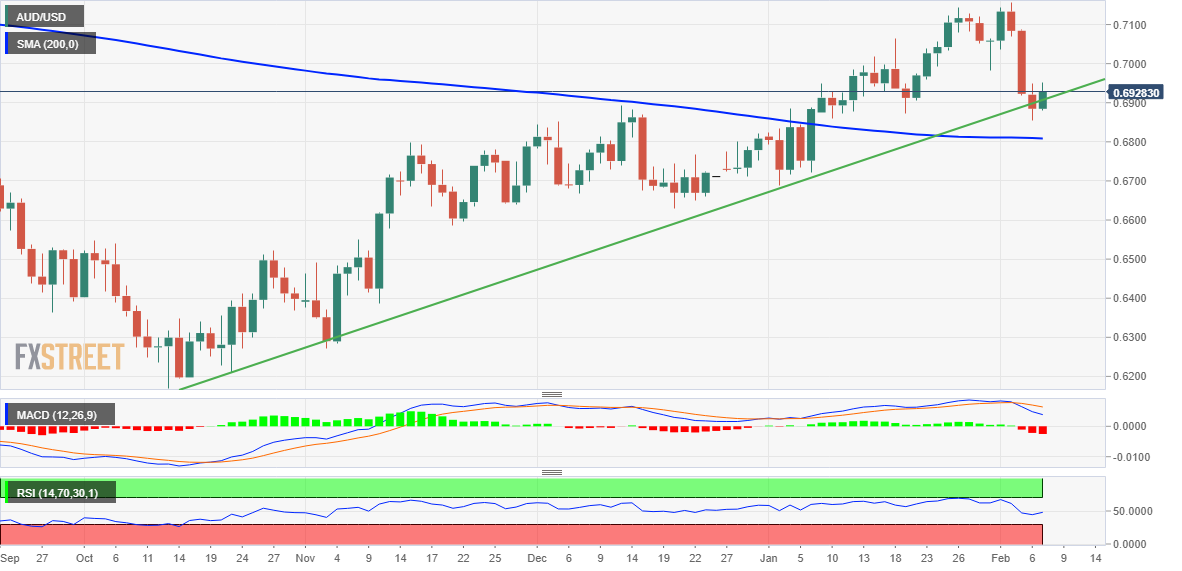
From a technical perspective, spot prices, so far, have been showing some resilience near support marked by an upward-sloping trend line extending from October 2022 swing low. The subsequent bounce suggests that the recent corrective pullback from the highest level since June 2022 touched last week might have run its course. That said, any further move up is more likely to confront stiff resistance ahead of the 0.7000 psychological mark. The latter should act as a pivotal point, above which the AUD/USD pair could climb back towards the 0.7055-0.7060 horizontal resistance. Some follow-through buying should pave the way for a move towards reclaiming the 0.7100 round figure.
On the flip side, the 0.6900 mark now protects the immediate downside ahead of the overnight swing low, around the 0.6855 region. Failure to defend the said support levels will mark a fresh bearish breakdown and make the AUD/USD pair vulnerable. Spot prices might then accelerate the fall towards challenging the very important 200-day SMA, currently around the 0.6800 mark, which, if broken decisively, will shift the near-term bias in favour of bearish traders.
Author

Haresh Menghani
FXStreet
Haresh Menghani is a detail-oriented professional with 10+ years of extensive experience in analysing the global financial markets.

















