AUD/USD Outlook: Bulls have the upper hand near multi-week top, FOMC minutes awaited
- AUD/USD gains positive traction for the sixth straight day and moves closer to a multi-week top.
- The optimism over China and RBA's signal of more rate increases/no cuts soon benefit the Aussie.
- Bulls now look to the release of the highly-anticipated FOMC minutes before placing fresh bets.

The AUD/USD pair attracts some buyers for the sixth successive day on Wednesday and trades around the 0.6570 area during the early European session, just below a nearly three-week high touched the previous day. The People’s Bank of China (PBoC) lowered its five-year loan prime rate by 25 basis points (bps) – the biggest cut since it was introduced in 2019 – to support real estate developers. Moreover, China reported a record upsurge in travel and consumption during the Lunar New Year holiday season, fuelling optimism over a potential recovery in Asia’s largest economy and benefitting the China-proxy Australian Dollar (AUD). Adding to this, the minutes of the latest Reserve Bank of Australia (RBA) monetary policy meeting held on February 5-6 revealed that policymakers are unwilling to rule out another cash rate increase in the wake of stick inflation.
The US Dollar (USD), on the other hand, languishes near its lowest level in almost three weeks and turns out to be another factor lending some support to the AUD/USD pair. Traders, however, might opt to move to the sidelines and prefer to wait for more cues about the Federal Reserve's (Fed) rate-cut path before placing fresh directional bets. Hence, the focus will remain glued to the release of the crucial FOMC monetary policy meeting minutes, due later during the US session. In the meantime, the markets have fully priced out the possibility of early interest rate cuts by the Fed. This remains supportive of elevated US Treasury bond yields, which should act as a tailwind for the buck. Apart from this, a generally softer tone around the equity markets could benefit the Greenback's relative safe-haven status and contribute to capping gains for the risk-sensitive Aussie.
Technical Outlook
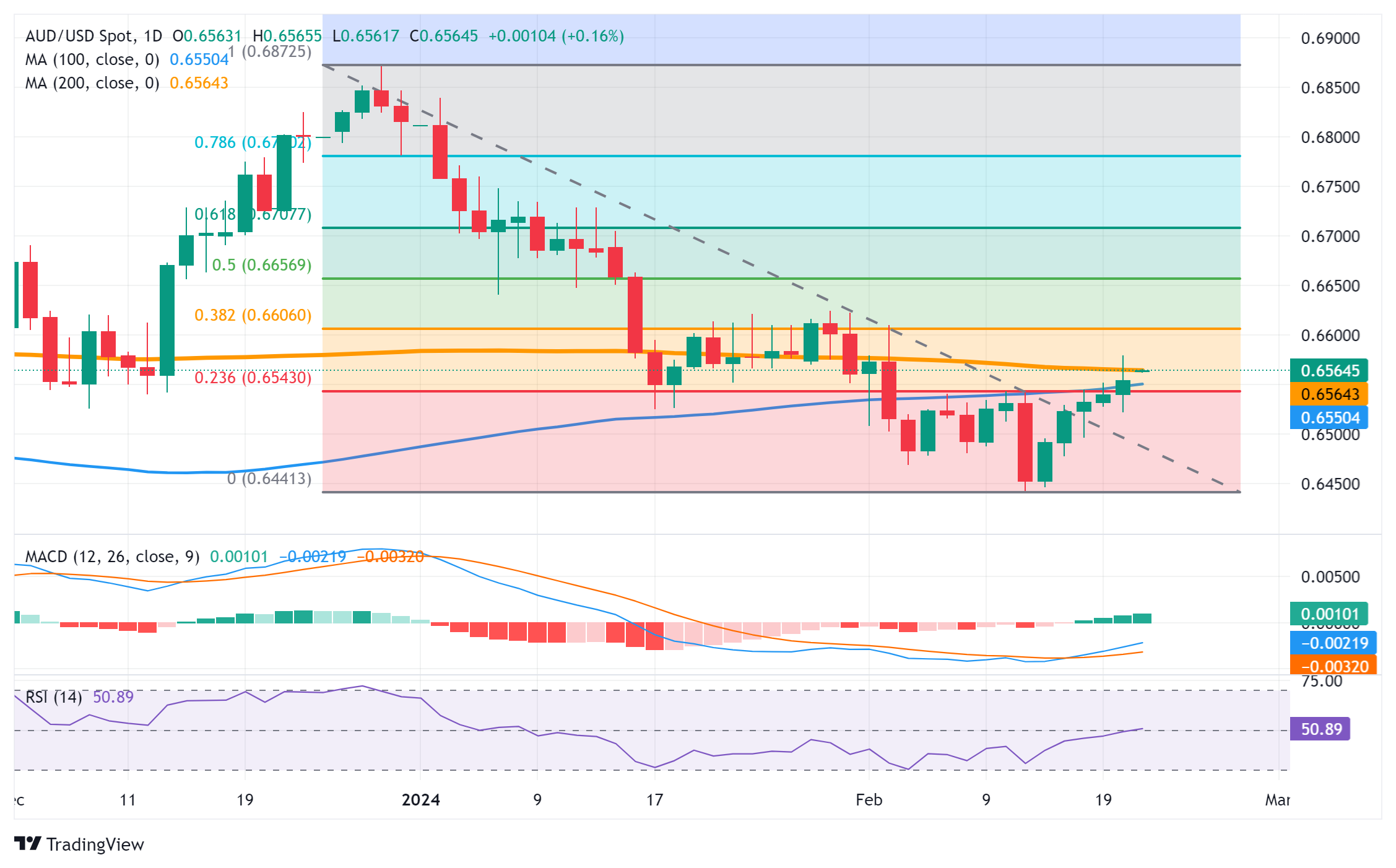
From a technical perspective, the overnight close above the 0.6540 confluence, comprising the 23.6% Fibonacci retracement level of the December-February fall and the 100-day Simple Moving Average (SMA) favours bullish traders. Moreover, oscillators on the daily chart have just started gaining positive traction and suggest that the path of least resistance for the AUD/USD pair is to the upside. That said, it will still be prudent to wait for some follow-through buying and acceptance beyond the 200-day SMA barrier, currently around the 0.6565 region, before positioning for further gains. Spot price might then aim to reclaim the 0.6600 round figure, representing the 38.2% Fibo. level. This is followed by the 0.6620-0.6625 supply zone, which if cleared should pave the way for a move towards the 50% Fibo. level, around the 0.6655-0.6660 region.
On the flip side, the 0.6520 area might protect the immediate downside ahead of the 0.6500 psychological mark. A convincing break below the latter might expose the multi-month low, around the 0.6445-0.6440 area touched last week. Some follow-through selling has the potential to drag the AUD/USD pair further towards the 0.6400 mark. The downward trajectory could get extended to the 0.6340-0.6335 support zone, or the November 2023 swing low, en route to the 0.6300 mark and the 2023 trough, near the 0.6270 area.
Author

Haresh Menghani
FXStreet
Haresh Menghani is a detail-oriented professional with 10+ years of extensive experience in analysing the global financial markets.

















