AUD/USD Outlook: Bearish flag pattern spotted on short-term charts ahead of FOMC decision
- AUD/USD is seen oscillating in a range just below a two-week high touched on Tuesday.
- Hawkish Fed expectations seem to underpin the USD and act as a headwind for the pair.
- Traders opt to wait on the sidelines ahead of the crucial FOMC monetary policy decision.


The AUD/USD pair attracts some dip-buying on Tuesday and holds steady around the 0.6465 region heading into the European session. Spot prices, however, lack bullish conviction and remain below a two-week high touched on Tuesday as traders opt to wait on the sidelines ahead of the crucial FOMC monetary policy decision later today.
The Federal Reserve (Fed) is widely expected to keep its benchmark interest rate unchanged at the current range of between 5.25% and 5.5%. The markets, however, seem convinced that the US central bank will keep the door open for at least one more rate hike by the end of this year. The recent resurgence in US consumer inflation, along with signs of a resilient economy, should allow the Fed to keep interest rates higher for longer. Hence, investors will closely scrutinize the accompanying monetary policy statement and Fed Chair Jerome Powell's comments at the post-meeting press conference for cues about the future rate-hike path. This, in turn, will play a key role in influencing the near-term USD price dynamics and provide a fresh directional impetus to the AUD/USD pair.
In the meantime, hawkish Fed expectations remain supportive of elevated US Treasury bond yields and continue to act as a tailwind for the Greenback. Apart from this, the market anxiety heading into the key central bank event risk contributes to keeping a lid on any meaningful upside for the risk-sensitive Australian Dollar (AUD) in the wake of China's conservative approach to introducing more stimulus measures. In fact, the People's Bank of China (PBoC) kept its Loan Prime Rates (LPR) unchanged at a monthly fixing earlier today. This, along with speculations that the Reserve Bank of Australia (RBA) might have ended its rate-hiking cycle, warrants caution before positioning for an extension of the AUD/USD pair's bounce from the 0.6355 area, or the YTD low set on September 6.
Technical Outlook
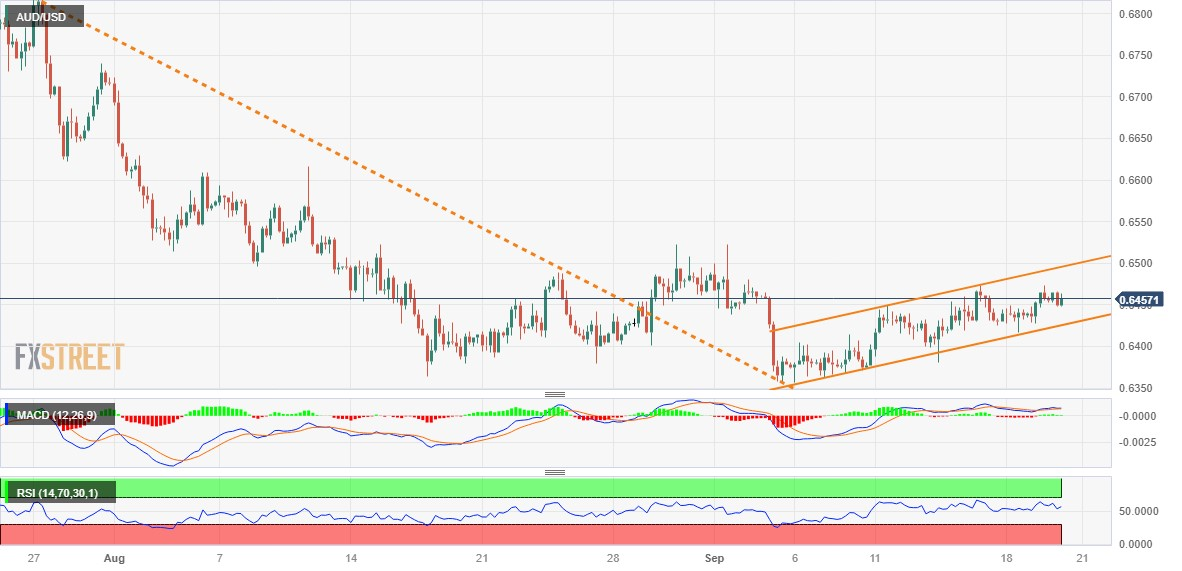
From a technical perspective, the recent move-up witnessed over the past two weeks or so has been along an upward-sloping channel. This comes on top of a steep fall from the 0.6900 neighbourhood and constitutes the formation of a bearish flag pattern on short-term charts. Meanwhile, technical indicators on the daily chart have fully recovered from the negative territory. Hence, a convincing break below the trend-channel support, currently pegged around the 0.6415 region, is needed to support prospects for the resumption of over a two-month-old downtrend.
The AUD/USD pair might then accelerate the fall back towards challenging the 2023 trough, around the 0.6355 region, before eventually dropping to the 0.6300 round figure. The downward trajectory could get extended further towards the next relevant support near the 0.6245-0.6240 area en route to the 0.6200 mark.
On the flip side, strength beyond the 0.6475 area, or the overnight swing high, is likely to confront a stiff barrier just ahead of the 0.6500 psychological mark, or the top boundary of the aforementioned trend-channel. A sustained strength beyond could trigger a short-covering rally and allow the AUD/USD pair to reclaim the 0.6600 round figure.
Premium
You have reached your limit of 3 free articles for this month.
Start your subscription and get access to all our original articles.
Author
Haresh Menghani
FXStreet
Haresh Menghani is a detail-oriented professional with 10+ years of extensive experience in analysing the global financial markets.