|

AUD/USD Forecast: Struggling to retain the 0.7800 threshold

AUD/USD Current Price: 0.7787

  • Australian Q4 Gross Domestic Product came in at 3.1% QoQ, better than expected.
  • Wall Street’s poor performance and rising US Treasury yields weighed on the pair.
  • AUD/USD is neutral in the near-term, bulls can build once above 0.7840.
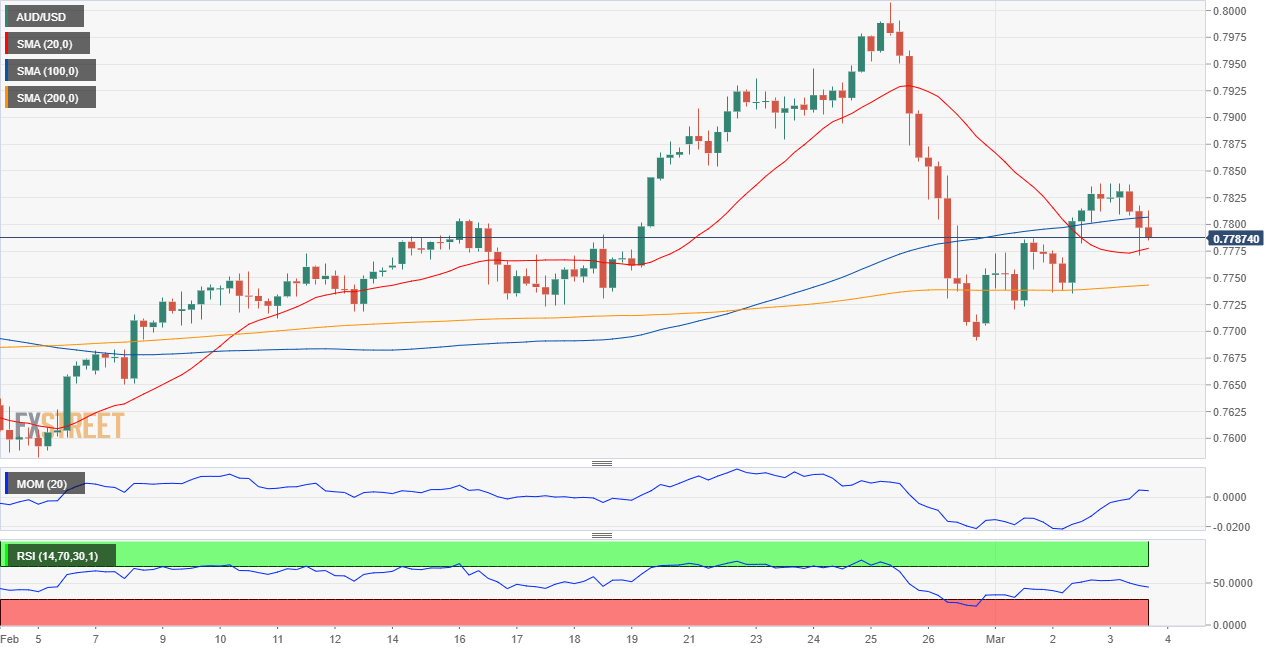
The AUD/USD pair trades around the 0.7800 level ahead of the Asian opening, little changed on a daily basis. During US trading hours, the pair fell to 0.7770 as the greenback got an intraday boost from rising US Treasury yields, while the aussie fell alongside equities, as Wall Street fell at the opening, later recovering and providing support to the pair.

The pair show little reaction to upbeat Australian growth figures, as the Q4 Gross Domestic Product came in at 3.1% QoQ, better than the 2.5% expected. The February Commonwealth Bank Services PMI printed at 53.4, down from 54.1 in the previous month, while the AIG Performance of Construction Index came in at 57.4 from 57.6 previously. During the upcoming Asian session, Australia will publish the final version of January Retail Sales and the Trade Balance for the same month.

AUD/USD short-term technical outlook

The AUD/USD pair is struggling to extend gains beyond the 0.7800 threshold, neutral in the near-term. The 4-hour chart shows that it´s trading between directionless moving averages, while the Momentum indicator retreats within positive levels, and the RSI consolidates around 47. Further gains are to be expected on a break above 0.7837, the weekly high.

Support levels: 0.7770 0.7730 0.7690

Resistance levels:  0.7840 0.7880 0.7920

View Live Chart for the AUD/USD

Author

Valeria Bednarik

Valeria Bednarik was born and lives in Buenos Aires, Argentina. Her passion for math and numbers pushed her into studying economics in her younger years.


More from Valeria Bednarik
Share:

Editor's Picks

AUD/USD bounces off multi-month low, nears 0.6900

AUD/USD edges higher toward 0.6900 in the Asian session on Wednesday, recovering some of the previous day’s losses to its lowest level since March as the US Dollar stalls the hot US CPI-inspired rally amid hopes of a US-Iran peace deal. Meanwhile, hawkish comments from FOMC members have almost confirmed another December rate hike, which favors USD bulls and should cap the Aussie.

USD/JPY remains capped below 159.00 amid looming intervention risks

USD/JPY struggles to build on the previous day’s strong gains to a near one-month top as intervention risk supports the Japanese Yen while hopes of a US-Iran peace deal cap the safe-haven US Dollar. That keeps the pair's upside limited below 159.00, for now.

Gold puts the $4,000 mark to the test

Gold now accelerates its daily correction, challenging the key $4,000 mark per troy ounce on Wednesday. The precious metal’s continuation of the downward trend comes against the backdrop of a robust performance of the US Dollar, rising US Treasury yields across the board and rising bets of extra rate hikes by the Fed.

Bitcoin Bull Score falls to 20 as USDT supply shrinks – CryptoQuant
Bitcoin's (BTC) market indicators have turned bearish at the same time, raising concerns that the top crypto could face a deeper correction despite historical similarities to previous market bottoms. In a report published Wednesday, CryptoQuant noted that its Bull Score Index dropped from 90 on October 13 to 20 in less than four weeks, reflecting a sharp deterioration in market conditions.
The Japanese Yen is doing something it hasn't done in ten weeks

USD/JPY climbs above the 159.00 resistance level, extending its advance on Wednesday, and bringing the Japanese Yen back toward its weakest levels in ten weeks amid renewed strength in the US Dollar. The move reflects a sharp repricing of Federal Reserve interest rate expectations following hawkish comments from Fed Governor Christopher Waller and stronger-than-expected US consumer inflation data.

What the US CPI headline doesn’t tell you about inflation

Brent crude has fallen about a third since mid-October on hopes the Iran war is ending, but diesel, freight and fertiliser costs haven't followed. Those costs reach US consumer prices in stages through 2027 and could keep inflation high after gasoline gets cheaper.