AUD/USD Forecast: Outlook remains positive above 0.6560
- AUD/USD added to Monday’s bearish price action.
- The RBA’s S. Hunter sounded cautious early on Tuesday.
- NAB’s Business Confidence receded to 0 in February.

The so-far weekly recovery of the US Dollar (USD) triggered a corrective movement in the risk-related universe, prompting AUD/USD to break below the 0.6600 key support and extend the pessimistic start of the week.
Meanwhile, further gains in the Greenback appeared propped up by extra advances in US yields across different timeframes, all against the backdrop of ongoing speculation about the Federal Reserve's (Fed) expected initial interest rate cut, anticipated in June. The move higher in yields and the US Dollar was reinvigorated after US inflation figures surprised to the upside in February.
Furthermore, negative sentiment surrounding the Australian dollar is exacerbated by renewed downward pressure on iron ore prices, driven by increasing inventories in China, reflecting growing uncertainty in its housing sector.
Regarding China, developments in its economy are likely to impact the AUD. While potential stimulus measures may offer temporary relief, sustained improvements in economic indicators are essential for bolstering the Australian currency and potentially initiating a significant upward trend in AUD/USD.
Additionally, the cautious stance of the Reserve Bank of Australia (RBA), which remains one of the last major central banks still considering interest rate cuts, acts as a constraint on the downside potential of the pair.
Still around the RBA, Assistant Governor Sara Hunter sounded prudent early in the Asian trading hours after she cautioned that while interest rate hikes pose challenges for some households, inflation remains the primary concern. Notably, household spending made no contribution to Q4 GDP growth, remaining stagnant after deducting -0.1 percentage points in Q3. Hunter remarked that the data align broadly with expectations, emphasizing ongoing monitoring and the forthcoming update of forecasts in May.
In summary, the RBA shows no urgency in reducing rates, yet subdued consumer spending supports market expectations of approximately 50 bps in rate cuts this year, likely commencing in August.
Given the disparity in timing between the RBA and the Fed's easing cycles, the Australian dollar could gain momentum later in the year, potentially leading to further advances in AUD/USD. Once the December 2023 peak of 0.6871 is surpassed, the pair could target the significant milestone of 0.7000 in the foreseeable future.
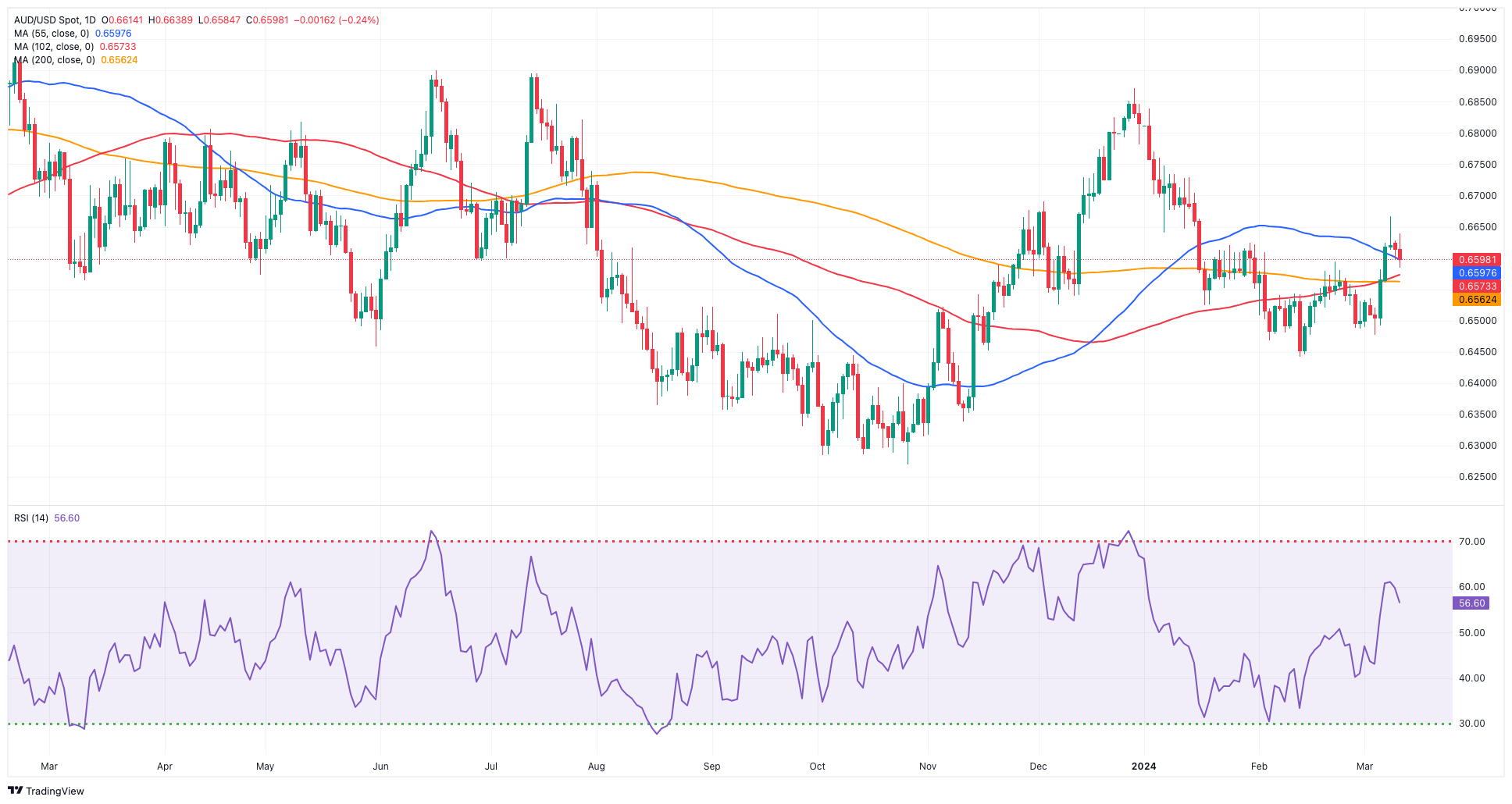
AUD/USD daily chart
AUD/USD short-term technical outlook
Once the AUD/USD trespasses the March peak of 0.6667 (March 8), a challenge of the December 2023 high of 0.6871 (December 28) could be on the horizon, followed by monthly tops of 0.6894 (July 14) and 0.6899 (June 16), all before the critical 0.7000 level.
However, if sellers take control, the pair may find early support at the March low of 0.6477 (March 5), which precedes the 2024 bottom of 0.6442 (February 13). Breaking below this level may result in a visit to the 2023 low of 0.6270 (October 26), followed by the round level of 0.6200 and the 2022 low of 0.6169 (October 13).
It is worth noting that the AUD/USD's positive bias should continue as long as it remains above the critical 200-day SMA at 0.6560.
According to the 4-hour chart, further losses could put spot on track to revisit the 200-SMA at 0.6542, followed by 06477, and lastly 0.6442. On the other hand, the immediate barrier appears at 0.6667, ahead of 0.6728 and 0.6871. Furthermore, the MACD continues in positive zone, and the RSI has dropped below the 50 threshold.
Author

Pablo Piovano
FXStreet
Born and bred in Argentina, Pablo has been carrying on with his passion for FX markets and trading since his first college years.















