|

AUD/USD Forecast: Losing bullish potential, but close to 0.6600

AUD/USD Current Price: 0.6536

  • Aussie weighed by the poor performance of equities, dismal market’s mood.
  • Tensions between Australia and China likely to set the tone for the pair this week.
  • AUD/USD could ease in the short-term, but the risk of a steep decline seems limited.
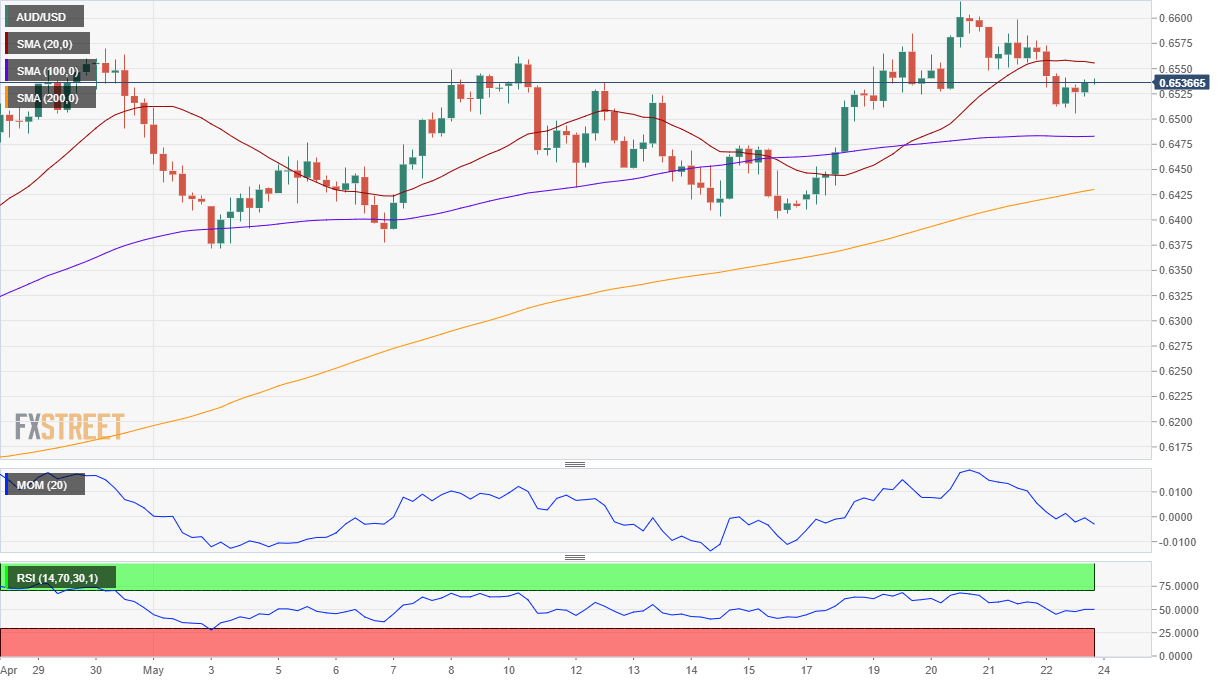
The AUD/USD pair settled at 0.6535, easing on Friday for a second consecutive day. Tensions between Australia and China weighed on the Aussie, amid Australia backing an investigation on the origins of COVID-19 and condemning Chin’s move to undermine Hong Kong’s autonomy through a  strict national security law. Firmer gold prices kept the downside limited for the pair, which anyway was unable to hold above the elusive 0.6600 threshold. China banned imports from Australian beef and imposed punitive tariffs on Australian barley, which also hit investor’s confidence in an economic recovery.

The Australian macroeconomic calendar will remain empty at the beginning of the week, with the focus on the country’s relationship with China.

AUD/USD short-term technical outlook

The AUD/USD pair has posted a weekly gain, despite easing at the end of it, and after posting a fresh 2-month high of 0.6615. The daily chart shows that the pair is losing its bullish potential, but it’s also far from bearish, as it holds above its 20 and 100 SMA, both converging at 0.6495, the immediate support level. Technical indicators, in the meantime, have turned lower but hold above their midlines. In the 4-hour chart, however, the pair is neutral-to-bearish, as the pair has settled below a now flat 20 SMA, while the Momentum indicator maintains its bearish slope within negative levels.

Support levels: 0.6495  0.6460 0.6420

Resistance levels: 0.6580 0.6615 0.6650  

View Live Chart for the AUD/USD

Author

Valeria Bednarik

Valeria Bednarik was born and lives in Buenos Aires, Argentina. Her passion for math and numbers pushed her into studying economics in her younger years.


More from Valeria Bednarik
Share:

Editor's Picks

AUD/USD struggles to recover as hawkish Fed bets escalate

The Australian Dollar is under pressure against the US Dollar as traders have raised bets supporting interest rate hikes by the Federal Reserve this year, with the AUD/USD pair posting a fresh almost eight-week low at around 0.7025. Hawkish Fed bets have accelerated following the release of the surprisingly strong United States Nonfarm Payroll (NFP) data for May.

USD/JPY holds higher ground toward 160.50 despite 'Yentervention' fears

USD/JPY holds higher ground toward 160.50 in Monday's Asian trading, despite intervention fears. Japan’s revised GDP print, which confirmed that the economy lost momentum in the first quarter, weighs on the Japanese Yen. Meanwhile, Friday's upbeat US NFP report and fresh Israel-Iran attacks favor the US Dollar bulls, underpinning the currency pair.

Gold sticks to the positive bias, still below  $4,350

Gold manages to reclaim the $4,300 mark per troy ounce and above on Monday. The yellow metal’s small uptick comes on the back of modest losses in the US Dollar, while traders continue to follow geopolitical events in the Middle East and the likelihood of a tighter-for-longer Fed.

Solana: ETF outflows and bearish sentiment reinforce downside risks

Solana (SOL) remains under pressure, trading below $66 on Monday after losing nearly 20% in the previous week. Institutional demand weakened with spot Exchange Traded Funds recording a net outflow of over $6.5 million last week, snapping a four-week streak of inflows.

$1.75 trillion: Is SpaceX the most popular IPO in history, or the most engineered?

On June 12, the largest initial public offering (IPO) in history is set to hit the tape, and almost nobody is asking whether the price is right, because almost everybody already wants in.

The US economy defies the rules: 100 days into the Oil shock and the recession signal is still missing

More than three months after the start of the Iran war and the resulting disruption to global energy markets, the US economy continues to display remarkable resilience. The conflict has triggered a sharp rise in Oil prices, reignited inflationary pressures and fueled widespread concerns about a potential economic slowdown.















