An existential crisis in the yen: is it losing its safe haven status?


The Japanese yen has, for decades, been considered the currency to plough into when the going gets tough in financial markets. Even when Japan was devastated by the 2011 tsunami, the yen surged, leading to multilateral action from the world’s central banks to supress its strength. However, as tensions mount in North Korea and the Bank of Japan appears committed to its ultra-lose monetary policy, then could the lure of the yen during hard times start to fade?
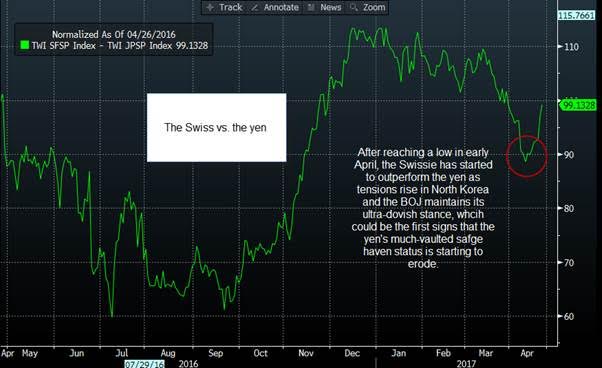
There are tentative signs that this could be the case. Firstly, we decided to see how the Japanese yen was performing relative to the Swiss franc, another currency viewed as a safe haven, as you can see in chart 1 below. We have looked at the spread between the trade weighted Swiss franc and the trade weighted yen. We have drawn a few conclusions below:
-
The spread has turned in the Swissie’s favour since the start of this month as North Korean tensions started to rise. This suggests that geopolitical issues on Japan’s door step could hurt the yen and erode its status as a safe haven going forward.
-
The BOJ is expected to maintain its large QE programme and dovish policy stance at its meeting on Thursday. This is at odds with other major central banks such as the Fed, who has started to normalise monetary policy, and even the ECB is expected to announce an early taper to its QE programme in the coming months. The continuation of QE in Japan when other central banks are starting to take steps to move away from dovish monetary policy, leads us to question whether the BOJ is actually jeopardising the safe haven status of the yen.
-
Chart 1 also suggests that the trend towards the Swissie and away from the yen began as early as October last year, and even occurred during the US Presidential election last November. Thus, this trend may continue in the foreseeable future.
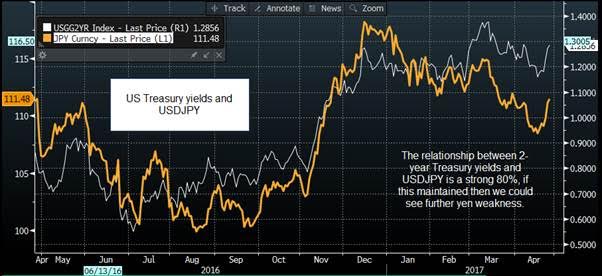
The second chart shows the correlation between USD/JPY and the 2-year US Treasury yield, which has surged to 80% since the start of this month, up from 56% a year ago. This means that 80% of the time, the yen weakens against the USD when US 2-year yields rise. The growing sensitivity of the yen to US Treasury yields may also weigh on the yen’s safe haven status, especially if you think that Treasury yields will continue to rise on the back of President Trump’s tax plan, to be announced today, and a continuation of the Fed’s normalisation of monetary policy.
Of course, there is a risk that if we see Treasury yields fall then we could see USD/JPY drop dramatically, however, that would be a major change in a medium-term trend, which appears fairly well entrenched at this stage. Unless Donald Trump’s tax plan causes major disappointment in the market, then we may see the yen weaken as Treasury yields continue to rise.
Author
Kathleen Brooks
XTB UK
Kathleen has nearly 15 years’ experience working with some of the leading retail trading and investment companies in the City of London.