|

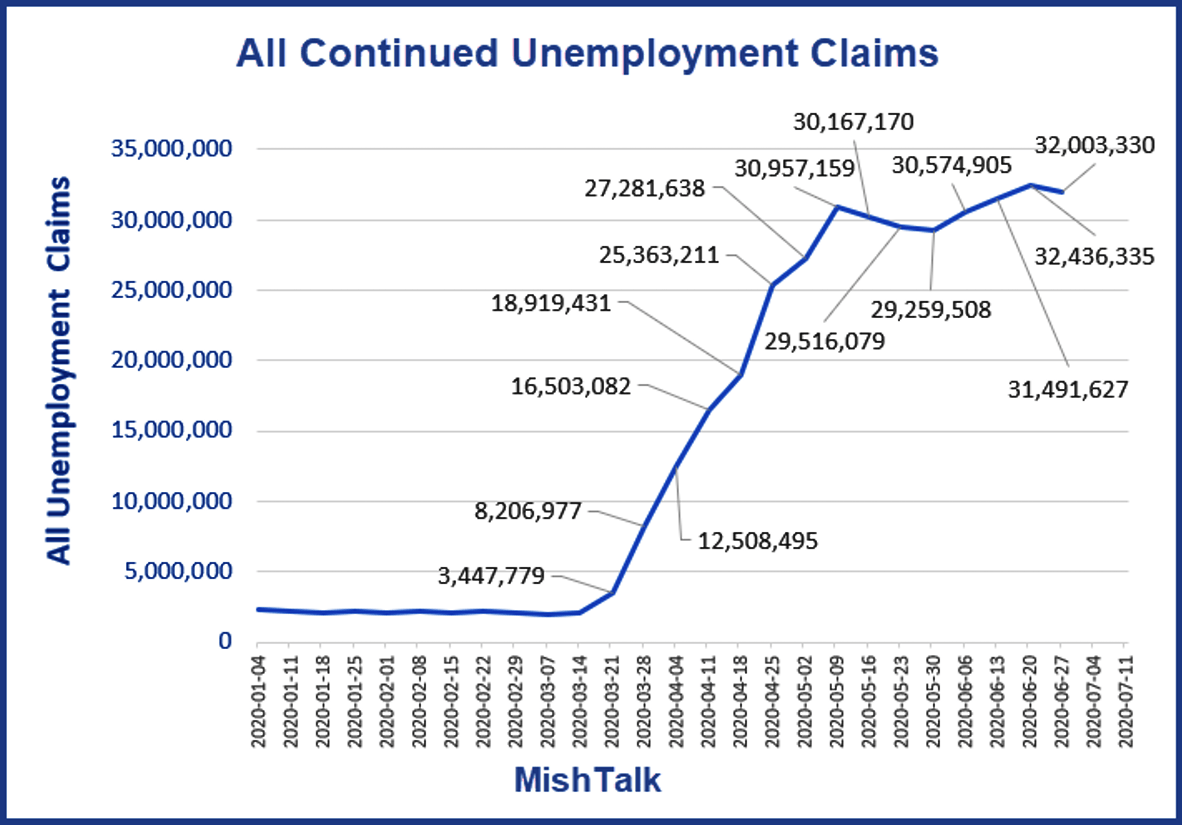
All continued Unemployment Claims top 32 million again
All continued claims dipped slightly but still top 32 million.

Based on Pandemic Unemployment Assistance, admittedly lagging, there is little or no improvement in the number of unemployed.

My "All Continued Claims" chart is the sum of state claims, federal claims, and various pandemic unemployment assistance (PUA) claims.

All claims lags state continued claims by two weeks.

State continued claims
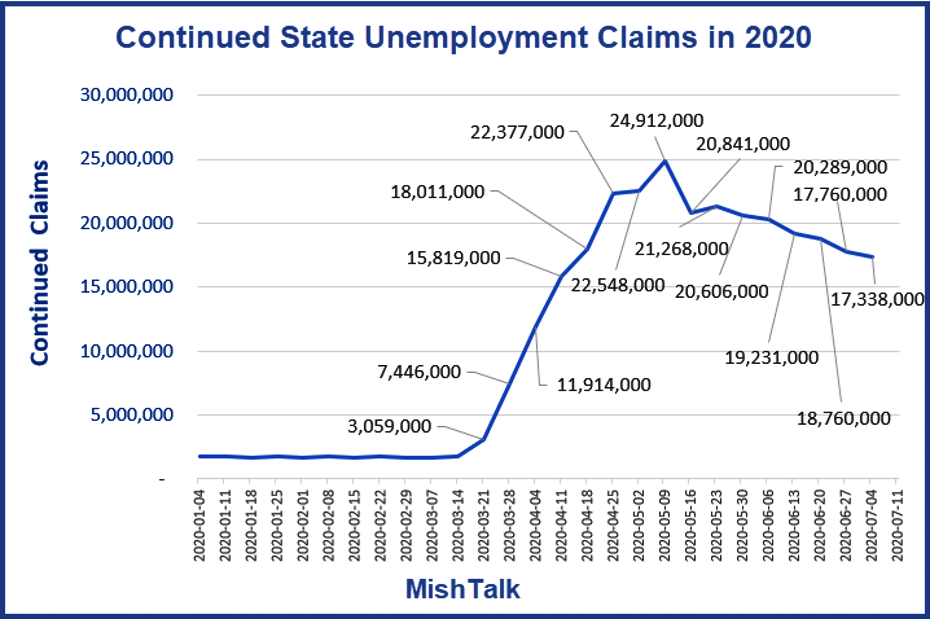
State continued claims dipped slightly to 17.338 million but have remained above 15 million for 13 weeks.

Based on trends in PUA claims, any improvement at the state level is likely a mirage.

Primary PUA claims
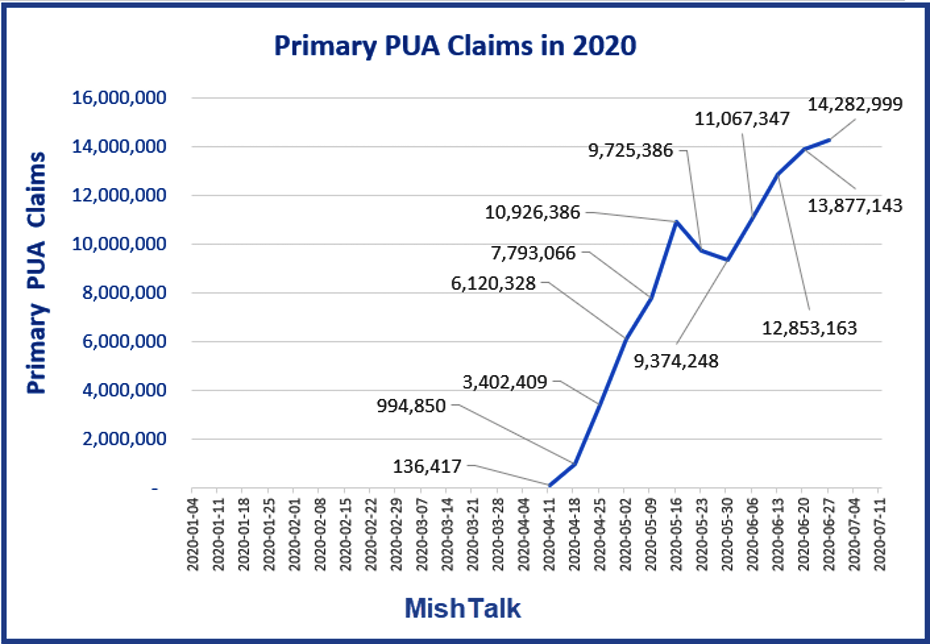
Primary PUA claims rose for the 4th week to a record 14.283 million. 

Initial State claims
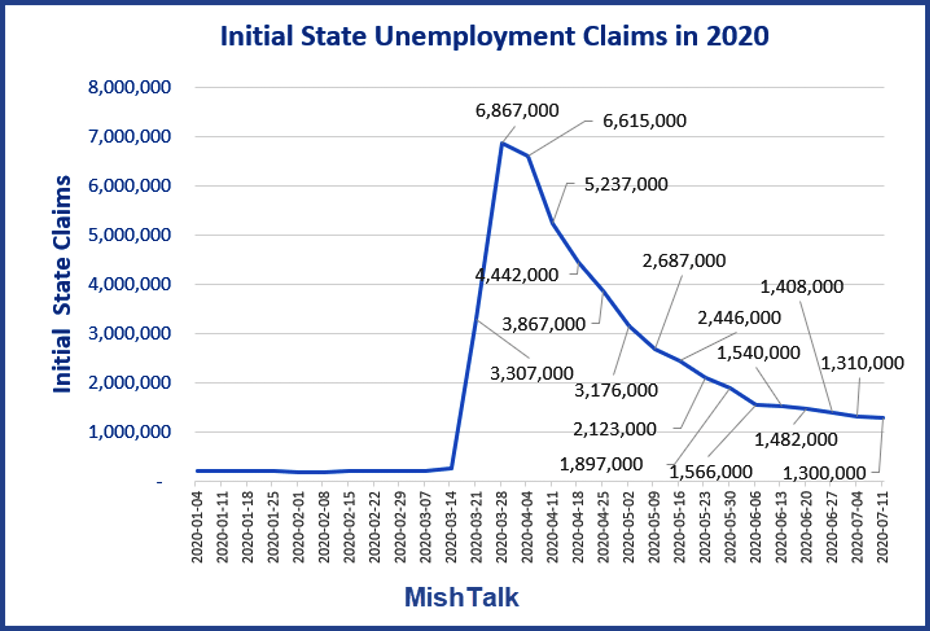
Initial claims turn into continued claims in a week. But people drop off continued claims if they find a job or expire all their benefits.

The number of initial claims is down from the pandemic surge but is very elevated historically.

People must first file at the state level but some do not qualify. And some who did qualify exhausted state benefits and now need to apply for PUA.

Not a pretty picture

The trends suggest the unemployment picture is not improving much. Instead, people who qualified at the state level now need PUA assistance.

Add it up and there are 20 to 30 million people unemployed.

Things about to get worse

With reopenings in reverse, and airlines in severe trouble, things are about to get worse. 

  1. American Airlines is in Deep Financial Stress and will shed 16,000 or more jobs.
  2. United Warns It May Cut 36,000 Employees
  3. A Surge in Small Business Bankruptcies is Underway
  4. That Fewer People Pay Their Rent on Time in July suggests more people are struggling.
  5. Phone Data Shows the Retail Recovery Has Stalled in Covid Hotspots
  6. Patients Stranded in Emergency Rooms as Hospitals Fill Up
  7. Trump Claims to Have Saved 51 Million Jobs

Author

Mike “Mish” Shedlock's

Mike “Mish” Shedlock's

Sitka Pacific Capital Management,Llc

More from Mike “Mish” Shedlock's
Share:

Editor's Picks

EUR/USD flirts with daily highs, retargets 1.1900

EUR/USD regains upside traction, returning to the 1.1880 zone and refocusing its attention to the key 1.1900 barrier. The pair’s slight gains comes against the backdrop of a humble decline in the US Dollar as investors continue to assess the latest US CPI readings and the potential Fed’s rate path.

GBP/USD remains well bid around 1.3650

GBP/USD maintains its upside momentum in place, hovering around daily highs near 1.3650 and setting aside part of the recent three-day drop. Cable’s improved sentiment comes on the back of the Greenback’s  irresolute price action, while recent hawkish comments from the BoE’s Pill also collaborate with the uptick.

Gold clings to gains just above $5,000/oz

Gold is reclaiming part of the ground lost on Wednesday’s marked decline, as bargain-hunters keep piling up and lifting prices past the key $5,000 per troy ounce. The precious metal’s move higher is also underpinned by the slight pullback in the US Dollar and declining US Treasury yields across the curve.

Crypto Today: Bitcoin, Ethereum, XRP in choppy price action, weighed down by falling institutional interest 

Bitcoin's upside remains largely constrained amid weak technicals and declining institutional interest. Ethereum trades sideways above $1,900 support with the upside capped below $2,000 amid ETF outflows.

Week ahead – Data blitz, Fed Minutes and RBNZ decision in the spotlight

US GDP and PCE inflation are main highlights, plus the Fed minutes. UK and Japan have busy calendars too with focus on CPI. Flash PMIs for February will also be doing the rounds. RBNZ meets, is unlikely to follow RBA’s hawkish path.

Ripple Price Forecast: XRP potential bottom could be in sight

Ripple edges up above the intraday low of $1.35 at the time of writing on Friday amid mixed price actions across the crypto market. The remittance token failed to hold support at $1.40 the previous day, reflecting risk-off sentiment amid a decline in retail and institutional sentiment.