Ahead of retail sales


Stocks are selling off, amid a serious bout of risk aversion in wider markets. Disappointing earnings reports so far saw Wall Street closing lower yesterday and the sell off has accelerated since then, as hopes of a US stimulus package ahead of the election fade and Covid-19 developments hit the economic outlook. Uncertainty over the outcome of the US election is also limiting the upside for stocks as investors wait for more earnings reports this week.
However the zenith of volatility is expected to be seen with the upcoming Retail sales from US tomorrow. Its a key report that should reveal further encouraging news on the recovery. The strength seen so far in July and August data suggest about a 33% rebound in Q3 GDP. Another month of strong vehicle sales should support, along with a continued rebound for sales of clothing, furniture, electronics, and appliances. There will also be fresh information on the manufacturing sector.
Retails Sales are expected to show a 0.9% September gain with a 0.6% ex-autos figures, after respective August gains of 0.6% and 0.7%. Chain store sales improved in September, but remained depressed. Consumer confidence was much stronger after a August lull. Vehicle sales rose another 8%. The gasoline component of CPI should ease -0.5% in September, but a climb in vehicle travel should raise service station sales. Construction jobs and hours-worked both grew, signaling further gains for building material sales.
The gasoline service station component of retail sales historically moves with gasoline prices, as gasoline sales volume usually adheres to its seasonal pattern. This spring, however, service station sales fell sharply relative to prices due to a lockdown induced volume drop, while rebounds have been seen over the summer but price weakness re-emerged in September. The gasoline component of CPI should fall by 0.5% in September form 2.0% in August.

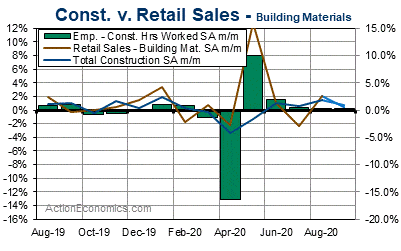
Changes in construction hours-worked from the monthly employment report flag movements in the building materials component of retail sales. The September jobs report revealed a 0.3% increase in construction hours-worked after gains of 0.3% in August, 0.4% in July, and 2.0% in June. Construction jobs rose 26k in September, 17k in August and 31k in July. The construction spending and building materials sales should rise 0.8% and 0.5% in September respectively.
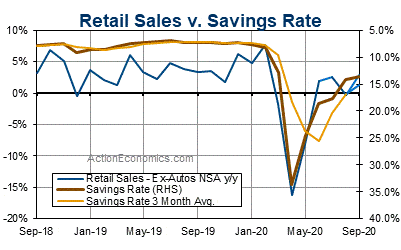
The savings rate is inversely correlated with monthly retail sales, as spending gains relative to disposable income pinch the savings residual.
Hence the savings rate is anticipated to drop to 13.5% in September from 14.1% in August, 17.7% in July, and 18.7% in June. Despite shutdowns most workers continued to get paid, alongside huge income boosts from the $1,200 direct payments to individuals and heightened jobless benefits with the CARES Act that peaked in April before steady unwinds in the subsequent months, and a drop-off in August as supplemental employment benefits expired.
Retail sales, consumer confidence, and stock performance are all correlated.
The various confidence measures have held up well in the face of extremely negative economic data, though the post-lockdown bounce has tapered off. The Conference Board’s consumer confidence index jumped to 101.8 in September from 86.3, versus an 18-year high of 137.9 in October of ’18 and a a 25.3 recession-low in February of ’09. The Michigan Sentiment index rose to 80.4 from 74.1, versus a 14-year high of 101.4 in March of ’18 and a 55.3 recession-low in November of ’08. Producer sentiment also improved in September.

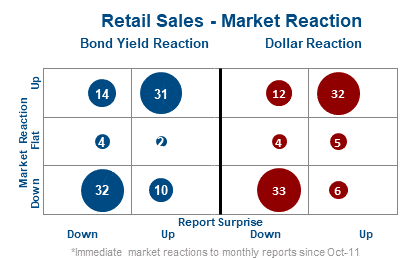
Stock prices eased slightly in September, and the y/y metric fell to 12.9% from 17.1% in August, 7.1% in July. Retail sales surprises are correlated with bond yields and FX moves. Hence theoretically market’s immediate response to the surprise in the retail sales report over the last 100 months shows according to ActionEconomics research is illustrated in the graph below:
Author
Having completed her five-year-long studies in the UK, Andria Pichidi has been awarded a BSc in Mathematics and Physics from the University of Bath and a MSc degree in Mathematics, while she holds a postgraduate diploma (PGdip) in