A decade after the referendum, the UK is facing the consequences of Brexit

23 June will mark the tenth anniversary of the Brexit referendum, which led to the UK’s official exit from the European Union on 31 January 2020 (followed by a transition period). Since then, the country has indeed regained control over certain policy domains, such as trade, migration and regulatory frameworks. However, both the anticipation of Brexit and its actual implementation in 2021 have been linked to a decline in the country’s performance across several key indicators. Against a backdrop of escalating geopolitical tensions and mounting shared challenges, the UK is now seeking to re-establish practical collaboration with its main economic partner: the European Union.
A decade after the referendum, the UK is facing the consequences of Brexit
An imperfect Brexit
While the referendum enabled the United Kingdom to regain exclusive competence over several areas of governance, this restored sovereignty has not resulted in a clean break with the European Union. Furthermore, it has led to developments that deviate from initial expectations.
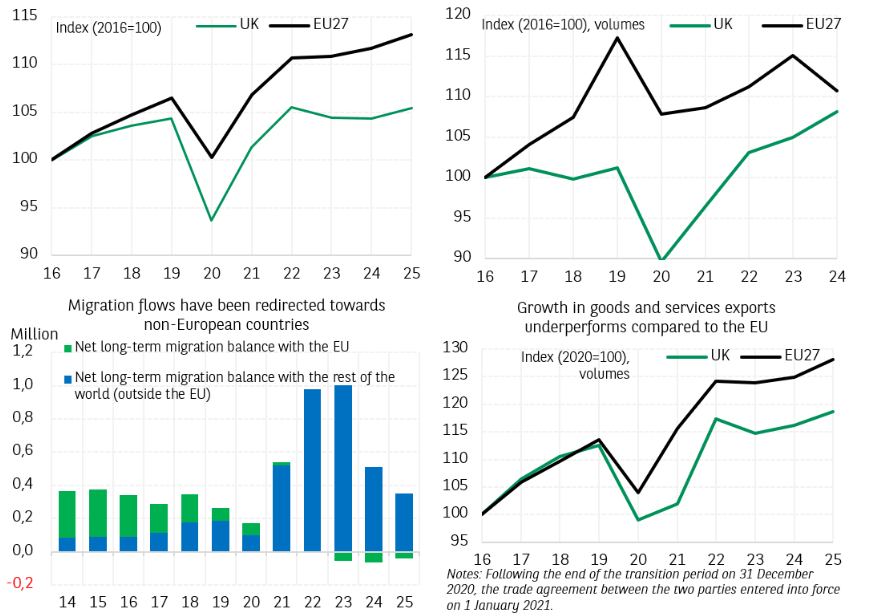
In terms of trade, the United Kingdom has negotiated new free trade agreements with Japan (2021), Australia and New Zealand (2023), before joining the Comprehensive and Progressive Agreement for Trans-Pacific Partnership (CPTPP, 2024). However, the momentum of UK exports has waned, lagging behind that of the EU (Chart4). Furthermore, while the volume of UK goods exported to the EU has fallen (-14% between 2019 and 2025), the EU continues to be the country’s largest trading partner, accounting for around 41% of its goods and services exports, underscoring the significance of geographical proximity in international trade.
Author

BNP Paribas Team
BNP Paribas
BNP Paribas Economic Research Department is a worldwide function, part of Corporate and Investment Banking, at the service of both the Bank and its customers.