A brief history of self-employment in France


After a long period of decline from the late 1940s to the early 2000s, self-employment has been on the rise once again in France for almost 20 years. This resurgence of self-employment, initiated by tax incentives in favour of home-based employment or craft industries (non-market services, domestic services, building crafts), was also fuelled by the outsourcing by companies of certain tasks (for the purpose of controlling costs on non-essential activities, incubating innovation) and the emergence of new needs (in particular in terms of maintenance and renovation in building). And lastly, transformations such as uberisation, the growth in teleworking and the increasing formalisation of self-employment (particularly through umbrella companies) have developed gateways between the two statuses (self-employed versus employed), causing a knock-on effect in favour of the former.
In the last two years (2022-23), self-employment has led to the net creation of one in four jobs. This figure is much higher than what it represents in total employment (11.5%) and reflects its relatively rapid growth. Although relatively recent, this trend seems to be a sign of a revival. It is easy to imagine the city of the immediate post-war period organised around a succession of businesses owned by independents, whether blacksmith, butcher or notary. This image of France oriented towards self-employment is not just a cliché.
According to INSEE statistics, at the end of the 1940s, there was one self-employed person for every two salaried employees, a ratio that was close to one in eight in Q4 2023, after falling below one in 10 in the early 2000s. However, this image is strongly biased by the major weight of agriculture in the immediate post-war period. The sharp decline in the sector explains that there are now fifty per cent fewer self-employed jobs than at the end of the 1940s (when statistics began).
Self-employment excluding agriculture (Chart 1) initially fell sharply, to the benefit of the wage system, accompanying in particular the development of more concentrated forms of trade (in other words, fewer small businesses, cheesemakers, butchers and bakers, and more mass distribution). The strengthening of the wage system also benefited from the creation and subsequent expansion of the scope of social security, which increased the attractiveness of the wage system.
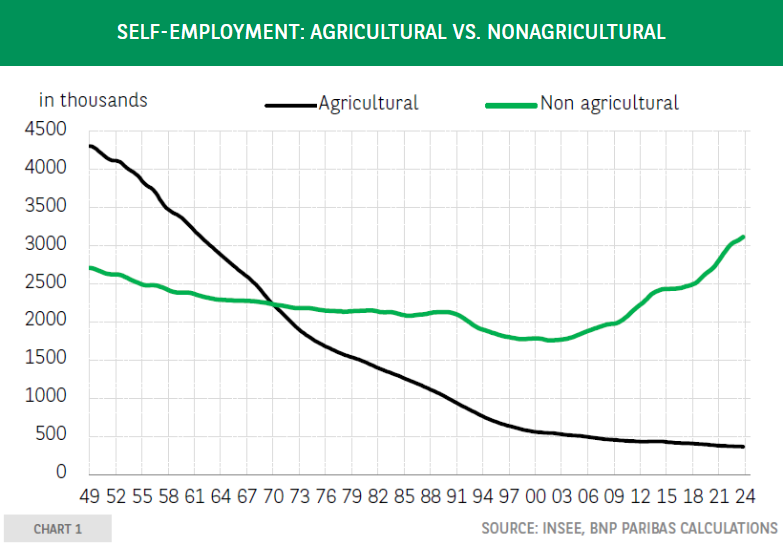
These phenomena have also been accompanied by a rural exodus that has seen children of farmers swell the ranks of industrial and service employees, mostly as salaried workers. And crises have added an accelerating effect, particularly in the 1990s, when the property crisis at the time led to severe job losses in the building crafts, while the decline in the number of farmers was further accelerating (before slowing down from the 2000s onwards). It was at the end of this truly lost decade, the 1990s, that self-employment reached a record low: nearly 2.3 million people in 2002 (1.8 million excluding agriculture).
Author
BNP Paribas Team
BNP Paribas
BNP Paribas Economic Research Department is a worldwide function, part of Corporate and Investment Banking, at the service of both the Bank and its customers.