60 days to pay: Nvidia is financing its own demand
The Jensen Huang-helmed Nvidia (NVDA) delivered its second-quarter earnings print with its stock roughly 11% beneath the peak it set in May and around 8% beneath where it traded in mid-August, on the day it told the market it would stand behind up to $105 billion of a single customer's rent. Then it beat everything. Revenue of $96.221 billion against a consensus near $92 billion. Adjusted earnings of $2.22 a share against $2.10. Data centre revenue of $89.023 billion against $86 billion. Third-quarter guidance of $108 billion against the $104 billion the street had pencilled in. Four for four, on the four lines the sell side actually publishes a forecast for.
The line nobody forecasts is days sales outstanding (DSO), and it went to 60 from 45 in a single quarter. That is the whole report in one number. Nvidia is selling everything it can build. It is no longer being paid for it on anything like the old terms, and the reason is a decision the company took deliberately and disclosed in the same document that carried the beat.
Everything they model beat, and the one thing they do not model broke
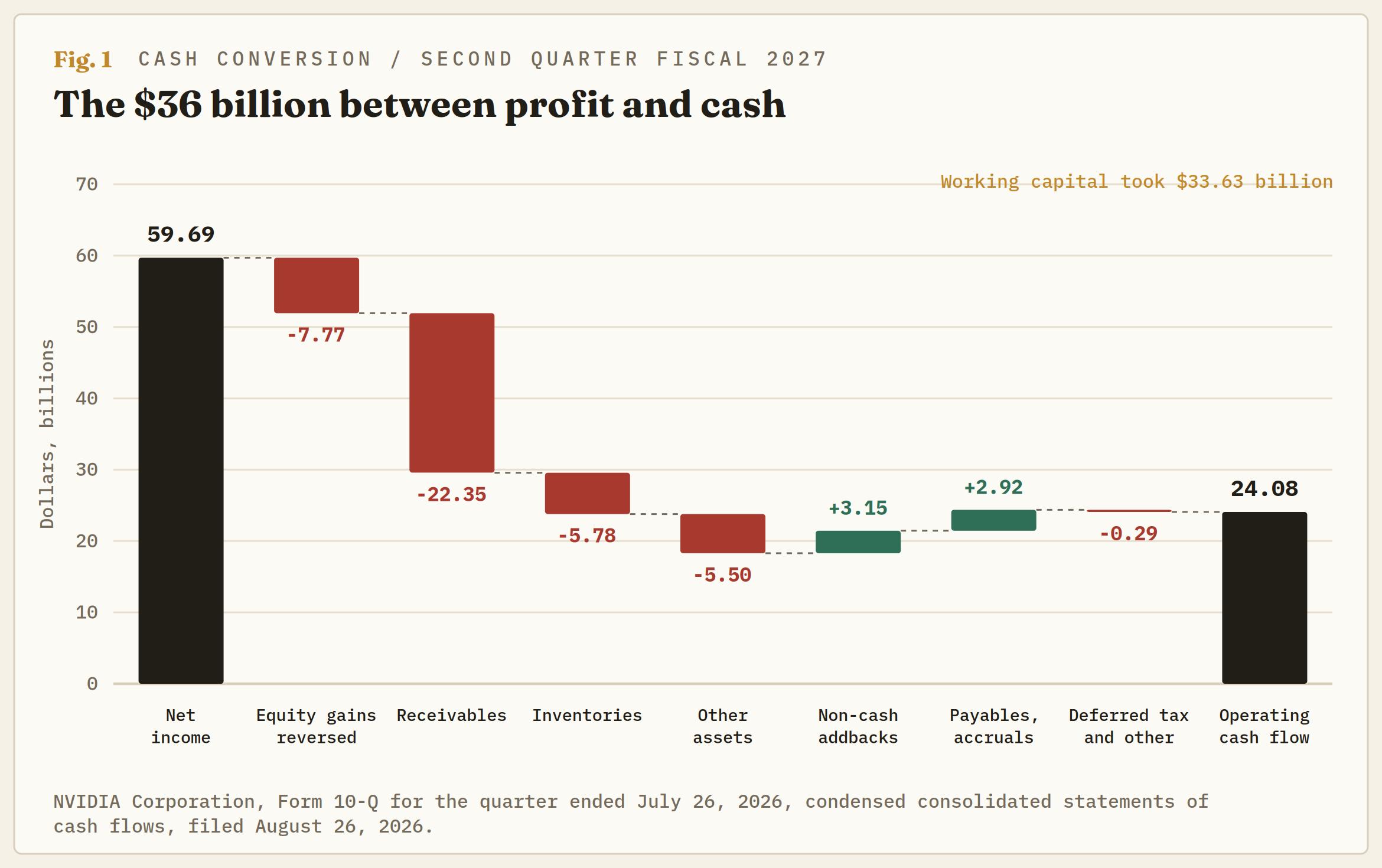
Net income was $59.688 billion. Cash from operations was $24.077 billion. A year ago those two numbers were $26.422 billion and $15.365 billion, close enough together that nobody looked. Three months ago they were $58.321 billion and $50.344 billion. This quarter the company booked 18% more revenue than last quarter and collected less than half the cash.
The $35.611 billion gap is not an accounting artifact. Receivables took $22.346 billion of it, inventories $5.784 billion, other assets $5.497 billion. Reversing out paper gains on equity holdings costs another $7.771 billion, because marks are not money. Free cash flow came in at $21.341 billion against $48.554 billion three months ago, on 18% more revenue.
Accounts receivable now stand at $63.059 billion, against $38.466 billion at the January year-end, equal to roughly two-thirds of a full quarter of sales. Inventory is $31.575 billion, against $21.403 billion. Put the two together and $94.634 billion of a $320.272 billion balance sheet is goods Nvidia has bought and not sold, or sold and not been paid for.
Six months from a flat denial
The annual report filed on February 25 addressed this head on. It recorded that the company had been asked to offer financing arrangements to support customer buildouts, and that it had entered into none. Six months later, the quarterly filing says the opposite in the plainest available language: financing arrangements with certain investment-grade customers, including extended payment terms under large multi-quarter agreements, will keep affecting the timing of operating cash flows. Not did affect. Will keep affecting.
The mechanic sits a few pages earlier. Payment is normally due shortly after delivery. For investment-grade customers buying at data centre scale, Nvidia now offers terms running from 90 days out to a full year. A company selling $96 billion a quarter and lending the proceeds back for up to twelve months is running two businesses, and only one of them has a margin anybody has modelled.
Concentration moved with it. Five direct customers account for 22%, 14%, 13%, 11% and 10% of the receivable balance, which is 70% of $63.059 billion sitting in five names. In January it was three names at 25%, 18% and 13%, or 56% of a far smaller balance. In dollars, concentrated receivable exposure went from roughly $21.5 billion to roughly $44.1 billion in six months. The number of names rose, which reads as diversification. The money inside them doubled, which does not.
Nvidia’s filing is candid about why. Its own risk language states that artificial intelligence (AI) clouds and AI model makers have real demand for training and inference compute and currently cannot secure the long-term infrastructure contracts or the investment-grade financing capacity to buy it. That is the vendor recording, in a document its lawyers signed, that a meaningful slice of its addressable market is not creditworthy.
$160 billion of memory in a single quarter
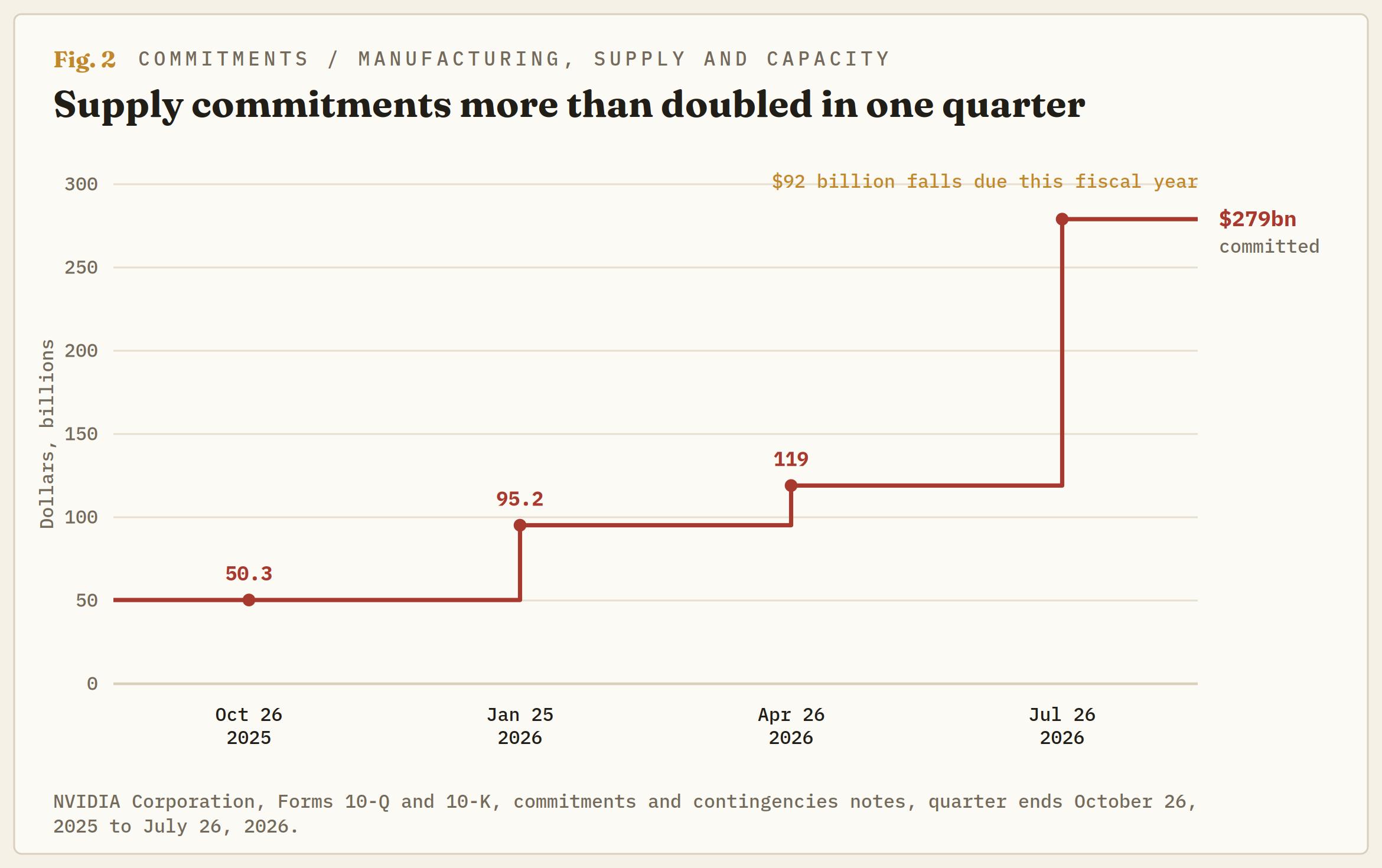
Manufacturing, supply and capacity commitments went to $279 billion from $119 billion three months ago, an increase the company attributes primarily to memory. That is not a rounding change. It is $160 billion of fresh obligation booked in thirteen weeks, against a quarter that produced $96.221 billion of revenue. Of the total, $92 billion falls due in the remainder of this fiscal year, $87 billion in the next and $88 billion in the one after.
The inventory build underneath tells you what is being bought. Raw materials went to $11.341 billion from $3.807 billion at the January year end, close to a tripling. Work in process rose to $13.377 billion. Stock ready to ship actually fell, to $6.857 billion from $8.774 billion. This is a company hoarding inputs rather than sitting on product it cannot shift, which is the honest bull reading and deserves stating.
The bill is already visible in the margin. Gross margin held at 75% and is guided to 74% next quarter, the first guided decline of this cycle. The consumer side is blunter still: edge revenue grew 13% sequentially with the commentary blaming elevated memory and system prices for softer personal computer sales. Holding a 75% margin by passing memory inflation through works while the shortage lasts. There is a calibration event on file for what happens when it does not, and it is the $4.5 billion charge taken on excess inventory and purchase obligations in the first quarter of fiscal 2026, when those obligations totalled $29.8 billion against $279 billion today.
The option Nvidia wrote
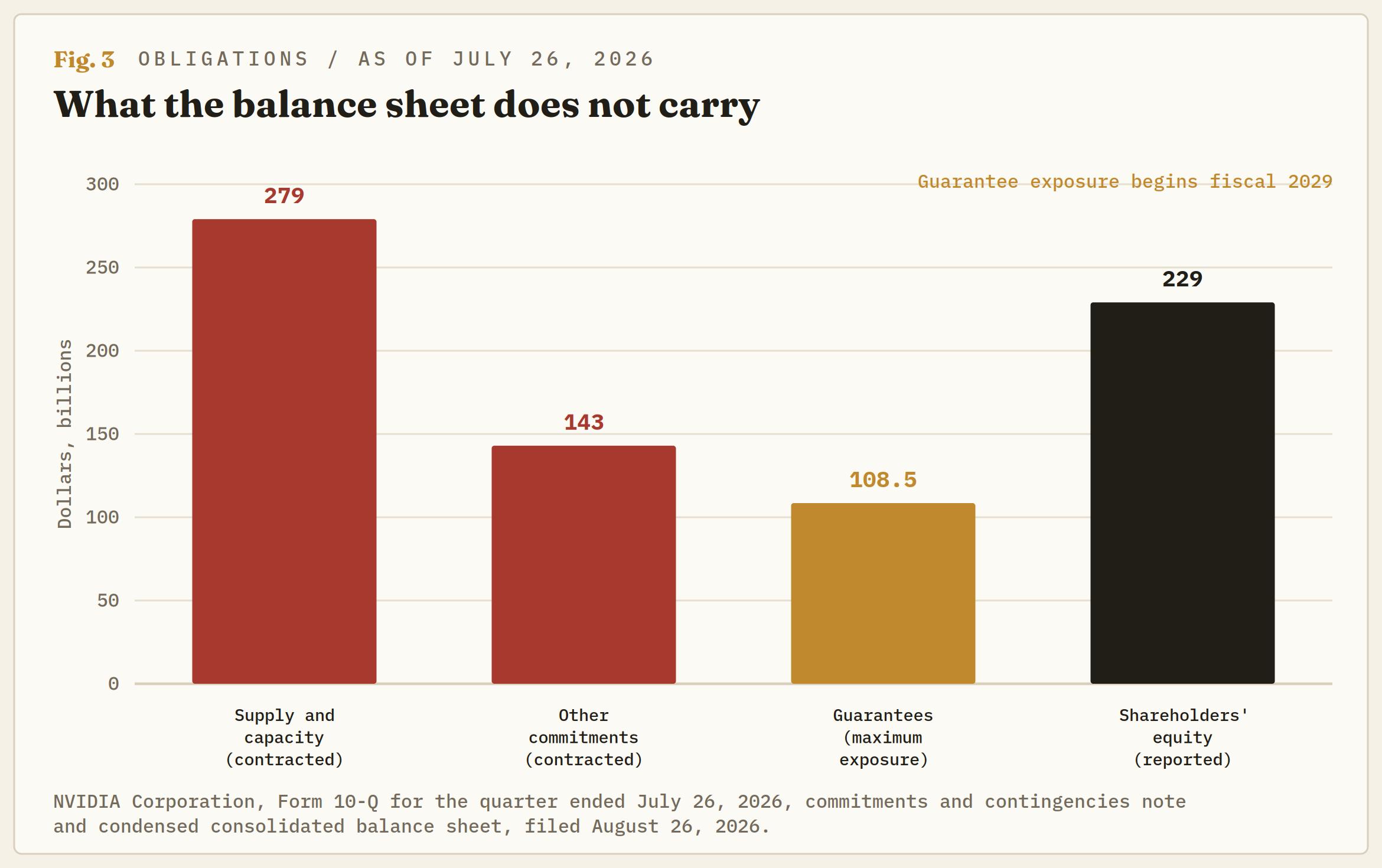
Add up what the balance sheet does not carry and the total is larger than the balance sheet. Contracted future commitments run to $366 billion. A second table adds $56 billion of AI cloud agreements and third-party leases. Guarantees carry a maximum gross exposure of $108.5 billion. Against all of that sits $320.272 billion of total assets and $228.984 billion of shareholders' equity.
The composition is more interesting than the total. Of the guarantee book, $105 billion is credit support on leases at a single Ohio campus, taken on behalf of one tenant, phasing in across nine construction stages from fiscal 2029 and running twenty years per phase. It terminates early on one condition, which is that tenant achieving a satisfactory credit rating. In exchange, the site hosts Nvidia compute exclusively, worth between $150 billion and $200 billion of revenue per hardware generation on the company's own arithmetic. Nvidia is buying two decades of exclusive demand with two decades of counterparty risk, and it holds an option to do the same again for a further 3.8 gigawatts.
The smaller guarantee line is the more revealing one. The $3.5 billion of lease guarantees written for AI cloud partners is carried in the derivatives note, classified by Nvidia's own accountants as credit derivatives, with partners escrowing $712 million against the exposure. The company is not describing this as a commercial arrangement. It is booking it as written credit protection.
Then there is the $36 billion of AI cloud agreements, and this is the line worth reading twice. Nvidia sells infrastructure to the clouds and simultaneously commits to buy cloud capacity back from them. Those clouds may unilaterally stop supplying Nvidia and resell the capacity to third parties at better rates. Which means Nvidia takes delivery only when nobody else wants it, and loses the capacity precisely when demand is strong. An agreement that binds you in the bad state and releases you in the good one is not a purchase contract. It is a written put on AI compute demand, and Nvidia is short it.
Everything in this section runs the same direction. The upside stays with the customer. The downside comes back to the vendor.
A borrower now
Nvidia issued $25 billion of senior unsecured notes in June across seven tranches, taking principal outstanding to $33.5 billion from $8.5 billion at the year end, and it holds an undrawn $25 billion commercial paper programme alongside it. In the same quarter it returned close to $26 billion to shareholders and bought $15.822 billion of equity securities. Gross cash and marketable debt securities rose to $56.6 billion on the strength of that issuance. Net of debt, the cash position fell by roughly $18.6 billion in a quarter that earned nearly $60 billion.
Equity holdings now total $93.94 billion across marketable and non-marketable, against $35.137 billion in January. Interest expense more than tripled to $227 million while interest income fell to $496 million from $592 million, because the money that used to sit in Treasuries now sits in customers.
The cavern under the beat
This is where Nvidia stops being a single-name story. Its generally accepted accounting principles (GAAP) profit grew 2% sequentially while revenue grew 18%, because the equity gain line halved to $7.771 billion from $15.936 billion. Nothing else changed. The marks simply stopped compounding at the previous rate, and a quarter of headline profit growth went with them.
That is the mechanism the whole index has been running on. With 88% of the S&P 500 reported, second-quarter earnings growth is tracking above 50%, against the 23.1% analysts expected on June 30. Strip out two companies and it falls to 32%. Alphabet's reported quarter carried a gain near $98 billion, aided by its holding in SpaceX (SPCX). Amazon's (AMZN) carried $53.4 billion, primarily from its investment in Anthropic. Remove both and the aggregate earnings surprise drops to under 11% from 29%. The index net profit margin, a record at 15.7%, falls to 14.4% on Alphabet alone.
Three of the largest companies in the market posted their best quarters in years by revaluing stakes in privately held AI companies. Nvidia is the third of them, and it is the first to show the reversal, in the quarter everyone is calling a blowout. When the marks are the earnings, the earnings inherit the volatility of the marks, and none of it arrives as cash. The after-hours tape swung from beneath the $205 handle back above $215 inside the first hour, which is what a market looks like when it cannot decide whether it has read a growth report or a credit report.
What actually resolves this
The bull case is intact and deserves stating at full strength. Demand is not the problem. One direct customer took 16% of revenue this quarter against two at 23% and 16% a year ago, so the end market is genuinely broadening rather than narrowing. Raw materials are piling up, not product waiting on a buyer. The guarantees pay nothing unless a tenant defaults, and the largest of them does not begin until fiscal 2029. None of this is a thesis about whether AI demand is real.
The fork is whether a chip company can carry a lender's balance sheet without eventually being priced as one. Two observables settle it and both land with the next report in late November. The first is DSO. Guidance three months ago was that 45 days would normalise, and it went to 60. If the next print takes it higher again against a $108 billion revenue guide, extended terms are not a timing quirk but the price of the growth rate. The second is operating cash flow against net income. Nvidia has already said, in writing, that financing arrangements will keep affecting it.
Watch the guarantee book alongside them. It went from nothing to $108.5 billion in six months, and the option on another 3.8 gigawatts sits entirely at Nvidia's discretion. Every dollar added to it buys revenue that lands inside two years against credit risk that lands inside twenty. The market has spent this cycle pricing the revenue. It has not yet had to price the other side, and the quarter that forces it will not arrive with a press release attached.
Author

Joshua Gibson
FXStreet
Joshua joins the FXStreet team as an Economics and Finance double major from Vancouver Island University with twelve years' experience as an independent trader focusing on technical analysis.
















