|

Brent Oil outlook: Brent price falls after recovery failed to clear important $90 barrier

Brent Oil

Brent oil price rose to the highest in over one week on Tuesday, in extension of Monday’s nearly 5% advance, following the latest verbal escalation by President Trump that quickly changed the sentiment and countered efforts of Iran and Oman to find solution for reopening of strategic Hormuz strait.

The latest demands from President Trump provoked reaction of Iran to stop negotiations with current US administration until the end of Trump’s mandate in 2029.

However, markets have already learned how to filter the waves of usually contradictory news that come on daily basis and how to get the best results in using so-called Trump indicator.

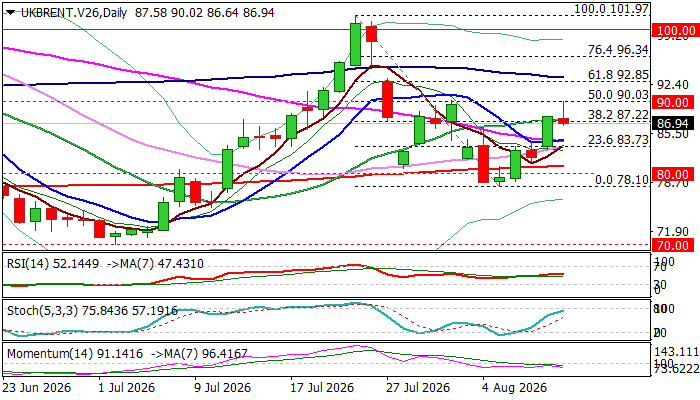
Daily chart still shows mixed signals as moving averages turned to almost full bullish configuration, but 14-d momentum remains in negative territory that partially offset positive signal that was reflected on today’s price action, when the price cracked psychological $90 barrier (also 50% retracement of $101.97/$78.10) but subsequent quick reversal warns that recovery might be running out of steam.

Fresh weakness (price was down over $3 during mid-European/early US session on Tuesday) cracked significant support at $87.22 (broken Fibo 38.2%/20DMA) with firm break here to open way for deeper pullback and keep the downside vulnerable of possible full reversal of recovery leg (in case of shift in Trump’s rhetoric).

On the other hand, limited pullback (ideally to hold above $87.22) or to find footstep above $85.00 zone (just above 10/55DMA bull-cross) would keep in play hopes of renewed attack at $90 pivots and unmask targets at $92.85/$93.28 (daily cloud top/Fibo 61.8%/100DMA).

Res: 88.57; 90.00; 92.85; 93.28.
Sup: 86.50; 85.00; 84.65; 83.73.
Chart

Author

Slobodan Drvenica

Slobodan Drvenica

Windsor Brokers

Industry veteran with over 22 years’ experience, Slobodan Drvenica joined Windsor Brokers in 1995 when he was an active trader for more than 10 years, managing the trading desk and own account departments.


More from Slobodan Drvenica
Share:

Editor's Picks

AUD/USD bulls regain control above 0.6950 amid USD retreat

AUD/USD regains traction and extends the previous day's bounce from the weekly low, aiming for 0.7000 in Asia on Friday. The overnight pullback in US bond yields keeps the US Dollar below an 18-month high, which in turn offers some support to the pair. Meanwhile, hawkish RBA expectations also keep the major underpinned.

USD/JPY holds gains near 158.00 after Japan's weak Household Spending data

USD/JPY clings to gains around 158.00 after data showed on Friday that Japan's Household Spending fell for the ninth straight month, undermining the Japanese Yen. Meanwhile, the US Dollar remains depressed as the overnight fall in US bond yields counters a hawkish Fed and geopolitical uncertainties, could cap any downside in the pair.

Gold remains range-bound below $4,200

Gold has given up some ground after an initial bullish attempt to reach weekly highs, returning to below the $4,200 mark per troy ounce on Friday. The US Dollar’s strong upside momentum, combined with rising US Treasury yields across the curve, seems to keep further gains in the yellow metal under scrutiny.

Has Bitcoin really escaped the macro forces it was built to fight?
Over 17 years ago, Satoshi Nakamoto designed Bitcoin (BTC) on the back of a global financial crisis as an alternative to the global monetary system outside the control of central banks, governments and traditional intermediaries. This raises a key question: has Bitcoin really become independent of the macroeconomic forces it was built to challenge?
The Euro is not the sick man of Europe. France's bond market is
EUR/USD remains under pressure, near the 17-month low of 1.1161 reached on Monday. The pair has lost more than 7% since its yearly peak, as concerns over France's public finances increasingly weigh on the single currency. But behind the weakness of the Euro (EUR), the problem does not necessarily lie with the European economy as a whole.
Has Bitcoin really escaped the macro forces it was built to fight?
Over 17 years ago, Satoshi Nakamoto designed Bitcoin (BTC) on the back of a global financial crisis as an alternative to the global monetary system outside the control of central banks, governments and traditional intermediaries. This raises a key question: has Bitcoin really become independent of the macroeconomic forces it was built to challenge?














