2024 sees UK register £2.1bn trade surplus with United States in sign of balanced relationship
-
ONS trade data reveals an increasingly balanced goods trading relationship with the US as 2024 records smallest trade surplus since 2001 amid President Trump tariff fears.
-
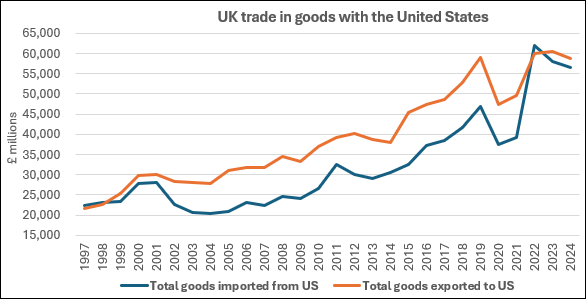
In 2024, the UK exported £58.7 billion in goods to the US and imported £56.6 billion of US goods – creating a narrow trade surplus of £2.1 billion.

Analysis of the latest ONS trade data reveals the UK maintained a closely balanced goods trading relationship with the US in 2024, marking a surplus of £2.1 billion, the narrowest surplus since 2001 and boosting US tariff avoidance hopes.
Across 2024, the UK exported £58.7 billion in goods to the US, just £2.1 billion more than the £56.6 billion total value of goods it imported from the US over the same 12 month period. In 2023, the goods trade surplus stood at a slightly wider £2.6 billion with the UK exporting £60.4 billion and importing £58.1 billion.
In 2022, the European energy crisis caused by the Ukraine-Russia war drove a significant surge in US gas imports, resulting in the first goods trade deficit since 1998 at £2.0 billion.
With the exception of 2022, the UK has held a goods trade surplus with the US for 25 years, with it reaching its widest point of £12.9 billion in 2015, when the UK exported £45.4 billion, significantly higher than the £32.6 billion of US goods that it imported.
When looking at the goods most likely to be impacted by any US tariffs, the top five export goods to the US include cars, medicinal & pharmaceutical products, mechanical power generators, scientific instruments and aircraft.
In 2024, the US was the UK’s most significant goods exporting market at £58.7 billion, almost double that of the second largest market Germany (£32.1 billion), the Netherlands (£28.1 billion), Ireland (£24.1 billion), and France (£23.2 billion).
When looking at the trade in both goods and services with the US, total trade was £294.1 billion in the four quarters to the end of Q3 2024, with total exports and imports at £182.6 billion and £111.5 billion respectively. This points to a total trade surplus of £71.1 billion and shows that the US was the UK’s largest trading partner in the four quarters to the end of Q3 2024, accounting for 17.2% of total UK trade.2
Samuel Edwards, Head of Dealing at global financial services firm Ebury, commented: “Analysis of ONS trade data shows that in 2024, the UK maintained a £2.1 billion trade surplus with the US in goods – its narrowest surplus since 2001.
While the trade in goods balance is narrowing, the UK has historically exported more to the US than it has imported. However, with a surplus at far lower levels than many other nations, it bolsters hopes of the UK avoiding or minimising any tariffs imposed by President Trump on the US’ global trading partners.
With President Trump set to announce further details on new ‘reciprocal’ tariffs, there is a possibility that the UK’s VAT regime could yet attract punitive measures from the new US administration.
The US remains the UK’s most significant export market, with goods exports totalling £58.7 billion in 2024—almost double that of the next-largest market, Germany. Given the scale of this trading relationship, any policy changes in Washington could deal a significant blow to a number of UK sectors at a time of domestic economic uncertainty and stuttering growth.
We have already seen the impact of the 25% steel and aluminium tariffs on UK businesses, forcing difficult conversations about staffing and productions costs.”
Author

Matthew Ryan, CFA
Ebury
Matthew is Global Head of Market Strategy at FX specialist Ebury, where he has been part of the strategy team since 2014. He provides fundamental FX analysis for a wide range of G10 and emerging market currencies.