2024 Indian election: Continuity expected as Modi looks set to win third term

Markets are keenly awaiting the outcome of the 2024 India general election, the world’s largest in history, due to be announced on June 4. India is the world’s biggest democracy and about 1 billion people are eligible to participate in the giant election.
Narendra Modi, the incumbent prime minister, looks set to gain a third term in office. While his reelection should bring continuity in economic policies, how majorities play out could impact the growth outlook, the performance of the country’s equity markets and the Indian Rupee (INR).
2024 Indian election: Here’s all you need to know
These voters are set to elect 543 politicians to the Lok Sabha, the lower house of parliament. Two other members are nominated, to make up a total strength of 545 in the house. The control of the prime minister’s office (PMO) is determined by a majority vote in the Lok Sabha.
The election process is spread into seven phases, beginning on April 19 and ending on June 1. The counting of votes will take place on June 4.
Various opinion polls have so far projected seat wins in the range of 315-329 for Bhartiya Janata Party (BJP) and its allies, so-called National Democratic Alliance (NDA), the party backing the incumbent government. The opposition party INDI Alliance is projected to win a range of 93-156 seats.
At this point, India’s Prime Minister Narendra Modi looks set to confirm a third term. Modi’s success in the previous two terms is reflected in the improved macroeconomic performance, the government’s focused approach in infrastructure development and fiscal prudence, which powered India to become the world’s fifth largest economy in the world.
However, it remains to be seen if the incumbent government surpasses a 400-seat majority, per their election campaign slogan “Abb ki baar 400 paar” (This time it will cross 400 seats).
An election victory with 400 plus seats in Loksabha will pave the way to muster a majority in the Rajyasabha, the upper house of the bicameral Parliament. The ruling NDA party has a two-thirds majority in Lok Sabha. A majority in both houses of the parliament would open the door for the merging of Pakistan-Occupied Kashmir (PoK) with India and the implementation of the Uniform Civil Code (UCC) across the country.
Most recent articles:
- USD/INR drifts lower, all eyes on Indian election outcome
- Stock Market Today: Nifty opens at record highs, cheers a likely PM Modi third term
How could India’s election impact the stock markets and the Indian Rupee?
Indian stock markets are sitting on hefty gains this year, near record highs. Meanwhile, the Indian Rupee (INR) has been more or less stable in the range between $82 to $84.
With a Modi third term widely priced in, expectations of political continuity and the government’s continued efforts on economic growth are likely to keep the sentiment uplifted around the Indian financial markets after the Loksabha election results are announced.
“Policy continuity will ensure that the government’s main focus will remain on infrastructure development and manufacturing, which will benefit sectors in Defence and Capital goods space. However, unlike in past periods, in this cycle we prefer Large caps over SMIDs in 2024 as we look for valuation comfort," said JM Finacial, a leading Indian investment banking firm, in a research note.
The Indian benchmark indices, the Sensex 30 and Nifty 50, are set to see another record-setting rally. At the same time, the Indian Rupee could rebound toward the 82.50 level against the US Dollar, riding the wave of economic optimism and political stability.
Still, the immediate reaction to the election results could be limited, as the markets’ focus will shift to the Union Budget, which is likely to be tabled in July.
Trading USD/INR on the 2024 India election
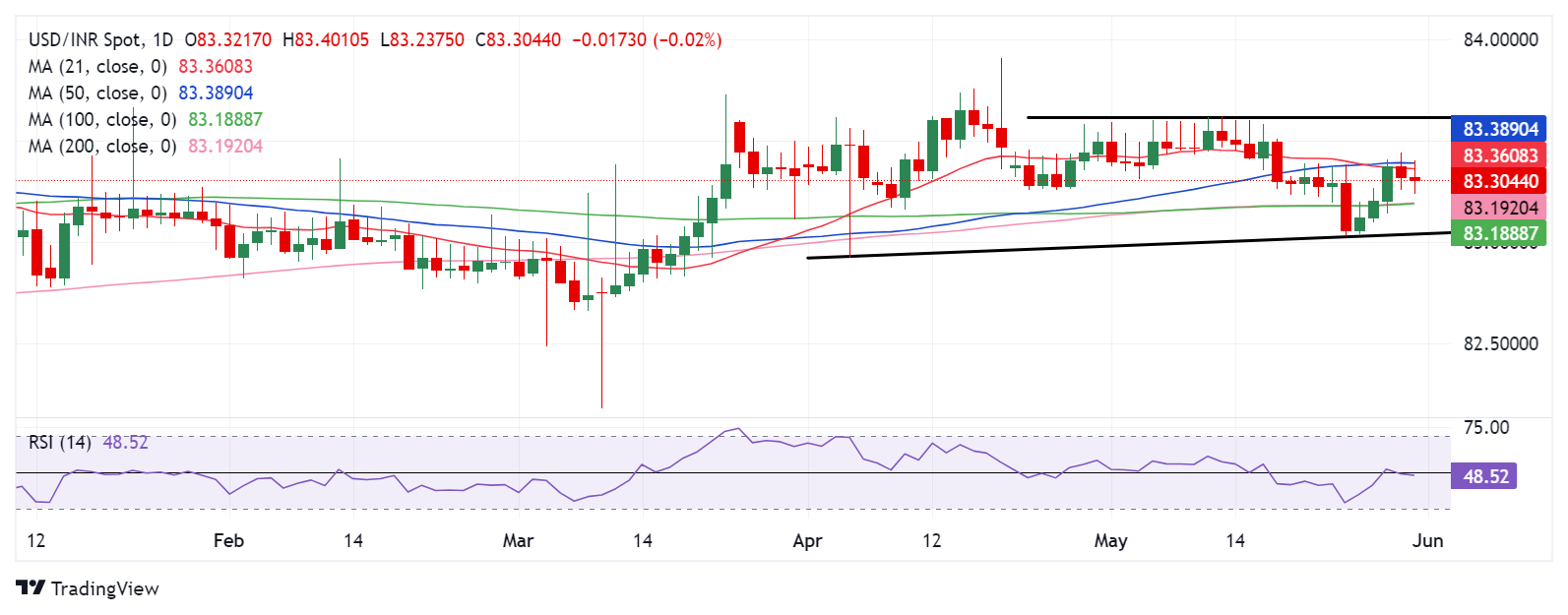
Should the incumbent government fail to secure a victory with over a 400-seat majority, it will raise investors’ concerns about PM Modi’s aim to acquire a two-thirds majority in the Rajya Sabha. In such a scenario, the Indian Rupee could face some selling pressure, prompting USD/INR to retest the static resistance near 83.60.
USD/INR could rise further toward the 84 mark on a win with less than 350 seats. The BJP and its allies won 352 of the 543 seats in the last election with the BJP alone winning 303 seats, per Reuters.
Conversely, the Indian Rupee could challenge the critical support at 83.18 against the US Dollar, if the NDA crosses the 400 figure, recording a historic win. Additional declines could test the rising trendline support at 83.04. A sustained break below the latter will initiate a fresh downtrend toward 82.50.
The 14-day Relative Strength Index (RSI) has pierced through the midline for the downside, indicating more pain for the USD/INR pair in the upcoming week.
Indian Rupee FAQs
The Indian Rupee (INR) is one of the most sensitive currencies to external factors. The price of Crude Oil (the country is highly dependent on imported Oil), the value of the US Dollar – most trade is conducted in USD – and the level of foreign investment, are all influential. Direct intervention by the Reserve Bank of India (RBI) in FX markets to keep the exchange rate stable, as well as the level of interest rates set by the RBI, are further major influencing factors on the Rupee.
The Reserve Bank of India (RBI) actively intervenes in forex markets to maintain a stable exchange rate, to help facilitate trade. In addition, the RBI tries to maintain the inflation rate at its 4% target by adjusting interest rates. Higher interest rates usually strengthen the Rupee. This is due to the role of the ‘carry trade’ in which investors borrow in countries with lower interest rates so as to place their money in countries’ offering relatively higher interest rates and profit from the difference.
Macroeconomic factors that influence the value of the Rupee include inflation, interest rates, the economic growth rate (GDP), the balance of trade, and inflows from foreign investment. A higher growth rate can lead to more overseas investment, pushing up demand for the Rupee. A less negative balance of trade will eventually lead to a stronger Rupee. Higher interest rates, especially real rates (interest rates less inflation) are also positive for the Rupee. A risk-on environment can lead to greater inflows of Foreign Direct and Indirect Investment (FDI and FII), which also benefit the Rupee.
Higher inflation, particularly, if it is comparatively higher than India’s peers, is generally negative for the currency as it reflects devaluation through oversupply. Inflation also increases the cost of exports, leading to more Rupees being sold to purchase foreign imports, which is Rupee-negative. At the same time, higher inflation usually leads to the Reserve Bank of India (RBI) raising interest rates and this can be positive for the Rupee, due to increased demand from international investors. The opposite effect is true of lower inflation.
Author

Dhwani Mehta
FXStreet
Residing in Mumbai (India), Dhwani is a Senior Analyst and Manager of the Asian session at FXStreet. She has over 10 years of experience in analyzing and covering the global financial markets, with specialization in Forex and commodities markets.

















