Why SPX dropped — And why it still looks like noise

Yesterday’s drop in the S&P 500 (SPX) caught attention fast. Futures softened early, sellers pressed throughout the session, and by the close the tone felt heavy. Financial media framed it as a warning shot. Traders felt the tension.
So what actually happened — and does it matter?
Let’s break it down.
Why the market dropped
The selloff wasn’t random. It was driven by a combination of macro and positioning factors that created a “risk-off” tone.
Policy and trade anxiety
Renewed tariff uncertainty re-entered the narrative. Any escalation in trade rhetoric raises concerns about margins, supply chains, and forward growth estimates. When traders can’t confidently model earnings, they reduce exposure.
AI and tech positioning shakeout
Technology and AI-linked names have been leadership drivers. When crowded trades start to wobble, they unwind quickly. Even small catalysts can trigger outsized moves due to positioning being stretched.
Fragile sentiment near resistance
SPX has been consolidating near the upper end of its rising channel and recent range highs. Markets often get twitchy near resistance. It doesn’t take much to spark profit-taking when price has struggled to break higher cleanly.
In short: the drop was narrative-fueled, positioning-sensitive, and technically well-timed.
But here’s the key question…
Was it structural?
The technical reality: Still inside the box
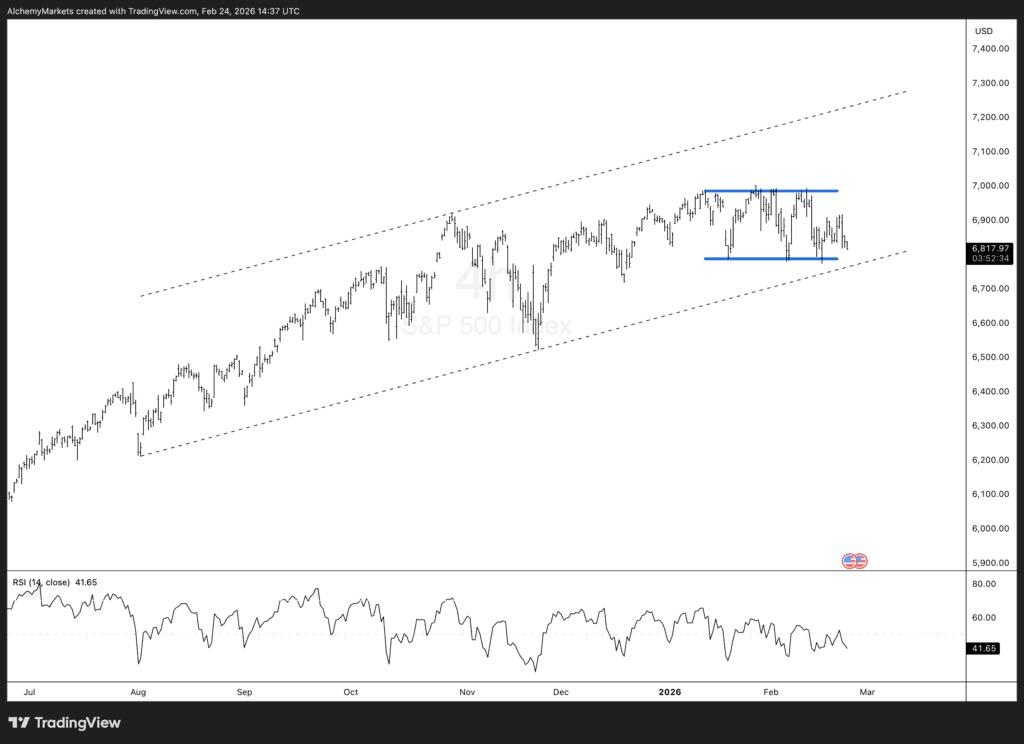
When we zoom out, the move looks far less dramatic.
SPX remains inside:
- A well-defined rising channel
- A multi-week horizontal range
- Above key structural support
Price rotated lower from near range highs and is now sitting closer to mid-to-lower range support. That’s not breakdown behavior — that’s range behavior.
Even momentum tells the same story. RSI has cooled into the low 40s. That’s soft, but not oversold. We’ve seen similar pullbacks multiple times during this broader uptrend.
There’s no confirmed breakdown.
There’s no impulsive lower low.
There’s no acceptance below support.
At this stage, the move fits inside normal volatility.
Our working theory: Noise until proven otherwise
Yes, markets were worried.
Yes, traders were on edge.
Yes, sentiment shifted defensive.
But technically? This still looks like noise inside consolidation.
Consolidation often feels scarier than it is. When price compresses near highs, volatility expands both directions. It shakes out weak hands before the next move.
Right now, unless SPX decisively breaks and builds below the lower range boundary, we have to treat this as:
Rotation within trend
Positioning reset
Momentum cooling
Not trend failure.
Could this still turn bearish?
Absolutely — but not yet.
If we see:
- A clean breakdown below support
- Follow-through selling
- Lower highs forming beneath prior structure
Then we can start discussing medium-term trend risk more seriously.
Until then, the uptrend channel is intact.
In fact, markets often attempt one more push higher before a larger trend shift develops. A bounce from this support zone could send SPX back toward range highs near 7,000. If that rally fails, then we can question whether the broader trend is exhausting.
But that confirmation hasn’t happened.
Bottom line this morning
Yesterday’s drop had clear catalysts — policy nerves, AI positioning, and resistance sensitivity.
However, structurally:
- The range is intact
- The channel is intact
- Momentum is cooling, not collapsing
This looks like normal range-bound behavior, not the start of a medium-term breakdown.
It feels loud.
It feels uncomfortable.
But for now, it’s technical noise.
Let’s see how price behaves at support. That’s where the real story begins.
Have a sharp trading day.
Author

Zorrays Junaid
Alchemy Markets
Zorrays Junaid has extensive combined experience in the financial markets as a portfolio manager and trading coach. More recently, he is an Analyst with Alchemy Markets, and has contributed to DailyFX and Elliott Wave Forecast in the past.