|

USD/MXN climbs from YTD lows, strengthening US economy and higher rates prospects, underpins the USD

  • USD/MXN rebounds off year-to-date lows, climbing towards 17.20, fueled by positive US economic data.
  • Private hiring data and upbeat consumer sentiment in the US signal economic resilience, hinting at a potential Fed rate hike.
  • Comments from Dallas Fed President Lorie Logan further support the USD/MXN rally, as she voices favor for a June rate hike.

USD/MXN rebounds off year-to-date (YTD) lows reached beneath the 17.00 figure, rises steadily past the 17.10 mark on solid data from the United States (US), showing the economy’s resilience despite 500 bps of tightening and expectations for more aggressive monetary policy. Hence, the USD/MXN moved upwards from a YTD low of 16.9761 to the 17.20 region at the time of writing.

US economy demonstrates tenacity: A catalyst for USD/MXN’s leap from yearly lows

A busy US economic calendar on Thursday began with the ADP  National Employment report from June, which shows that private hiring skyrocketed to 497K, above estimates of 228K. The latest consumer sentiment poll showed that Americans were upbeat about the labor market in the last month, relative to May. Further data showed that Initial Jobless Claims exceeded 245K estimates and rose by 248K in the week ending July 1. Although it showed signs of easing, private hiring revealed by ADP could be a prelude to Friday’s US Nonfarm Payrolls, reported to be announced on July 7.

JOLTs data revealed that job vacancies dropped in May though they remained high, with figures rising by 9.824M, falling almost 500K, and missing the 9.935M estimated.

Aside from labor market data, the US ISM Non-Manufacturing PMI for June came above estimates of 51 and climbed to 53.9. Digging deep into the report, a measure of prices paid showed signs of deflation.

After the data, money market futures showed odds for a 25 bps hike by the Federal Reserve (Fed) increased to 95%, while for the November meeting increased to 38%. Consequently, US Treasury bond yields advanced above 4% for the first time since March 2023.

The USD/MXN resumed its uptrend on higher US Treasury bond yields. Also, comments from the Dallas Fed President Lorie Logan that she favored a rate hike in June were a catalyst for USD/MXN to lift the exchange rate from 17.12 toward the 17.20s area.

USD/MXN Price Analysis: Technical outlook
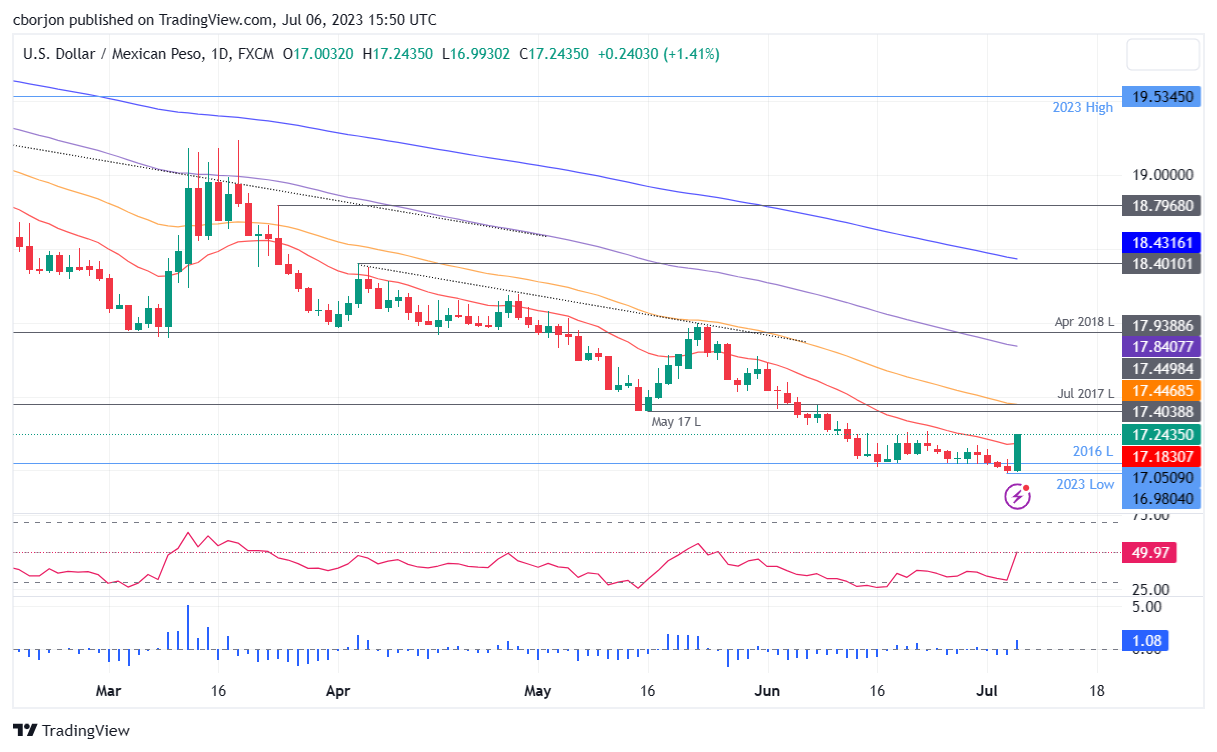
USD/MXN Daily chart

The USD/MXN remains downward biased but jumped above the 20-day Exponential Moving Average (EMA) at 17.1802. If USD/MXN achieves a daily close above the latter, the USD/MXN can rally toward the May 17 daily low of 17.4039, a crucial resistance level that, once cracked, can pave the way to challenge the 50-day EMA at 17.4460 before challenging 17.5000. Conversely, if USD/MXN drops beneat 17.1802, the pair could test the 17.00 mark.

USD/MXN

Overview
Today last price17.2174
Today Daily Change0.2124
Today Daily Change %1.25
Today daily open17.005
 
Trends
Daily SMA2017.146
Daily SMA5017.4846
Daily SMA10017.8852
Daily SMA20018.6544
 
Levels
Previous Daily High17.076
Previous Daily Low16.9803
Previous Weekly High17.1791
Previous Weekly Low17.0456
Previous Monthly High17.7286
Previous Monthly Low17.0243
Daily Fibonacci 38.2%17.0168
Daily Fibonacci 61.8%17.0394
Daily Pivot Point S116.9648
Daily Pivot Point S216.9247
Daily Pivot Point S316.8692
Daily Pivot Point R117.0605
Daily Pivot Point R217.1161
Daily Pivot Point R317.1562

Author

Christian Borjon Valencia

Christian Borjon began his career as a retail trader in 2010, mainly focused on technical analysis and strategies around it. He started as a swing trader, as he used to work in another industry unrelated to the financial markets.

More from Christian Borjon Valencia
Share:

Markets move fast. We move first.

Orange Juice Newsletter brings you expert driven insights - not headlines. Every day on your inbox.

By subscribing you agree to our Terms and conditions.

Editor's Picks

EUR/USD eases toward 1.1700 as USD finds fresh demand

EUR/USD eases toward the 1.1700 mark in Europe trading on Friday. The pair faces headwinds from a renewed uptick in the US Dollar as investors look past softer US inflation data. However, the EUR/USD downside appears capped by expectations of the Fed-ECB monetary policy divergence. 

GBP/USD steadies below 1.3400 as traders digest BoE policy update and US inflation data

The GBP/USD pair stalls the previous day's pullback from the vicinity of mid-1.3400s and a nearly two-month high, though it struggles to attract meaningful buyers during the Asian session on Friday. Spot prices currently trade around the 1.3380-1.3385 region, up only 0.05% for the day, amid mixed cues.

Gold stays weak below $4,350 as USD bulls shrug off softer US CPI

Gold holds the previous day's late pullback from the vicinity of the record high and stays in the red below $4,350 in the European session on Friday. The US CPI report released on Thursday pointed to cooling inflationary pressures, but the US Dollar seems resilient amid a fresh bout of short-covering.

Bitcoin, Ethereum and Ripple correction slide as BoJ rate decision weighs on sentiment

Bitcoin, Ethereum, and Ripple are extending their correction phases after losing nearly 3%, 8%, and 10%, respectively, through Friday. The pullback phase is further strengthened as the upcoming Bank of Japan’s rate decision on Friday weighs on risk sentiment, with BTC breaking key support, ETH deepening weekly losses, and XRP sliding to multi-month lows.

How much can one month of soft inflation change the Fed’s mind?

One month of softer inflation data is rarely enough to shift Federal Reserve policy on its own, but in a market highly sensitive to every data point, even a single reading can reshape expectations. November’s inflation report offered a welcome sign of cooling price pressures. 

Ethereum Price Forecast: EF outlines ways to solve growing state issues

Ethereum price today: $2,920. The EF noted that Ethereum's growing state could lead to centralization and weaken censorship resistance. The Stateless Consensus team outlined state expiry, state archive and partial statelessness as potential solutions to the growing state load.