USD/JPY soars to 3-month high as Powell dials down September cut bets
- Fed holds rates steady; Powell avoids commitment on September move.
- USD/JPY rallies to 149.38, the highest since April.
- Powell: Tariff passthrough slower than expected, more data needed.
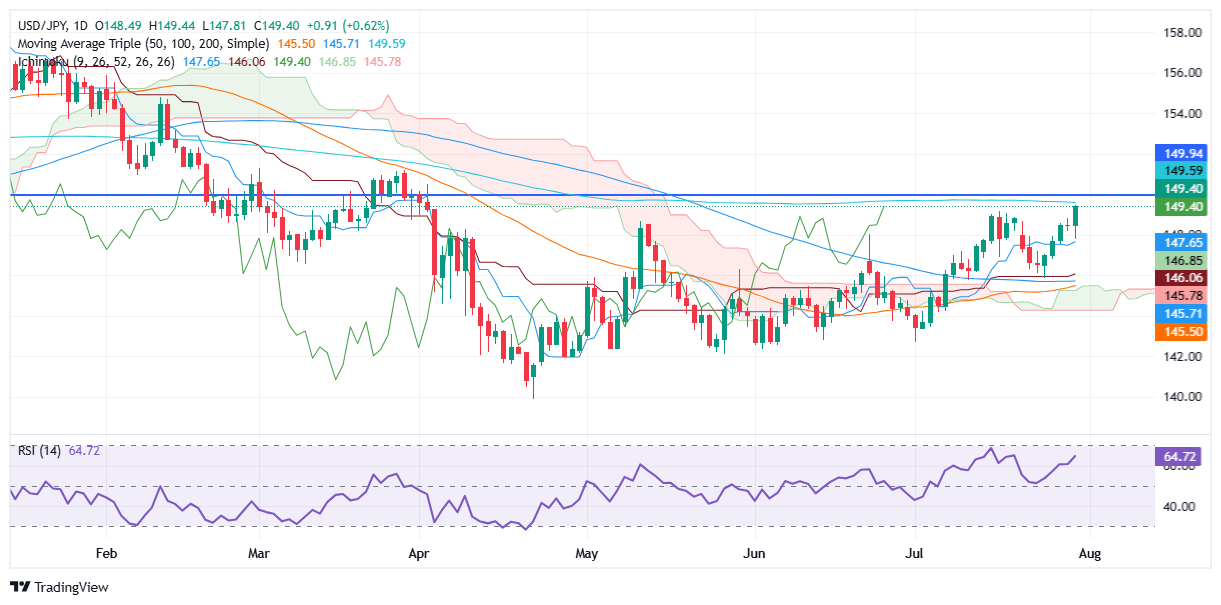
The USD/JPY rallies over 0.60% after the Federal Reserve held interest rates unchanged and as Fed Chair Jerome Powell, turned slightly hawkish and muted for a September rate cut. The pair trades at 149.38, refreshing three-month highs.
Powell turns hawkish; after FOMC's split vote for holding rates
During his post-meeting press conference, Federal Reserve Chair Jerome Powell stated that they have no made any decisions regarding the September meeting. He said that policy is moderately restrictive and that it will take time to fully understand the effects of newly imposed tariffs, noting, “Tariff passthrough to prices may be slower than thought.” He added that the Fed expects to see more tariff-related impacts reflected in upcoming economic data.
The Fed’s monetary policy statement acknowledged that economic activity moderated during the first half of the year, while the unemployment rate remains low and inflation is “somewhat elevated.” Policymakers reaffirmed their dual mandate of achieving maximum employment and returning inflation to the 2% target, while emphasizing that “uncertainty about the economic outlook remains elevated.”
The central bank also confirmed it will continue reducing its balance sheet, including holdings of Treasury securities, agency debt, and mortgage-backed securities.
USD/JPY Daily chart
Fed FAQs
Monetary policy in the US is shaped by the Federal Reserve (Fed). The Fed has two mandates: to achieve price stability and foster full employment. Its primary tool to achieve these goals is by adjusting interest rates. When prices are rising too quickly and inflation is above the Fed’s 2% target, it raises interest rates, increasing borrowing costs throughout the economy. This results in a stronger US Dollar (USD) as it makes the US a more attractive place for international investors to park their money. When inflation falls below 2% or the Unemployment Rate is too high, the Fed may lower interest rates to encourage borrowing, which weighs on the Greenback.
The Federal Reserve (Fed) holds eight policy meetings a year, where the Federal Open Market Committee (FOMC) assesses economic conditions and makes monetary policy decisions. The FOMC is attended by twelve Fed officials – the seven members of the Board of Governors, the president of the Federal Reserve Bank of New York, and four of the remaining eleven regional Reserve Bank presidents, who serve one-year terms on a rotating basis.
In extreme situations, the Federal Reserve may resort to a policy named Quantitative Easing (QE). QE is the process by which the Fed substantially increases the flow of credit in a stuck financial system. It is a non-standard policy measure used during crises or when inflation is extremely low. It was the Fed’s weapon of choice during the Great Financial Crisis in 2008. It involves the Fed printing more Dollars and using them to buy high grade bonds from financial institutions. QE usually weakens the US Dollar.
Quantitative tightening (QT) is the reverse process of QE, whereby the Federal Reserve stops buying bonds from financial institutions and does not reinvest the principal from the bonds it holds maturing, to purchase new bonds. It is usually positive for the value of the US Dollar.
Author

Christian Borjon Valencia
FXStreet
Markets analyst, news editor, and trading instructor with over 14 years of experience across FX, commodities, US equity indices, and global macro markets.

















