USD/JPY slumps amid falling US bond yields, JGB’s yields rise
- Japanese Yen strengthens against the US Dollar, with USD/JPY tumbling amid falling US bond yields and a mixed market mood.
- BOJ data suggests wage increase among small and medium-sized firms; possible end to the massive stimulus triggers jump in JGBs.
- Traders anticipate US June CPI data; Fed officials express concerns over high inflation, hinting at potential rate hikes.

The Japanese Yen (JPY) remains the strongest currency as the North American session begins, gaining 0.27% against the US Dollar (USD), as the USD/JPY pair tumbles after hitting a daily high of 143.00. Hence, the USD/JPY is trading at 141.65
Yen’s strength bolsters amid wage increase reports and BOJ’s potential end to stimulus while the US awaits key inflation data
A mixed market mood has set the tone for the session. Nevertheless, US bond yields drop, undermining the greenback, as shown by the US Dollar Index (DXY). The DXY, a measure of the US Dollar performance against a basket of six currencies, fell 0.05% to 102.213. Meanwhile, the US 10-year Treasury note yields 4.038%, losses three basis points, and weighed on the USD/JPY pair.
Data revealed by the Bank of Japan (BoJ) showed that small and medium-sized firms have begun to raise wages, a reflection of a tight labor market, the BoJ said. Hence, additional increases could keep inflation anchored past the BoJ’s 2% target, meeting the conditions required by the Japanese central bank to end its massive stimulus. The report spurred a jump in the Japanese Government Bonds (JGB), with the 10-year JGB yielding 0.468%, three basis points higher than the open and closing into the 0.50% cap imposed by the BoJ.
Aside from this, the lack of economic data in the United States (US) keeps traders awaiting the release of the Consumer Price Index (CPI) for June, scheduled for Wednesday at 12:30 GMT. In the meantime, a slew of Federal Reserve (Fed) officials have stressed that inflation is too high, the labor market tight, and that further action would be needed. The Fed’s Vice-Chairman for Supervision, Michael Barr, said the Fed still has “a bit of work to do” on rates, but it’s close, while his colleague Cleveland’s Fed President Loretta Mester said that more hikes are needed to bring inflation back down to target.
At the same time, the San Francisco Fed President Mary Daly said there’s more to be done, suggesting that a couple of more hikes this year “are likely needed” and emphasized that although risks on inflation and growth have become more “balanced,” a tight labor market, outweigh the risks of overtightening.
USD/JPY Price Analysis: Technical outlook
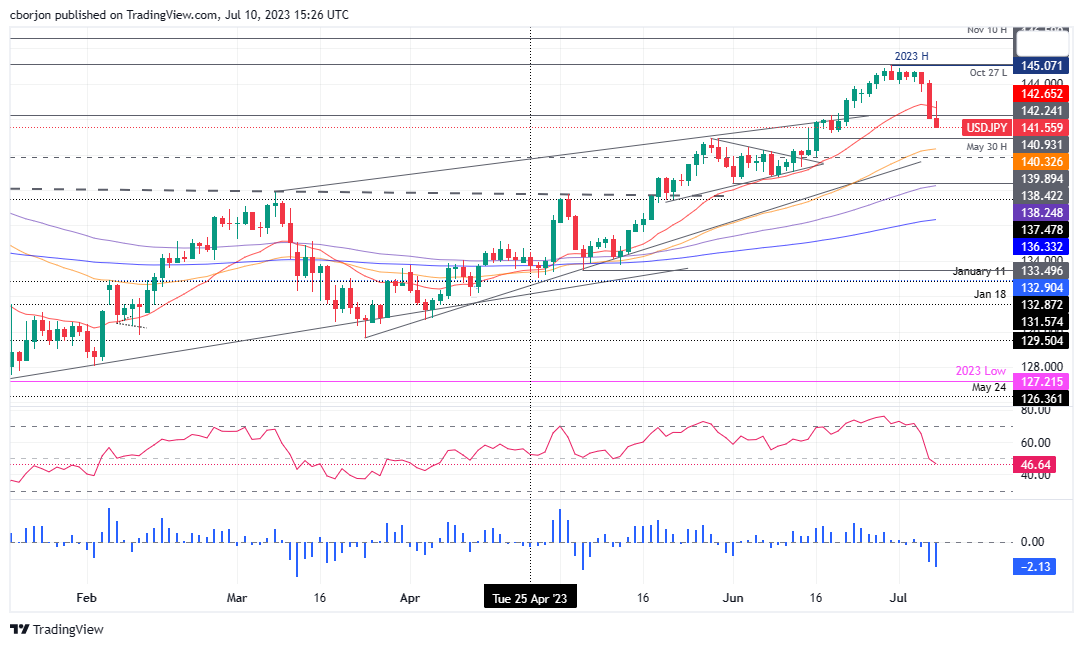
From a technical perspective, the USD/JPY last Friday’s 1.30% fall alongside a drop below the 20-day Exponential Moving Average (EMA) opened the door for further losses. Still, immediate support emerges at a June 20 daily low of 141.21, slightly above the May 30 high at 140.93. If USD/JPY breaches below that area, the following support would be the 50-day EMA at 140.33, followed by the 140.00 mark. Conversely, if USD/JPY fails to conquer 141.20, the 142.00 figure surfaces as the next resistance, followed by the 20-day EMA at 142.67 and 143.00.
Author
Christian Borjon Valencia
FXStreet
Markets analyst, news editor, and trading instructor with over 14 years of experience across FX, commodities, US equity indices, and global macro markets.

















