USD/JPY Price Forecast: US Dollar is nearing a key support area at 147.00
- The Yen extends gains for the second consecutive day, favoured by USD weakness.
- Moderate US inflation data boosted hopes of immediate cuts by the Fed, and sent the US Dollar tumbling
- USD/JPY might activate a Bearish Flag formation below 147.00


The US Dollar is trading lower against its main peers on Wednesday, and has extended its reversal against the Japanese Yen after the moderate US inflation figures shown on Tuesday boosted hopes that the Fed will cut interest rates in after the summer.
July’s Consumer Prices Index figures showed that yearly inflation remained steady at 2.7%, against expectations of a slight increase to 2.8%. The stronger-than-expected Core CPI, which accelerated to a 3.1% year-on-year rate from 2.9% in June, beyond the market consensus for a 3.0% reading, did not prevent investors from ramping up hopes of a September cut, which are now priced at 95%, according to the CME Fed Watch Tool.
Technical analysis: Potential bearish flag below 147.00
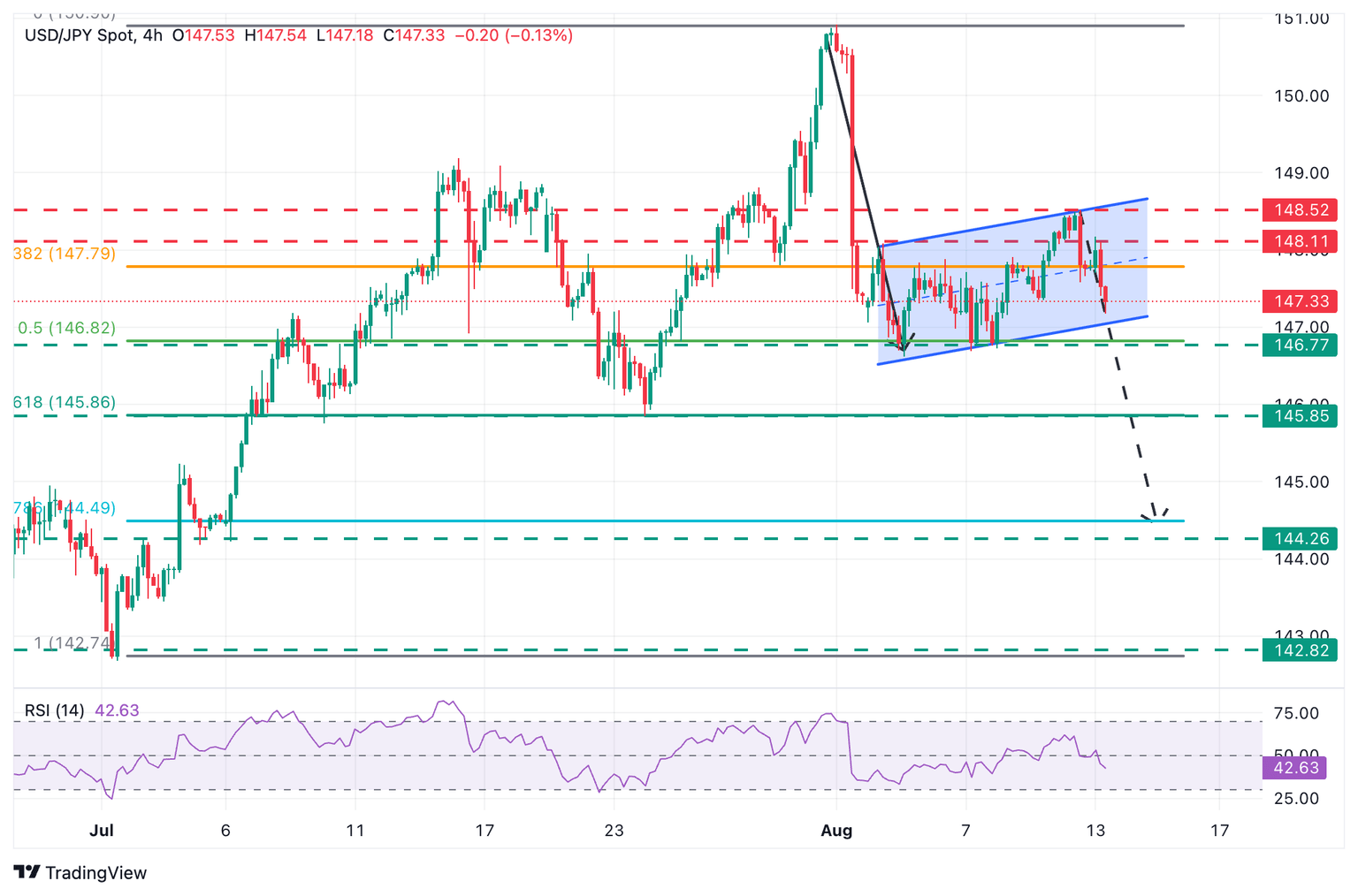
The technical picture shows the pair trading within a corrective channel from the August 5 lows, now at 147.05. A successful break of that level would highlight a bearish flag, which would be confirmed below August 7 and 8 lows, at 146.75.
Further down, the next bearish target is at the July 25 low of 145.85. The Berarish Flag’s measured target is the 78.6% Fibonacci retracement of July’s bullish cycle, at 144.50.
To the upside, immediate resistance is at the intraday high of 148.10, ahead of Tuesday’s peak, at 148,50, and the top of the mentioned bullish channel, now at 148.60.
Fed FAQs
Monetary policy in the US is shaped by the Federal Reserve (Fed). The Fed has two mandates: to achieve price stability and foster full employment. Its primary tool to achieve these goals is by adjusting interest rates. When prices are rising too quickly and inflation is above the Fed’s 2% target, it raises interest rates, increasing borrowing costs throughout the economy. This results in a stronger US Dollar (USD) as it makes the US a more attractive place for international investors to park their money. When inflation falls below 2% or the Unemployment Rate is too high, the Fed may lower interest rates to encourage borrowing, which weighs on the Greenback.
The Federal Reserve (Fed) holds eight policy meetings a year, where the Federal Open Market Committee (FOMC) assesses economic conditions and makes monetary policy decisions. The FOMC is attended by twelve Fed officials – the seven members of the Board of Governors, the president of the Federal Reserve Bank of New York, and four of the remaining eleven regional Reserve Bank presidents, who serve one-year terms on a rotating basis.
In extreme situations, the Federal Reserve may resort to a policy named Quantitative Easing (QE). QE is the process by which the Fed substantially increases the flow of credit in a stuck financial system. It is a non-standard policy measure used during crises or when inflation is extremely low. It was the Fed’s weapon of choice during the Great Financial Crisis in 2008. It involves the Fed printing more Dollars and using them to buy high grade bonds from financial institutions. QE usually weakens the US Dollar.
Quantitative tightening (QT) is the reverse process of QE, whereby the Federal Reserve stops buying bonds from financial institutions and does not reinvest the principal from the bonds it holds maturing, to purchase new bonds. It is usually positive for the value of the US Dollar.
Author
Guillermo Alcala
FXStreet
Graduated in Communication Sciences at the Universidad del Pais Vasco and Universiteit van Amsterdam, Guillermo has been working as financial news editor and copywriter in diverse Forex-related firms, like FXStreet and Kantox.