USD/JPY Price Forecast: Signs of stabilization above 20-day EMA back more upside
- USD/JPY trades lower against its peers after the BoJ’s policy outcome.
- Both the Fed and the BoJ hiked interest rates last week.
- The Fed signaled at least one more interest rate hike this year.

The Japanese Yen (JPY) underperforms its major currency peers at the start of the week, with the USD/JPY pair trading 0.1% higher to near 157.00 in the early European trade. The Japanese currency has come under pressure after the Bank of Japan’s (BoJ) monetary policy announcement on Friday.
Japanese Yen Price Today
The table below shows the percentage change of Japanese Yen (JPY) against listed major currencies today. Japanese Yen was the weakest against the Australian Dollar.
| USD | EUR | GBP | JPY | CAD | AUD | NZD | CHF | |
|---|---|---|---|---|---|---|---|---|
| USD | 0.06% | 0.14% | 0.11% | 0.16% | 0.04% | 0.07% | 0.10% | |
| EUR | -0.06% | 0.02% | 0.04% | 0.03% | -0.08% | -0.07% | 0.00% | |
| GBP | -0.14% | -0.02% | 0.00% | 0.02% | -0.09% | -0.10% | 0.00% | |
| JPY | -0.11% | -0.04% | 0.00% | 0.04% | -0.12% | -0.04% | 0.04% | |
| CAD | -0.16% | -0.03% | -0.02% | -0.04% | -0.15% | -0.10% | -0.02% | |
| AUD | -0.04% | 0.08% | 0.09% | 0.12% | 0.15% | 0.04% | 0.11% | |
| NZD | -0.07% | 0.07% | 0.10% | 0.04% | 0.10% | -0.04% | 0.07% | |
| CHF | -0.10% | -0.01% | -0.00% | -0.04% | 0.02% | -0.11% | -0.07% |
The heat map shows percentage changes of major currencies against each other. The base currency is picked from the left column, while the quote currency is picked from the top row. For example, if you pick the Japanese Yen from the left column and move along the horizontal line to the US Dollar, the percentage change displayed in the box will represent JPY (base)/USD (quote).
What happened at the BoJ meeting
The BoJ hiked interest rates by 25 basis points (bps) to 1.25%, as expected, the highest level seen in 31 years. Two BoJ board members: Toichiro Asada and Ayano Sato opposed the hike decision.
The Japanese central bank kept the door open for further interest rate hikes and warned that “inflation might exceed the central bank’s 2% target”, adding, “Recent Yen depreciation likely to push prices higher.”
Meanwhile, investors seek fresh cues regarding how much more the BoJ could raise interest rates without hurting the economic growth.
On the US Dollar (USD) front, the currency flattens at the start of the week with investors awaiting commentary from various Federal Reserve (Fed) policymakers after the monetary policy announcement last week.
The Fed hiked its policy rates by 25 bps to the 3.75%-4.00% range, as expected. 16 of 18 Fed members signaled through the dot plot that there would be at least one more interest rate hike this year.
USD/JPY Technical Analysis
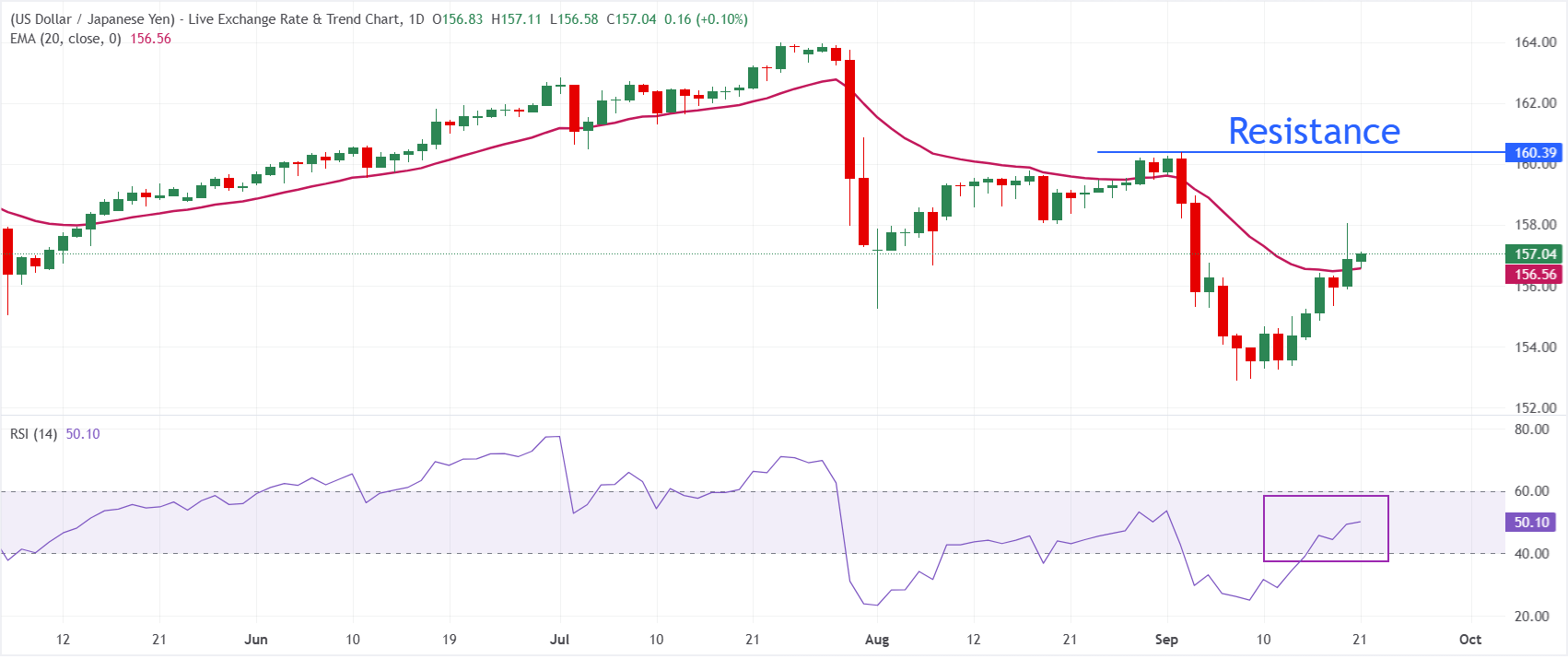
In the daily chart, USD/JPY trades at 157.06, holding a mild bullish bias as it clings above the 20-day Exponential Moving Average (EMA) at 156.56. The pair has stabilized after its recent pullback from higher levels, and the Relative Strength Index (RSI) around 50 suggests neutral momentum, hinting that directional conviction remains tentative despite the short-term recovery above the EMA.
On the downside, the 20-day EMA at 156.56 acts as immediate support, and a daily close below this level would expose a deeper retracement toward the September 17 low at 155.34. On the upside, the pair could rise toward the September 2 high at 160.39 if it manages to break above Friday's high near 158.00.
(The technical analysis of this story was written with the help of an AI tool. Know more.)
Bank of Japan FAQs
The Bank of Japan (BoJ) is the Japanese central bank, which sets monetary policy in the country. Its mandate is to issue banknotes and carry out currency and monetary control to ensure price stability, which means an inflation target of around 2%.
The Bank of Japan embarked in an ultra-loose monetary policy in 2013 in order to stimulate the economy and fuel inflation amid a low-inflationary environment. The bank’s policy is based on Quantitative and Qualitative Easing (QQE), or printing notes to buy assets such as government or corporate bonds to provide liquidity. In 2016, the bank doubled down on its strategy and further loosened policy by first introducing negative interest rates and then directly controlling the yield of its 10-year government bonds. In March 2024, the BoJ lifted interest rates, effectively retreating from the ultra-loose monetary policy stance.
The Bank’s massive stimulus caused the Yen to depreciate against its main currency peers. This process exacerbated in 2022 and 2023 due to an increasing policy divergence between the Bank of Japan and other main central banks, which opted to increase interest rates sharply to fight decades-high levels of inflation. The BoJ’s policy led to a widening differential with other currencies, dragging down the value of the Yen. This trend partly reversed in 2024, when the BoJ decided to abandon its ultra-loose policy stance.
A weaker Yen and the spike in global energy prices led to an increase in Japanese inflation, which exceeded the BoJ’s 2% target. The prospect of rising salaries in the country – a key element fuelling inflation – also contributed to the move.
Author

Sagar Dua
FXStreet
Sagar Dua is associated with the financial markets from his college days. Along with pursuing post-graduation in Commerce in 2014, he started his markets training with chart analysis.