USD/JPY Price Forecast: Aims to extend rally above 160.00
- USD/JPY rises to near 159.70 as the Japanese Yen faces pressure.
- Japan’s Q2 GDP growth remains moderate at 0.3%, missing 0.5% estimates.
- Investors await FOMC minutes, which will be released on Wednesday.

The Japanese Yen (JPY) underperforms its major currency peers on Tuesday, with USD/JPY trading 0.16% higher at around 159.70 during the European trading session. The Japanese currency is under pressure as financial markets doubt the Bank of Japan (BoJ) to hold its hawkish policy stance amid growing economic concerns.
Economists at Societe Generale note that Japan’s latest GDP release undershot expectations, with “headline growth missed consensus, with consumption and capex—the two drivers we had expected to support growth—both disappointing.” They add that the inflation backdrop offers some support to tightening prospects, as “the higher GDP deflator should support near-term BoJ hike expectations,” but caution that “if weakness in consumption and capex continues, it would raise concerns over a faster and higher hiking path.”
On Monday, the Japanese Cabinet Office reported that the economy grew at a quarterly pace of 0.3% in the second quarter this year, slower than estimates and the prior release of 0.5%. On an annualized basis, the economy expanded at a moderate pace of 1.1% against the previous reading of 1.8%.
Within that, Societe Generale highlights the services sector as a key risk marker for policy. They warn that “continued services weakness would flash a yellow light for the BoJ,” stressing that “this is an important component to watch, as sustained weakness in services consumption would raise a warning flag for the BoJ’s faster and higher rate-hike path.”
Meanwhile, the US Dollar trades marginally higher ahead of the Federal Open Market Committee (FOMC) minutes of the July policy meeting, which will be released on Wednesday.
In the policy meeting, the Fed left interest rates unchanged in the range of 3.50%-3.75%, as expected, and remained committed to “no forward guidance” on interest rates.
USD/JPY Technical Analysis
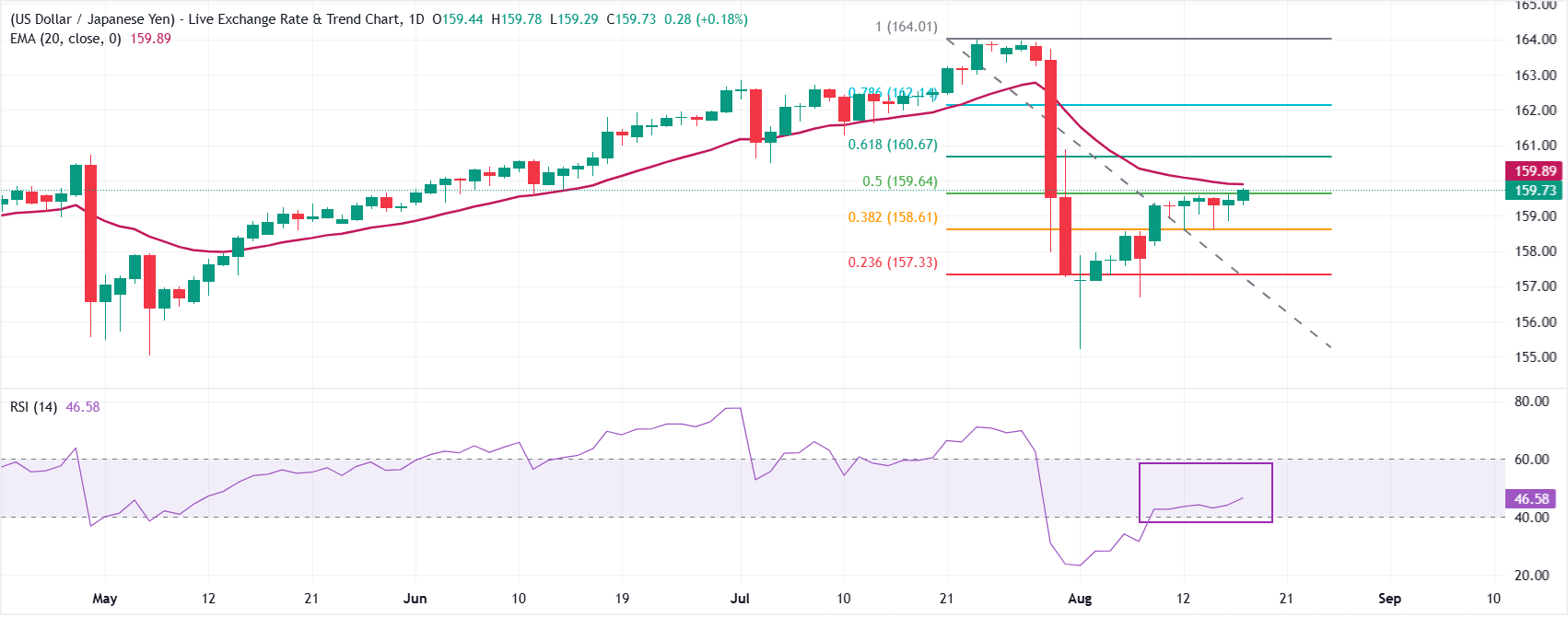
USD/JPY trades at 159.70, keeping a bearish near-term bias as spot holds beneath the 20-day Exponential Moving Average (EMA) at 159.89 and below the 61.8% Fibonacci retracement at 160.67. The pair is hovering just above the 50% retracement at 159.64, suggesting a fragile consolidation after the recent pullback, while the Relative Strength Index (14) at 46.60 points to neutral momentum that neither strongly favors a rebound nor an extension of selling pressure.
On the topside, immediate resistance is located at the 20-day EMA at 159.89, followed by the 61.8% retracement at 160.67; a sustained break above these levels would ease downside pressure and open the way toward the 78.6% retracement at 162.14 and the recent cycle high near the 100% retracement at 164.01. On the downside, initial support is seen at the 50% retracement at 159.64, ahead of the 38.2% retracement at 158.61 and the 23.6% retracement at 157.33, where buyers would be expected to emerge to defend the broader uptrend.
(The technical analysis of this story was written with the help of an AI tool. Know more.)
Japanese Yen FAQs
The Japanese Yen (JPY) is one of the world’s most traded currencies. Its value is broadly determined by the performance of the Japanese economy, but more specifically by the Bank of Japan’s policy, the differential between Japanese and US bond yields, or risk sentiment among traders, among other factors.
One of the Bank of Japan’s mandates is currency control, so its moves are key for the Yen. The BoJ has directly intervened in currency markets sometimes, generally to lower the value of the Yen, although it refrains from doing it often due to political concerns of its main trading partners. The BoJ ultra-loose monetary policy between 2013 and 2024 caused the Yen to depreciate against its main currency peers due to an increasing policy divergence between the Bank of Japan and other main central banks. More recently, the gradually unwinding of this ultra-loose policy has given some support to the Yen.
Over the last decade, the BoJ’s stance of sticking to ultra-loose monetary policy has led to a widening policy divergence with other central banks, particularly with the US Federal Reserve. This supported a widening of the differential between the 10-year US and Japanese bonds, which favored the US Dollar against the Japanese Yen. The BoJ decision in 2024 to gradually abandon the ultra-loose policy, coupled with interest-rate cuts in other major central banks, is narrowing this differential.
The Japanese Yen is often seen as a safe-haven investment. This means that in times of market stress, investors are more likely to put their money in the Japanese currency due to its supposed reliability and stability. Turbulent times are likely to strengthen the Yen’s value against other currencies seen as more risky to invest in.
Author

Sagar Dua
FXStreet
Sagar Dua is associated with the financial markets from his college days. Along with pursuing post-graduation in Commerce in 2014, he started his markets training with chart analysis.

















