USD/JPY Price Forecast: 158.00 caps upside as the pair consolidates near January 2025 highs
- The Japanese Yen firms modestly as political uncertainty around the Fed weighs on the US Dollar.
- USD/JPY consolidates near multi-month highs within a well-defined daily uptrend.
- A break above 158.20 could open the door toward the 160.00 psychological level.

The Japanese Yen (JPY) gains modest ground against the US Dollar (USD) at the start of the week as the Greenback comes under pressure across the board, following reports of a criminal probe involving Federal Reserve (Fed) Chair Jerome Powell that have unsettled market sentiment.
At the time of writing, USD/JPY trades around 157.75, holding close to its highest level since January 2025. The pair lacks strong follow-through selling, with Japan-China tensions and speculation over a possible snap election in Japan’s lower house keeping the Yen on the defensive.
That said, the upside in USD/JPY also appears capped for now, as sustained weakness in the Yen could revive intervention risks, with the currency hovering near levels that previously prompted both verbal and direct intervention from Japanese authorities.
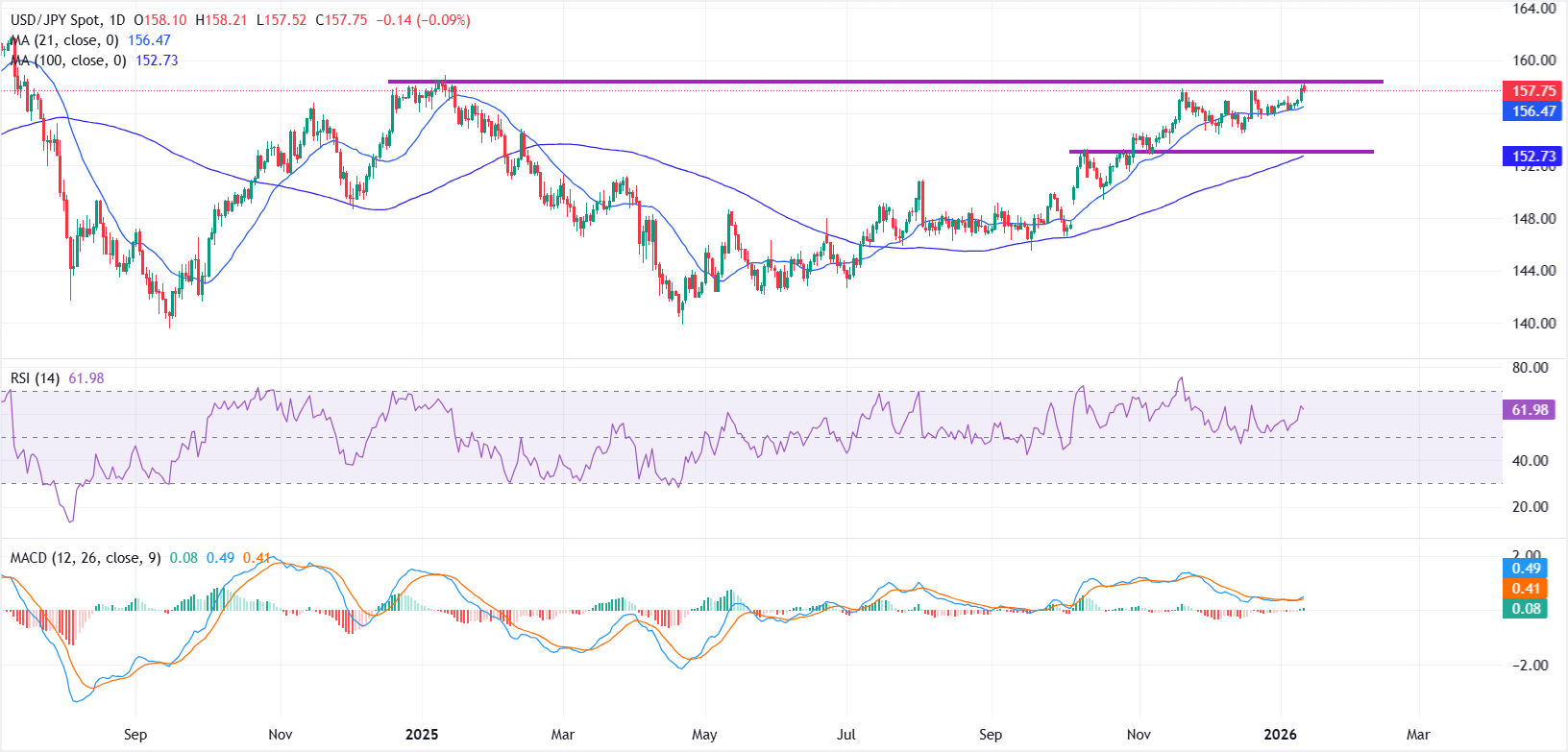
From a technical perspective, USD/JPY remains in a steady uptrend, trading well above its key moving averages on the daily chart. The 21-day Simple Moving Average (SMA), near 156.48, is acting as immediate support.
A decisive break below this level could expose the December low around 154.50, followed by a strong demand zone near 153.00, which closely aligns with the 100-day SMA at 152.73.
On the upside, the 157.80-158.20 region continues to cap gains, as reflected in the rejections seen in November and December. A sustained break above this zone would strengthen bullish momentum and open the door toward the 160.00 psychological mark, last seen in July 2024.
Momentum indicators support the upside bias. The Moving Average Convergence Divergence (MACD) histogram has turned positive near the zero line, with the MACD line above the signal line, pointing to improving bullish momentum.
Meanwhile, the Relative Strength Index (RSI) stands at 62, remaining in bullish territory without flashing overbought conditions.
Japanese Yen FAQs
The Japanese Yen (JPY) is one of the world’s most traded currencies. Its value is broadly determined by the performance of the Japanese economy, but more specifically by the Bank of Japan’s policy, the differential between Japanese and US bond yields, or risk sentiment among traders, among other factors.
One of the Bank of Japan’s mandates is currency control, so its moves are key for the Yen. The BoJ has directly intervened in currency markets sometimes, generally to lower the value of the Yen, although it refrains from doing it often due to political concerns of its main trading partners. The BoJ ultra-loose monetary policy between 2013 and 2024 caused the Yen to depreciate against its main currency peers due to an increasing policy divergence between the Bank of Japan and other main central banks. More recently, the gradually unwinding of this ultra-loose policy has given some support to the Yen.
Over the last decade, the BoJ’s stance of sticking to ultra-loose monetary policy has led to a widening policy divergence with other central banks, particularly with the US Federal Reserve. This supported a widening of the differential between the 10-year US and Japanese bonds, which favored the US Dollar against the Japanese Yen. The BoJ decision in 2024 to gradually abandon the ultra-loose policy, coupled with interest-rate cuts in other major central banks, is narrowing this differential.
The Japanese Yen is often seen as a safe-haven investment. This means that in times of market stress, investors are more likely to put their money in the Japanese currency due to its supposed reliability and stability. Turbulent times are likely to strengthen the Yen’s value against other currencies seen as more risky to invest in.
Author

Vishal Chaturvedi
FXStreet
I am a macro-focused research analyst with over four years of experience covering forex and commodities market. I enjoy breaking down complex economic trends and turning them into clear, actionable insights that help traders stay ahead of the curve.