GBP/USD rallies as 'Sell America' trade returns on Fed independence fears
- GBP/USD jumps as threats to Fed independence spark renewed 'Sell America' flows into G10 currencies.
- The US Dollar weakens sharply, with DXY sliding as markets react to Powell’s remarks on political pressure.
- Focus shifts to UK GDP and jobs data for clues on the Bank of England’s policy outlook.

The British Pound (GBP) stages a comeback on Monday as traders grow risk-averse following threats to the US Federal Reserve (Fed) independence. A scarce economic docket in the UK shifts the focus to geopolitical developments and the US Dollar (USD), which continued to soften as the 'Sell America' trade is back into play. At the time of writing, GBP/USD trades at 1.3473, up 0.55%.
Sterling rebounds as political pressure on the Federal Reserve dents the US Dollar
Over the weekend, Fed Chair Jerome Powell released a statement and commented in a video that “the US central bank had been served grand jury subpoenas from the Justice Department threatening a criminal indictment.” He said the move “should be seen in the broader context of the administration’s threats and ongoing pressure,” and added that “the threat of criminal charges is a consequence of the Federal Reserve setting interest rates based on our best assessment of what will serve the public, rather than following the preferences of the President.”
Consequently, the Greenback plunged, as depicted by the US Dollar Index (DXY). The DXY, which measures the performance of the buck’s value versus six currencies, is down 0.35% at 98.79.
Although US President Donald Trump denied any knowledge of the investigation into the central bank, he has consistently bullied Fed Chair Powell over the lack of a reduction in interest rates as he expected.
Across the pond, some analysts argued that the reduction in fiscal and political risks in the UK is a tailwind for the Pound, following Chancellor Rachel Reeves' budget presentation in November.
Traders’ eyes are on the release of the UK’s Gross Domestic Product figures on Thursday and jobs data next week, which could determine the Bank of England’s path.
GBP/USD Price Forecast: Technical outlook
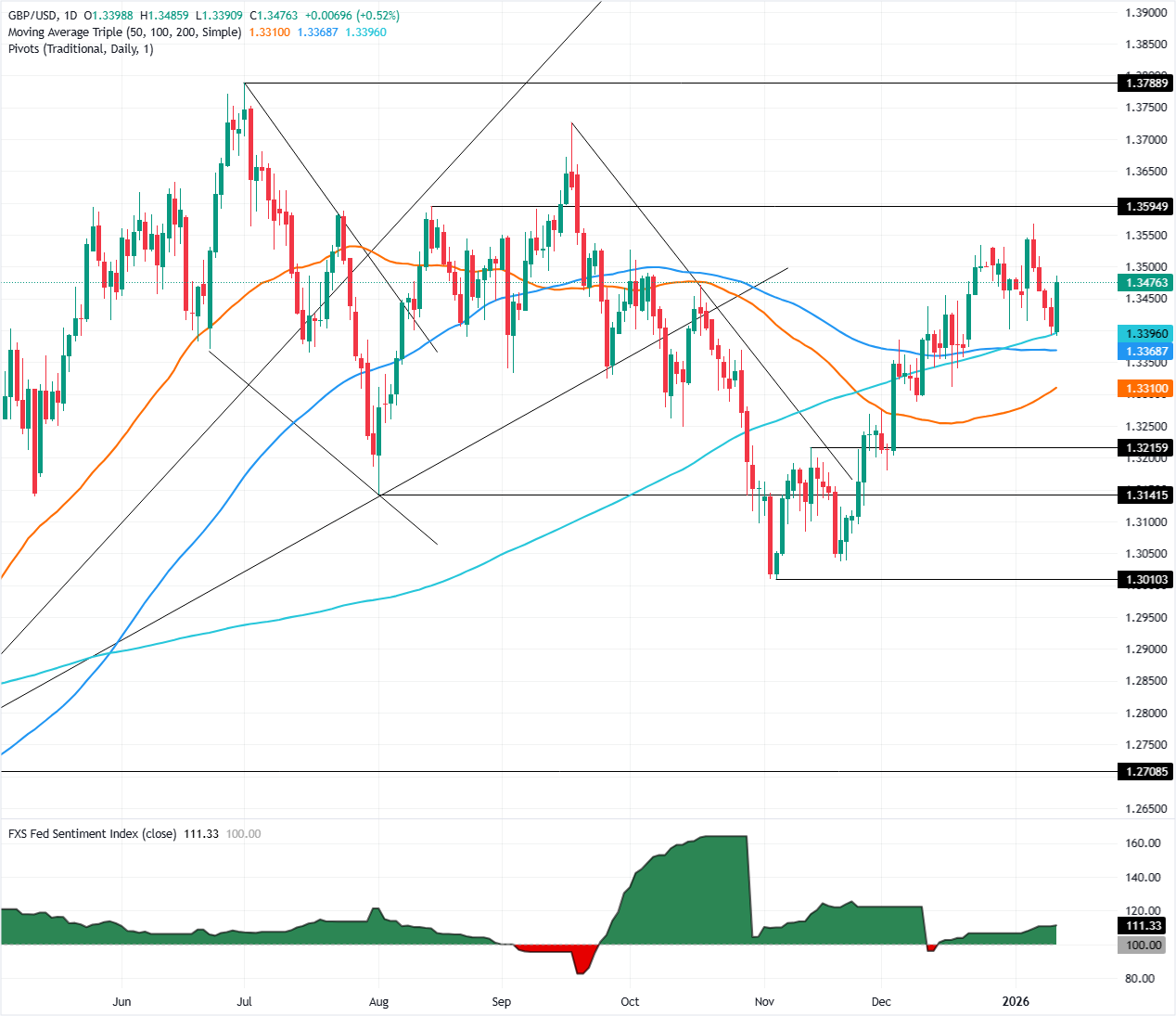
GBP/USD is enjoying a spike on bullish momentum, as depicted by the pair hitting a three-day high at 1.3485, along with the recovery of the Relative Strength Index (RSI), which remains in bullish territory.
If the pair exceeds 1.3500, this would clear the way to test the yearly high of 1.3567, ahead of 1.3600. Conversely, a drop below 1.3400 would expose the 200-day SMA at 1.3386.
Pound Sterling Price This week
The table below shows the percentage change of British Pound (GBP) against listed major currencies this week. British Pound was the strongest against the US Dollar.
| USD | EUR | GBP | JPY | CAD | AUD | NZD | CHF | |
|---|---|---|---|---|---|---|---|---|
| USD | -0.42% | -0.57% | -0.14% | -0.30% | -0.56% | -0.60% | -0.60% | |
| EUR | 0.42% | -0.16% | 0.33% | 0.12% | -0.14% | -0.18% | -0.18% | |
| GBP | 0.57% | 0.16% | 0.49% | 0.28% | 0.02% | -0.03% | -0.02% | |
| JPY | 0.14% | -0.33% | -0.49% | -0.19% | -0.45% | -0.49% | -0.48% | |
| CAD | 0.30% | -0.12% | -0.28% | 0.19% | -0.28% | -0.31% | -0.30% | |
| AUD | 0.56% | 0.14% | -0.02% | 0.45% | 0.28% | -0.05% | -0.04% | |
| NZD | 0.60% | 0.18% | 0.03% | 0.49% | 0.31% | 0.05% | -0.01% | |
| CHF | 0.60% | 0.18% | 0.02% | 0.48% | 0.30% | 0.04% | 0.00% |
The heat map shows percentage changes of major currencies against each other. The base currency is picked from the left column, while the quote currency is picked from the top row. For example, if you pick the British Pound from the left column and move along the horizontal line to the US Dollar, the percentage change displayed in the box will represent GBP (base)/USD (quote).
Author

Christian Borjon Valencia
FXStreet
Markets analyst, news editor, and trading instructor with over 14 years of experience across FX, commodities, US equity indices, and global macro markets.