|

USD/JPY Price Analysis: Pullback from YTD highs, intervention threats weight on the USD

  • USD/JPY trades lower, retreating from its year-to-date (YTD) high amid signals of potential intervention by Japanese authorities.
  • Despite the upward bias, USD/JPY may extend its losses below the 144.00 mark, potentially reaching the 20-day Exponential Moving Average (EMA) at 142.95.
  • Resistance levels lie at the YTD high of 145.07 and the May 10 high of 146.59.

USD/JPY retreats from the year-to-date (YTD) high of 145.07, extending its losses below the 144.10 area, as the US Dollar (USD) weakens despite US Treasury bond yields, particularly the 10-year benchmark note rate edged above the 4.00% threshold. At the time of writing, the USD/JPY exchanges hand at 144.06, down 0.40%.

USD/JPY Price Analysis: Technical outlook

USD/JPY price action suggests the pair is headed for a deeper pullback after Japanese authorities threatened to intervene in the Forex market. The USD/JPY remains upward biased, but the pullback could extend past the 144.00 mark toward the 20-day Exponential Moving Average (EMA) at 142.95.

Of note, the USD/JPY achieved a daily close below the July 3 daily open of 144.08. That could exacerbate a drop below 144.00, exposing the 143.50 psychological level, followed by the 20-day EMA at 142.95. Downside risks will emerge at the June 21 daily high of 142.37, followed by the 142.00 mark.

On the upside, immediate resistance lies at the year-to-date (YTD) high of 145.07, followed by the May 10 high at 146.59.

USD/JPY Price Action – Daily chart
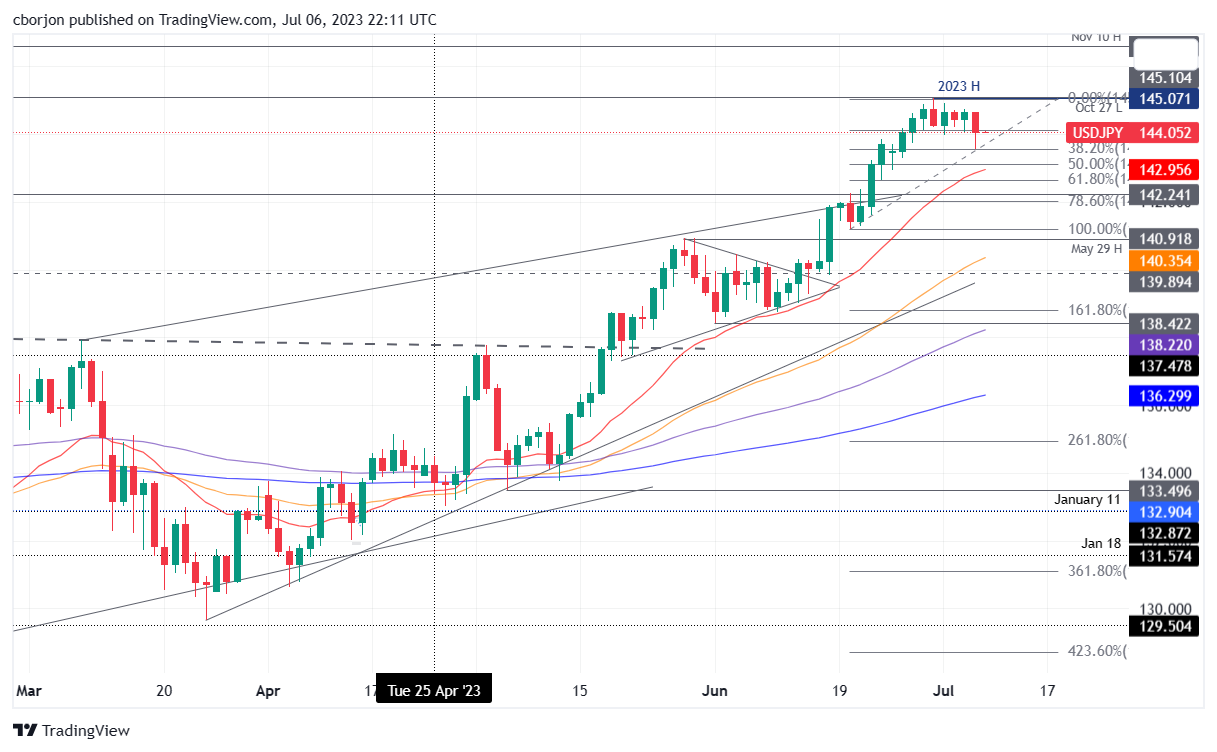
USD/JPY Daily chart

USD/JPY

Overview
Today last price144.05
Today Daily Change-0.61
Today Daily Change %-0.42
Today daily open144.66
 
Trends
Daily SMA20142.37
Daily SMA50139.44
Daily SMA100136.62
Daily SMA200137.24
 
Levels
Previous Daily High144.74
Previous Daily Low144.08
Previous Weekly High145.07
Previous Weekly Low142.94
Previous Monthly High145.07
Previous Monthly Low138.43
Daily Fibonacci 38.2%144.49
Daily Fibonacci 61.8%144.33
Daily Pivot Point S1144.25
Daily Pivot Point S2143.84
Daily Pivot Point S3143.59
Daily Pivot Point R1144.9
Daily Pivot Point R2145.15
Daily Pivot Point R3145.56

Author

Christian Borjon Valencia

Markets analyst, news editor, and trading instructor with over 14 years of experience across FX, commodities, US equity indices, and global macro markets.


More from Christian Borjon Valencia
Share:

Editor's Picks

AUD/USD keeps the red near 0.6950 after weak Aussie jobs data

AUD/USD holds losses near 0.6950 on disappointing Australian jobs data, extending the previous day's retracement slide from the monthly high and hitting a fresh weekly low during Thursday’s Asian session. Meanwhile, declining US bond yields drag the US Dollar away from the April 2025 high, touched after Wednesday's hot US CPI, helping limit losses for the currency pair.

USD/JPY slides back below 158.00 as USD reverses post-CPI gains

USD/JPY extends the previous day's pullback from a three-week high, attracting follow-through selling and sliding below 158.00 during Thursday's Asian session. Traders remain on high alert amid speculation that authorities will step in to prop up the Japanese Yen. The US Dollar, meanwhile, reverses Wednesday's hot CPI-led gains to April 2025 highs as US bond yields retreat on China bond-buying talk, further pressuring the pair.

Gold rebounds firmly as China Treasuries-buying report smashes US yields

Gold stages a solid comeback from weekly lows, retakes $4,150 early Thursday. US Dollar declines sharply alongside Treasury yields on China’s bond-buying report. Technically, the daily RSI remains bearish and a headwind for Gold buyers.

Zcash declines as US inflation surprise offsets fresh ETF inflows
Zcash (ZEC) is trading in the red on Friday, extending its previous day’s roughly 6% losses as the broader cryptocurrency market falls on rising US inflation. The US Consumer Price Index (CPI) print came in higher than expected, at an annual increase of 3.7% versus the expected 3.6%, raising concerns about inflation and rate hikes.
China seems routing US Treasury holdings through Canada

According to a Bloomberg report, China seems to be moving United States securities to non-US custodian banks in other countries, masking its role in financing US deficits.

Has Bitcoin really escaped the macro forces it was built to fight?
Over 17 years ago, Satoshi Nakamoto designed Bitcoin (BTC) on the back of a global financial crisis as an alternative to the global monetary system outside the control of central banks, governments and traditional intermediaries. This raises a key question: has Bitcoin really become independent of the macroeconomic forces it was built to challenge?















