USD/INR approaches all-time highs amid elevated oil prices
- The Indian Rupee falls further against the US Dollar as higher oil prices boost demand for the Greenback by Indian importers.
- Fresh concerns over India Inc.'s earnings projections have dampened the FIIs interest in the Indian stock market.
- This week, investors will pay close attention to the Fed’s monetary policy.

The Indian Rupee (INR) weakens further against the US Dollar (USD) on Tuesday after a brief pause in the last two trading days. The USD/INR pair jumps to near 94.50 as elevated oil prices continue to hurt the Indian Rupee.
As of writing, the WTI Oil price trades 0.6% higher to near $95.60 and is close to its two-week high of $97 posted on Thursday.
Currencies from economies, such as India, which rely heavily on oil imports to meet their energy needs, tend to underperform in a high oil price environment.
Oil prices have remained higher due to uncertainty over the reopening of the Strait of Hormuz, a critical passage to almost 20% of global energy supply.
According to a Reuters report, oil-linked flows and hedging-related US Dollar demand are key headwinds for the Indian Rupee
Higher oil prices keep Indian Rupee under pressure
The uncertainty regarding the reopening of the Hormuz remains escalated, as Washington has not shown any signs of interest in proposals delivered by Iran to end the war. On late Monday, White House press secretary Karoline Leavitt stated that US President Trump discussed Iran’s proposal with the national security team, which calls for the reopening of the Strait of Hormuz and a permanent ceasefire. Leavitt didn’t reveal any information regarding the odds of whether it will be taken forward by Washington.
"I wouldn't say they're considering it. I would just say that there was a discussion this morning that I don't want to get ahead of, and you'll hear directly from the president, I'm sure, on this topic," Leavitt said.
On Monday, US President Trump received another proposal from Iran, which he called “better” than the one was expected to present in canceled peace talks in Islamabad over the weekend, but "still not good enough”.
FIIs continue to offload their stake in Indian stock market
In the last six trading days, Foreign Institutional Investors (FIIs) have remained net sellers and have offloaded their stake worth Rs. 18,291.34 crore after a little buying in the April 15-17 period. FIIs appear to be dumping their stake in the Indian equity market due to elevated oil prices, which have raised concerns over India Inc.'s earnings projections.
Fed to hold interest rates steady
This week, the major trigger for the US Dollar will be the Federal Reserve’s (Fed) monetary policy announcement on Wednesday, in which it is expected to leave interest rates unchanged in the range of 3.50%-3.75% for the third time in a row. Investors will pay close attention to Fed Chair Jerome Powell’s comments regarding the monetary policy outlook in the wake of the energy price shock amid the Hormuz closure.
Technical Analysis: USD/INR aims to revisit all-time high above 95.20
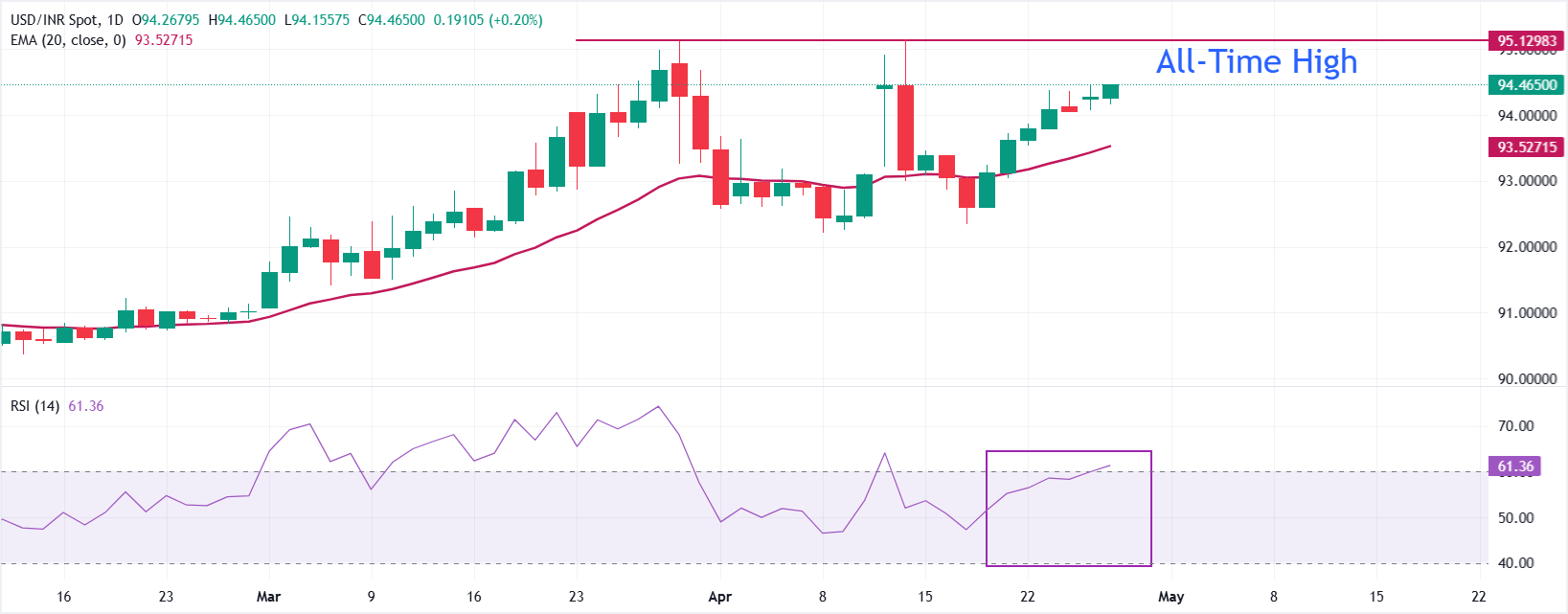
USD/INR trades higher at around 94.50, maintaining a bullish near-term bias, as it holds above the 20-day Exponential Moving Average (EMA) at 93.53. The positioning above this rising EMA suggests the broader uptrend remains intact, while the Relative Strength Index (RSI) around 61 indicates firm but not overstretched upside momentum.
On the downside, the 20-day EMA at 93.53 stands as the first layer of dynamic support, and a daily close below this level would hint at a deeper corrective phase within the broader trend. Looking up, the pair aims to revisit the all-time high around 95.20. The spot would enter uncharted territory if it manages a decisive break above 95.20.
(The technical analysis of this story was written with the help of an AI tool.)
Fed FAQs
Monetary policy in the US is shaped by the Federal Reserve (Fed). The Fed has two mandates: to achieve price stability and foster full employment. Its primary tool to achieve these goals is by adjusting interest rates. When prices are rising too quickly and inflation is above the Fed’s 2% target, it raises interest rates, increasing borrowing costs throughout the economy. This results in a stronger US Dollar (USD) as it makes the US a more attractive place for international investors to park their money. When inflation falls below 2% or the Unemployment Rate is too high, the Fed may lower interest rates to encourage borrowing, which weighs on the Greenback.
The Federal Reserve (Fed) holds eight policy meetings a year, where the Federal Open Market Committee (FOMC) assesses economic conditions and makes monetary policy decisions. The FOMC is attended by twelve Fed officials – the seven members of the Board of Governors, the president of the Federal Reserve Bank of New York, and four of the remaining eleven regional Reserve Bank presidents, who serve one-year terms on a rotating basis.
In extreme situations, the Federal Reserve may resort to a policy named Quantitative Easing (QE). QE is the process by which the Fed substantially increases the flow of credit in a stuck financial system. It is a non-standard policy measure used during crises or when inflation is extremely low. It was the Fed’s weapon of choice during the Great Financial Crisis in 2008. It involves the Fed printing more Dollars and using them to buy high grade bonds from financial institutions. QE usually weakens the US Dollar.
Quantitative tightening (QT) is the reverse process of QE, whereby the Federal Reserve stops buying bonds from financial institutions and does not reinvest the principal from the bonds it holds maturing, to purchase new bonds. It is usually positive for the value of the US Dollar.
Author

Sagar Dua
FXStreet
Sagar Dua is associated with the financial markets from his college days. Along with pursuing post-graduation in Commerce in 2014, he started his markets training with chart analysis.