USD/INR holds losses, downside seems limited due to risk aversion
- The Indian Rupee appreciates despite a risk aversion sentiment over a potential slowdown in the US economy.
- Traders expect potential RBI interventions to prevent the INR from falling below the 84.00 mark.
- The US Dollar remains stable as Friday’s US labor data reduce the odds of an aggressive Fed rate cut in September.

The Indian Rupee (INR) extends its gains for the second successive session against the US Dollar (USD) on Monday. However, the USD/INR pair might experience appreciation in the near term due to a broader decline in Asian equities and currencies, driven by increasing concerns over a potential slowdown in the US economy.
Last week, the Reserve Bank of India (RBI) likely intervened multiple times to support the Indian Rupee. Traders are likely watching for potential RBI interventions to prevent the INR from falling below the 84.00 mark. Additionally, rising Oil prices could exert pressure on the INR, given that India is the world’s third-largest Oil consumer and importer.
The downside of the USD/INR pair could be restrained as the US Dollar receives support as Friday’s US labor data reduce the likelihood of an aggressive interest rate cut by the Federal Reserve (Fed) at its September meeting. The US Nonfarm Payrolls (NFP) added 142,000 jobs in August, below the forecast of 160,000 but an improvement from July’s downwardly revised figure of 89,000.
According to the CME FedWatch Tool, markets are fully anticipating at least a 25 basis point (bps) rate cut by the Federal Reserve at its September meeting. The likelihood of a 50 bps rate cut has slightly decreased to 29.0%, down from 30.0% a week ago.
Daily Digest Market Movers: Indian Rupee appreciates due to less likelihood of aggressive Fed rate cuts
- Federal Reserve (Fed) Bank of Chicago President Austan Goolsbee remarked on Friday that Fed officials are starting to align with the broader market's sentiment that a policy rate adjustment by the US central bank is imminent, according to CNBC. FXStreet’s FedTracker, which uses a custom AI model to evaluate Fed officials' speeches on a dovish-to-hawkish scale from 0 to 10, rated Goolsbee's comments as dovish, assigning them a score of 3.2.
- India's FX Reserves reached a record high of $683.99 billion as of August 30, up from $681.69 billion previously. This surge is largely due to a substantial influx of foreign exchange into the Indian economy, spurred by robust economic growth and the long-anticipated inclusion of Indian assets in JPMorgan's major emerging market debt index, which has enhanced foreign investment.
- ADP Employment Change showed on Thursday that private-sector employment increased by 99,000 in August, following July’s increase of 111,000 and below the estimate of 145,000. Meanwhile, the weekly US Initial Jobless Claims rose to 227,000 for the week ending August 30, compared to the previous reading of 232,000 and below the initial consensus of 230,000.
- “The Composite PMI for India continued to show strong growth in August, driven by accelerated business activity in the service sector, which experienced its fastest expansion since March. This growth was largely fuelled by an increase in new orders, particularly domestic orders,” said Pranjul Bhandari, Chief India Economist at HSBC.
- The World Bank has raised India's growth forecast to 7% for the current financial year (FY25), up from an earlier projection of 6.6%.
- US JOLTS Job Openings dropped to 7.673 million in July, down from 7.910 million in June, marking the lowest level since January 2021 and falling short of market expectations of 8.10 million.
Technical Analysis: USD/INR remains below 84.00, tests support at nine-day EMA
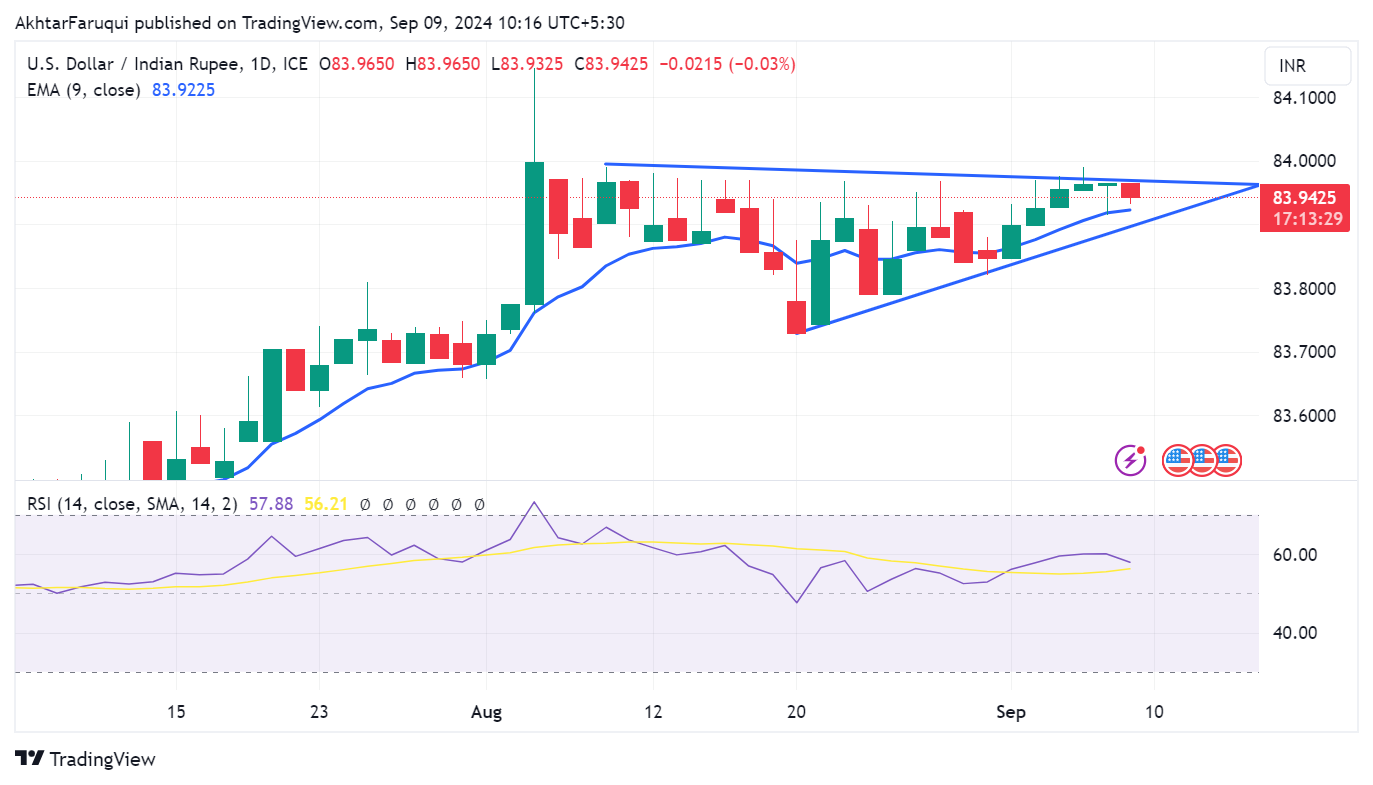
The Indian Rupee trades around 84.00 on Monday. Analysis of the daily chart shows that the USD/INR pair consolidates within the symmetrical triangle pattern, indicating a period of consolidation and a decrease in volatility. However, the 14-day Relative Strength Index (RSI) remains just above the 50 level, suggesting that the overall trend is still bullish.
On the downside, the nine-day Exponential Moving Average (EMA) at 83.92 level acts as immediate support, followed by the lower boundary of the symmetrical triangle around the level of 83.90. A break below this level could reinforce the bearish bias and put downward pressure on the USD/INR pair to revisit its six-week low at 83.72 level. Consequently, a decline below the 50 level on the RSI could indicate a shift toward a bearish bias.
In terms of resistance, the USD/INR pair tests the upper boundary of the symmetrical triangle at the 84.00 level. A breakthrough above this level could lead the pair to explore the region around its recent high of 84.14 level, recorded on August 5.
USD/INR: Daily Chart
Indian economy FAQs
The Indian economy has averaged a growth rate of 6.13% between 2006 and 2023, which makes it one of the fastest growing in the world. India’s high growth has attracted a lot of foreign investment. This includes Foreign Direct Investment (FDI) into physical projects and Foreign Indirect Investment (FII) by foreign funds into Indian financial markets. The greater the level of investment, the higher the demand for the Rupee (INR). Fluctuations in Dollar-demand from Indian importers also impact INR.
India has to import a great deal of its Oil and gasoline so the price of Oil can have a direct impact on the Rupee. Oil is mostly traded in US Dollars (USD) on international markets so if the price of Oil rises, aggregate demand for USD increases and Indian importers have to sell more Rupees to meet that demand, which is depreciative for the Rupee.
Inflation has a complex effect on the Rupee. Ultimately it indicates an increase in money supply which reduces the Rupee’s overall value. Yet if it rises above the Reserve Bank of India’s (RBI) 4% target, the RBI will raise interest rates to bring it down by reducing credit. Higher interest rates, especially real rates (the difference between interest rates and inflation) strengthen the Rupee. They make India a more profitable place for international investors to park their money. A fall in inflation can be supportive of the Rupee. At the same time lower interest rates can have a depreciatory effect on the Rupee.
India has run a trade deficit for most of its recent history, indicating its imports outweigh its exports. Since the majority of international trade takes place in US Dollars, there are times – due to seasonal demand or order glut – where the high volume of imports leads to significant US Dollar- demand. During these periods the Rupee can weaken as it is heavily sold to meet the demand for Dollars. When markets experience increased volatility, the demand for US Dollars can also shoot up with a similarly negative effect on the Rupee.
Author

Akhtar Faruqui
FXStreet
Akhtar Faruqui is a Forex Analyst based in New Delhi, India. With a keen eye for market trends and a passion for dissecting complex financial dynamics, he is dedicated to delivering accurate and insightful Forex news and analysis.