|

USD/CHF Price Prediction: Pull back unfolding after higher high

  • USD/CHF is correcting back after peaking as it extends its uptrend. 
  • The pair will probably resume its bullish bias after the pull back has completed. 

USD/CHF is pulling back within its short-term uptrend after peaking at 0.8642 on Monday. The move is only likely to be a temporary correction, however, before the pair resumes its uptrend and extends its sequence of higher highs and higher lows. 

USD/CHF 4-hour Chart 
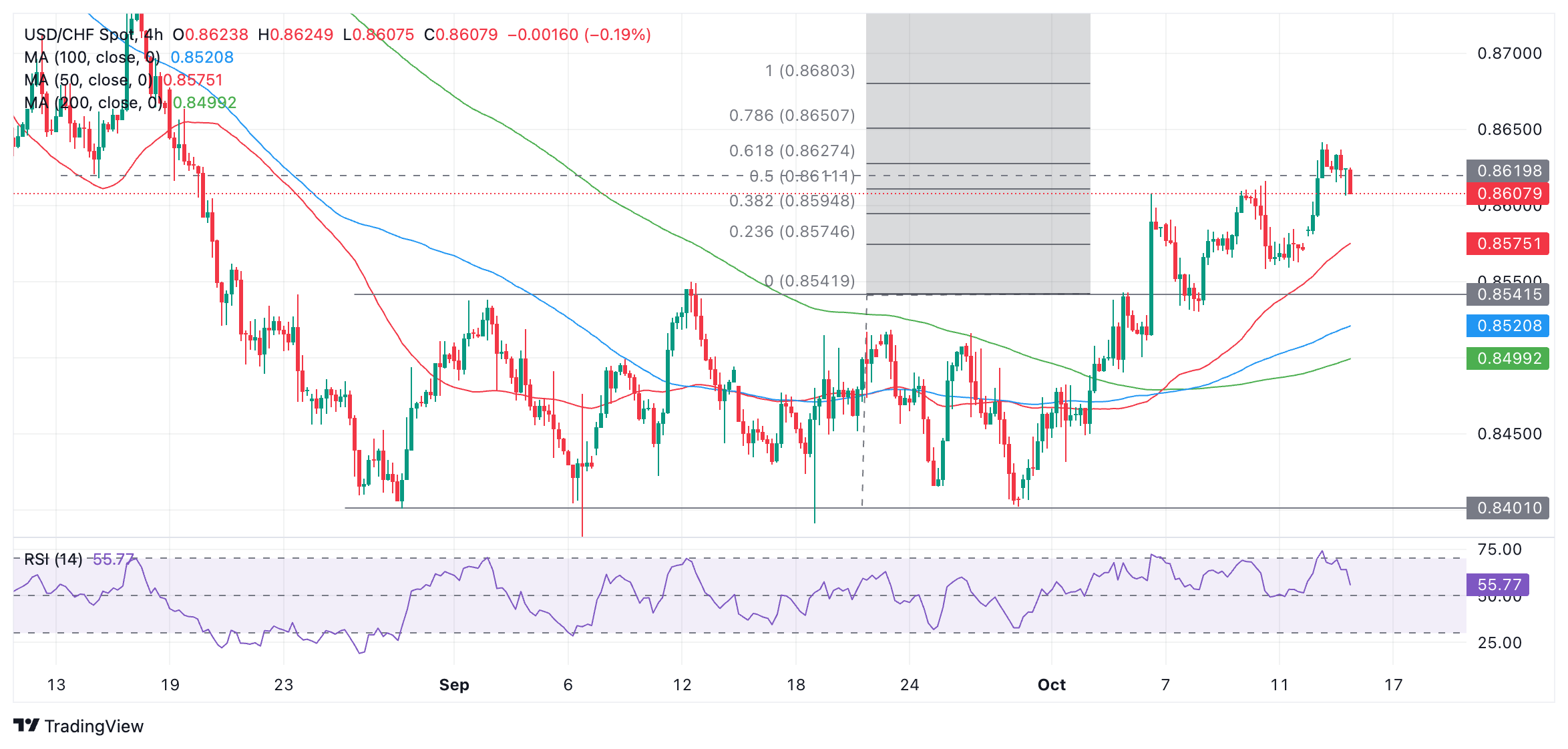
USD/CHF will probably reach the target generated after it broke out of the range, at 0.8680, the 100% Fibonacci (Fib) extrapolation of the height of the range higher. It has already met the conservative target at 0.8627, the 61.8% Fib level.

The Relative Strength Index (RSI) has exited the overbought region giving traders a signal to liquidate their long positions and sell short. 

A chart gap opened on Monday morning and there is a risk the market could pull back all the way to fill this gap. If so, it could correct down to 0.8574. It would require a break below the former range highs at 0.8541 to confirm a probable change of trend. 

Author

Joaquin Monfort

Joaquin Monfort is a financial writer and analyst with over 10 years experience writing about financial markets and alt data. He holds a degree in Anthropology from London University and a Diploma in Technical analysis.


More from Joaquin Monfort
Share:

Editor's Picks

AUD/USD hangs near two-month low, below 0.6950 as USD preserves its bullish tone

AUD/USD consolidates near a two-month low, trading just below mid-0.6900s during the Asian session on Thursday amid a bullish US Dollar. The US PCE data tempered October Fed hike bets, though oil-driven inflation fears remain supportive of elevated US bond yields. Adding to this, geopolitical uncertainty underpins the buck, which, along with the RBA's cautious outlook, acts as a headwind for the currency pair.


USD/JPY advances to weekly top, around 157.75 as bullish USD counters intervention risks

USD/JPY recovers further from a one-and-a-half-week low, touched the previous day, climbing to the top end of its weekly range during the Asian session on Thursday. Despite the softer US PCE data, oil-driven inflation risks keep US bond yields elevated near multi-year highs. Moreover, the US-Iran standoff benefits the safe-haven US Dollar and supports the currency pair. However, BoJ rate hike bets and intervention fears could limit losses for the Japanese Yen, warranting caution for bulls.

Gold trades below $4,150 as elevated US bond yields and Iran risks support USD

Gold drifts lower for the second straight day on Thursday, looking to extend the previous day's pullback from $4,220. Oil-driven inflation risks counter softer US PCE data and support elevated US bond yields, undermining the non-yielding bullion. Moreover, geopolitical uncertainties allow the safe-haven US Dollar to retain its bullish undertone, further weighing on the commodity.

Ethereum: Leverage capital cools to lowest level since March amid consolidation
Ethereum (ETH) remains range-bound on Wednesday, with leverage capital continuing to dwindle despite lower-than-expected inflation data. Open interest, the total value of outstanding contracts in a derivatives market, in the top altcoin has trended down over the past week, reaching 12.49 million ETH, its lowest level since March 1.
The Fed's October hike shrinks with the inflation it was built on

Traders have moved the next Federal Reserve hike from October 28 to December 9, and the inflation report that added to the move said more about July than August. The government's annual rewrite, published alongside the August Personal Consumption Expenditures Price Index, cut July's core reading, which leaves out food and energy, from 3.3% to 3%.

The Euro is near a one-year low: Inflation could trigger its rebound, not its fall

EUR/USD has fallen to its lowest level since May 2025, but a fresh inflation shock in the Eurozone could give the Euro (EUR) an unexpected lifeline. The pair hit 1.1312 on Wednesday and trades well below the January peak of 1.2082.