The New Zealand Dollar edges lower as US yields outweigh China's beats
- NZD/USD edges lower and closes under 0.5650 for a second session.
- An RBNZ hike to 3% on October 28 is about 80% priced.
- China's official services index at 50.2 against a 49.3 forecast.

The Kiwi has followed US bond yields all month, and better numbers from New Zealand's biggest export market didn't change that on Wednesday. China's official services index came in at 50.2 against a 49.3 forecast, and the private services and factory gauges beat as well. NZD/USD still closed lower, its second close in a row under 0.5650, and it lost more than 4% in September. China's services index beat by nine tenths of a point and the Kiwi finished lower than it opened.
Markets price a hike the RBNZ's own forecast didn't
The Reserve Bank of New Zealand (RBNZ) raised its Official Cash Rate (OCR) to 2.75% on September 2, and its own projected path pointed to a pause in October and a hike in December. Markets now price about an 80% chance of a hike to 3% on October 28. ANZ's business survey showed confidence easing to about 52 from 54, with higher fuel prices weighing on late responses, and firms' pricing intentions slipped to 48 from 51.
Even at 3%, the OCR would be three-quarters of a point below the bottom of the Fed's 3.75-4.00% range, so the Kiwi's rate gap to the Dollar stays negative whatever the RBNZ does. An October hike would cut that gap from a full point to three-quarters of one, which is a lot of pricing for a quarter-point.
Consumer confidence might matter if the hike weren't already priced
ANZ-Roy Morgan consumer confidence is due Thursday at 21:00 GMT, last at 98. The Institute for Supply Management (ISM) survey of US factories on Thursday and Friday's Nonfarm Payrolls, expected to show 90K new jobs, carry more weight for NZD/USD because they move the US yields it has been following. New Zealand votes on November 7, ten days after the RBNZ decides. August building permits rose 5.6% after a 4.3% fall in July, and the Kiwi fell through both months.
NZD/USD levels with momentum pinned low
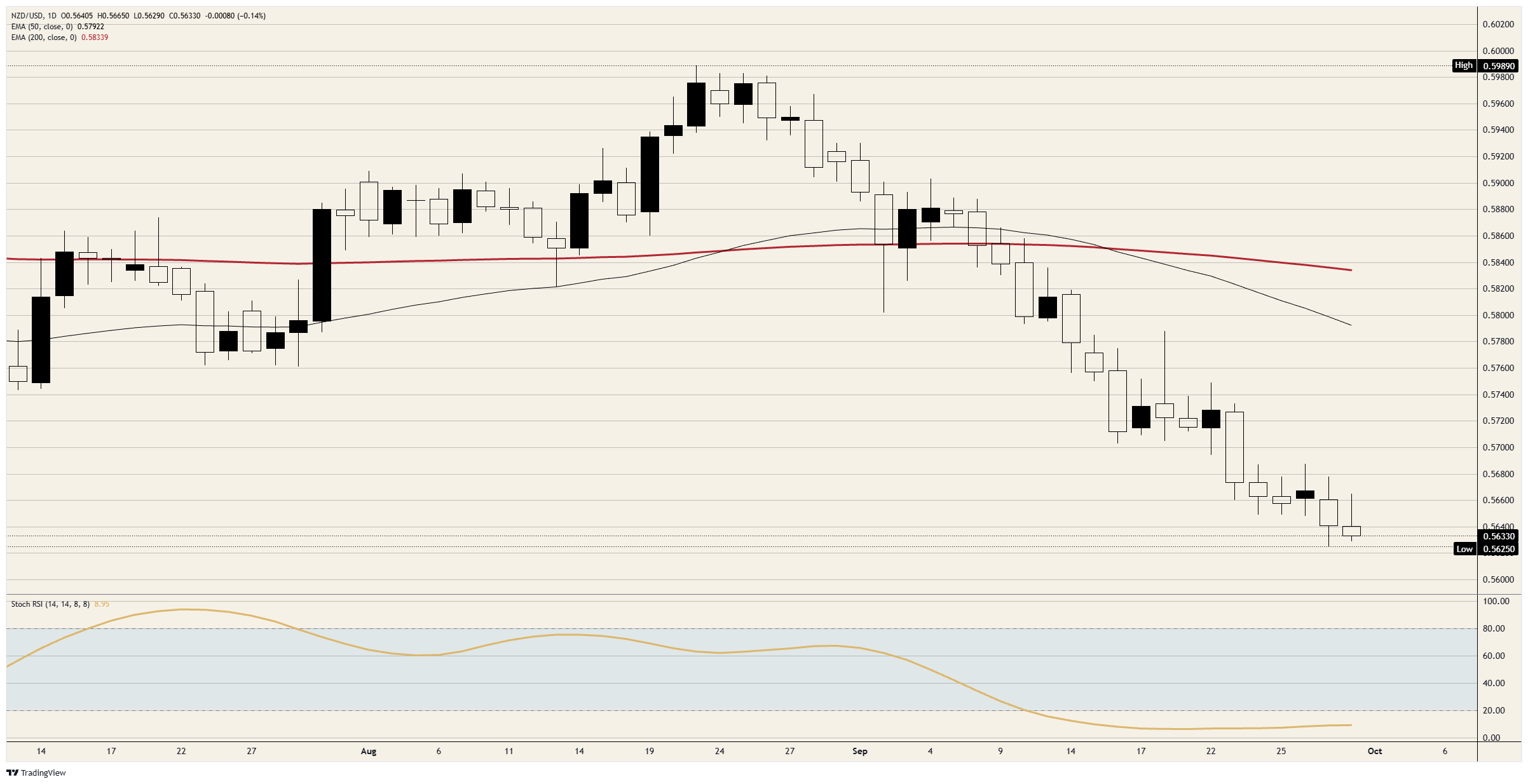
Resistance: Wednesday's high just above 0.5650 is the first level. 0.5700 has capped every session since September 23.
Support: 0.5600 sits just below Tuesday's low, which was the Kiwi's lowest since June. 0.5550 is next.
Bias: Risk-reward stays skewed lower below 0.5700, with 0.5600 the first objective and 0.5550 the second. Daily momentum is stretched rather than finished: the Stochastic Relative Strength Index (Stoch RSI) has stayed under 20 since mid-September and reads near 9. A daily close above 0.5700 would end the short.
NZD/USD daily chart
New Zealand Dollar FAQs
The New Zealand Dollar (NZD), also known as the Kiwi, is a well-known traded currency among investors. Its value is broadly determined by the health of the New Zealand economy and the country’s central bank policy. Still, there are some unique particularities that also can make NZD move. The performance of the Chinese economy tends to move the Kiwi because China is New Zealand’s biggest trading partner. Bad news for the Chinese economy likely means less New Zealand exports to the country, hitting the economy and thus its currency. Another factor moving NZD is dairy prices as the dairy industry is New Zealand’s main export. High dairy prices boost export income, contributing positively to the economy and thus to the NZD.
The Reserve Bank of New Zealand (RBNZ) aims to achieve and maintain an inflation rate between 1% and 3% over the medium term, with a focus to keep it near the 2% mid-point. To this end, the bank sets an appropriate level of interest rates. When inflation is too high, the RBNZ will increase interest rates to cool the economy, but the move will also make bond yields higher, increasing investors’ appeal to invest in the country and thus boosting NZD. On the contrary, lower interest rates tend to weaken NZD. The so-called rate differential, or how rates in New Zealand are or are expected to be compared to the ones set by the US Federal Reserve, can also play a key role in moving the NZD/USD pair.
Macroeconomic data releases in New Zealand are key to assess the state of the economy and can impact the New Zealand Dollar’s (NZD) valuation. A strong economy, based on high economic growth, low unemployment and high confidence is good for NZD. High economic growth attracts foreign investment and may encourage the Reserve Bank of New Zealand to increase interest rates, if this economic strength comes together with elevated inflation. Conversely, if economic data is weak, NZD is likely to depreciate.
The New Zealand Dollar (NZD) tends to strengthen during risk-on periods, or when investors perceive that broader market risks are low and are optimistic about growth. This tends to lead to a more favorable outlook for commodities and so-called ‘commodity currencies’ such as the Kiwi. Conversely, NZD tends to weaken at times of market turbulence or economic uncertainty as investors tend to sell higher-risk assets and flee to the more-stable safe havens.
Author

Joshua Gibson
FXStreet
Joshua joins the FXStreet team as an Economics and Finance double major from Vancouver Island University with twelve years' experience as an independent trader focusing on technical analysis.
















