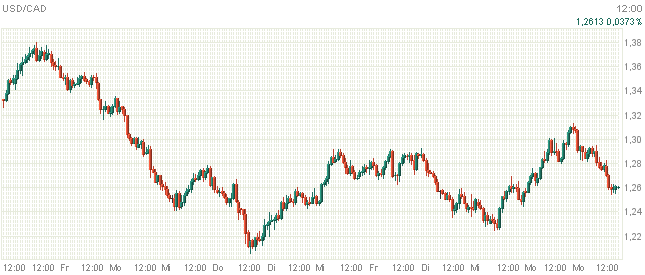
USD/CAD struggling to develop upward momentum above 1.26
- The Loonie is getting a boost from crude oil and NAFTA renegotiations.
- The BoC's rate decision this week promises some action, though the bank may stand pat.

The USD/CAD lifted steadily through Monday's Asia session after gapping lower to kick off the new week.
This week sees a potential rate hike from the Bank of Canada (BoC), as well as the BoC's Monetary Policy Report, all happening on Wednesday, while the US side will kick things off with Retail Sales in the Monday New York session at 12:30 GMT. Core Retail Sales for March are expected at 0.3 percent, a slight uptick from the previous reading of 0.2.
The CAD is also receiving a boost from Higher oil prices following last week's ramp-up in Middle East tensions that peaked with coordinated missile strikes on Syrian targets in retaliation for chemical weapons attacks undertaken by Bashar al-Assad, while NAFTA is also providing a boost for the Loonie as participants in the ongoing negotiations remain hopeful for a satisfactory conclusion, despite failing to rough together a draft framework in time for the Americas Summit in Lima as US President Trump had initially demanded.
USD/CAD Levels to watch
As FXStreet's own Yohay Elam noted recently, "The USD/CAD broke below critical support and continued downhill from there. On the way, it pierced through the 50-day Simple Moving Average and eventually the 200-day SMA. The upside cross of these two lines has not resulted in a recovery. The RSI shows that the pair leans lower, but nears oversold territory. Momentum is robust to the downside. Support appears at the mid-April lows of $1.2550, a triple-bottom on the chart. Further below, we are back to levels last seen in mid-February: 1.2450. Even lower, the round number of 1.2400 works as the next line of support. Looking up, there are plenty of resistance lines. 1.2630 capped the pair in mid-April and is also where the 200-day SMA comes out. Further above, 1.2680 was a swing high in early February. Even higher, 1.2760 was another swing higher later that month.
Author

Joshua Gibson
FXStreet
Joshua joins the FXStreet team as an Economics and Finance double major from Vancouver Island University with twelve years' experience as an independent trader focusing on technical analysis.
















