USD/CAD Price Forecast: Posts fresh two-month low below 1.3900
- USD/CAD trades lower as the Canadian Dollar gains.
- The US and Canada are close to reaching a deal before the tariff deadline.
- Investors expect the Fed to leave policy rates unchanged again in September.

The Canadian Dollar (CAD) outperforms a majority of its currency peers on Friday, with the USD/CAD pair trading 0.32% lower at around 1.3888. The Canadian currency gains on hopes of a United States (US)-Canada interim deal.
A Canadian government source directly familiar with trade negotiations with the United States said on Thursday that talks were progressing well and Washington also wanted an agreement before a new US tariff deadline on August 19, Reuters reports.
Meanwhile, weakness in the US Dollar due to receding fears of a Federal Reserve (Fed) interest rate hike in the September meeting has also weighed on the Loonie pair. At press time, the US Dollar Index (DXY), which gauges the Greenback’s value against six major currencies, trades 0.23% lower to near 99.70.
Fed patience holds as US inflation trend improves but remains above target
Analysts at Wells Fargo observe that “inflation remains elevated, but the trend is improving,” noting that “while inflation remains above target, the recent upturn appears narrow rather than broad-based.” Against this backdrop, they judge that “the Fed remains stuck on hold,” with policymakers reluctant to shift policy until they see clearer evidence that price pressures are durably contained.
Commerzbank’s Bernd Weidensteiner similarly highlights that the inflation data for July “indicated only moderate inflationary pressure; consumer prices excluding food and energy rose by 0.2% from the previous month, while the year-over-year rate fell slightly to 2.5%.” He adds that, although this outcome was broadly in line with expectations, “these figures, combined with the unexpectedly weak jobs data, eased the pressure on the Fed to raise its key interest rates anytime soon.” Together, the banks’ commentary underscores a picture of gradually improving but still above-target US inflation, reinforcing the case for the Fed to remain on hold for now.
USD/CAD Technical Analysis
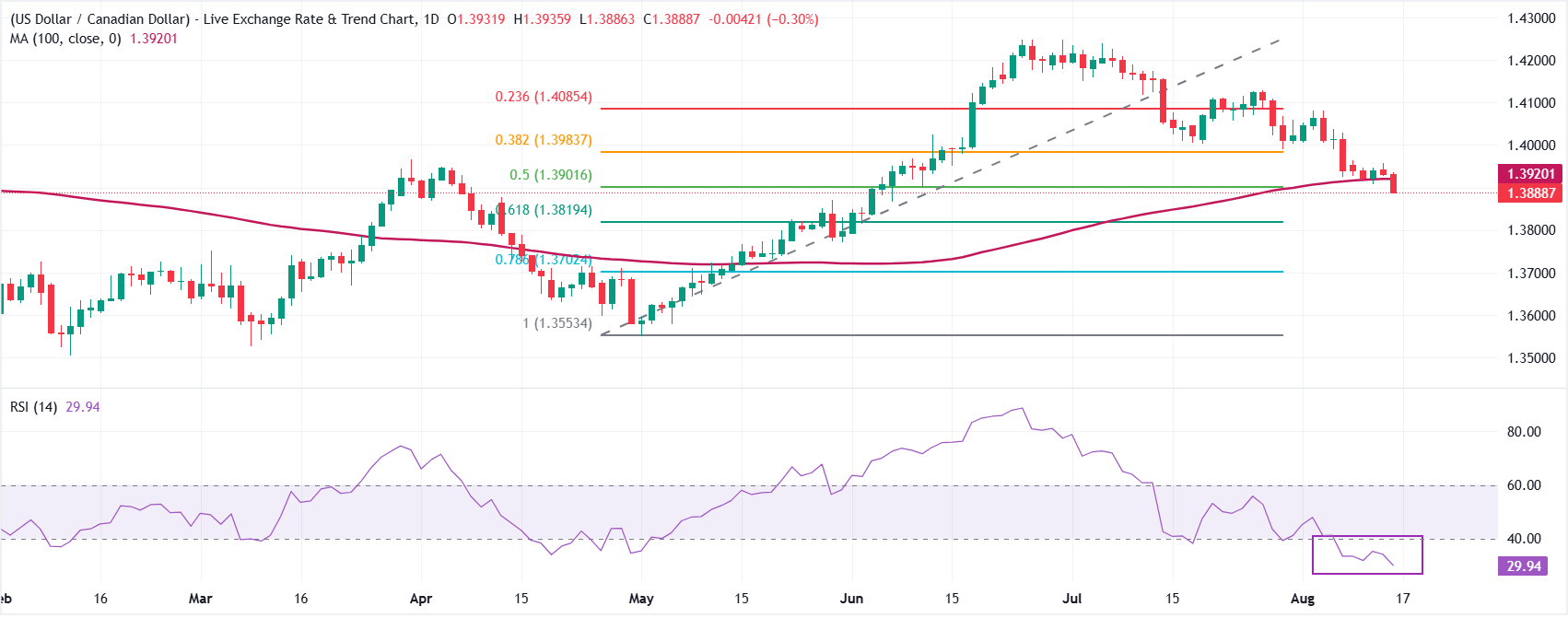
USD/CAD trades lower at around 1.3888, keeping a bearish near‑term tone as spot holds under the 100‑day simple moving average (SMA) at 1.3920 and the 50.0% Fibonacci retracement at 1.3902. The pair has retreated from recent highs toward the middle of the prior upswing range, while the Relative Strength Index (14) at 29.95 slips into oversold territory, hinting that downside momentum is stretched but not yet reversed.
On the topside, immediate resistance is located at the 50.0% retracement of the latest move at 1.3902, followed by the 100‑day SMA at 1.3920; a sustained break above this band would ease the current bearish pressure and expose the 38.2% level at 1.3984 and then the 23.6% retracement at 1.4085. On the downside, initial support is seen at the 61.8% Fibonacci retracement at 1.3819, ahead of the 78.6% level at 1.3702, while deeper losses would bring the structural swing low region near the 100.0% retracement at 1.3553 into focus.
(The technical analysis of this story was written with the help of an AI tool. Know more.)
Fed FAQs
Monetary policy in the US is shaped by the Federal Reserve (Fed). The Fed has two mandates: to achieve price stability and foster full employment. Its primary tool to achieve these goals is by adjusting interest rates. When prices are rising too quickly and inflation is above the Fed’s 2% target, it raises interest rates, increasing borrowing costs throughout the economy. This results in a stronger US Dollar (USD) as it makes the US a more attractive place for international investors to park their money. When inflation falls below 2% or the Unemployment Rate is too high, the Fed may lower interest rates to encourage borrowing, which weighs on the Greenback.
The Federal Reserve (Fed) holds eight policy meetings a year, where the Federal Open Market Committee (FOMC) assesses economic conditions and makes monetary policy decisions. The FOMC is attended by twelve Fed officials – the seven members of the Board of Governors, the president of the Federal Reserve Bank of New York, and four of the remaining eleven regional Reserve Bank presidents, who serve one-year terms on a rotating basis.
In extreme situations, the Federal Reserve may resort to a policy named Quantitative Easing (QE). QE is the process by which the Fed substantially increases the flow of credit in a stuck financial system. It is a non-standard policy measure used during crises or when inflation is extremely low. It was the Fed’s weapon of choice during the Great Financial Crisis in 2008. It involves the Fed printing more Dollars and using them to buy high grade bonds from financial institutions. QE usually weakens the US Dollar.
Quantitative tightening (QT) is the reverse process of QE, whereby the Federal Reserve stops buying bonds from financial institutions and does not reinvest the principal from the bonds it holds maturing, to purchase new bonds. It is usually positive for the value of the US Dollar.
Author

Sagar Dua
FXStreet
Sagar Dua is associated with the financial markets from his college days. Along with pursuing post-graduation in Commerce in 2014, he started his markets training with chart analysis.