USD/CAD Price Forecast: Corrects to near 1.3800 as Fed rate cut bets weigh on US Dollar
- USD/CAD falls to near 1.3800 after failing extend five-day winning streak.
- Traders seem confident that the Fed will cut interest rates in the policy meeting in September.
- Canadian employers fired 65.5K workers in August.

The USD/CAD pair retraces to near 1.3800 at the start of the week from its weekly high of 1.3855 posted on Friday. The Loonie pair fails to continue its five-day winning streak as the US Dollar faces selling pressure amid firm expectations that the Federal Reserve (Fed) will cut interest rates in the policy meeting next week.
At the time of writing, the US Dollar Index (DXY), which tracks the Greenback’s value against six major currencies, trades slightly lower to near 97.60.
According to the CME FedWatch tool, traders see a 10% chance that the Fed will cut interest rates by 50 basis points (bps) to 3.75%-4.00%, while the rest point a 25-bps interest rate reduction.
Fed dovish speculation intensified after the release of the United States Nonfarm Payrolls (NFP) data for August on Friday, which showed that downside risks to labor market warned by Federal Open Market Committee (FOMC) members, including Chair Jerome Powell, in their latest commentaries are real.
Meanwhile, the outlook of the Canadian Dollar (CAD) is also uncertain as a surprise decline in the Canadian labor force in August has prompted hopes that the Bank of Canada (BoC) will resume its monetary-easing campaign in the policy meeting this month, which it paused earlier this year.
The Canadian employment report for August showed on Friday that employment laid-off 65.5K workers, while they were anticipated to have hired fresh 7.5K job-seekers. The Unemployment Rate came in higher at 7.1%, against expectations of 7% and the prior reading of 6.9%.
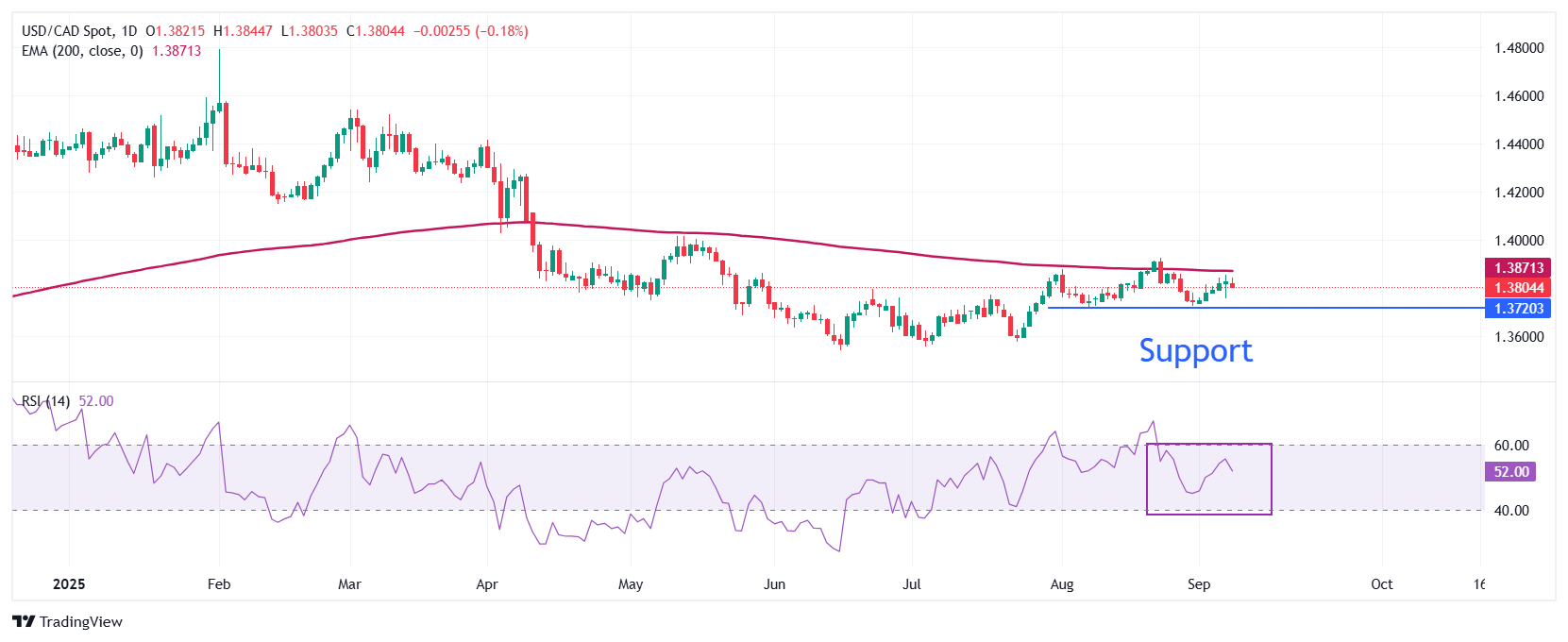
USD/CAD stays below the 200-day Exponential Moving Average (EMA), which trades around 1.3870, suggesting that the overall trend is bearish.
The 14-day Relative Strength Index (RSI) oscillates inside the 40.00-60.00 range, indicating a sideways trend.
Going forward, the asset could slide towards the round level of 1.3600 and June 16 low of 1.3540 if it breaks below the August 7 low of 1.3722.
On the flip side, a recovery move by the pair above the August 22 high of 1.3925 would open the door towards the May 15 high of 1.4000, followed by the April 9 low of 1.4075.
USD/CAD daily chart
Employment FAQs
Labor market conditions are a key element to assess the health of an economy and thus a key driver for currency valuation. High employment, or low unemployment, has positive implications for consumer spending and thus economic growth, boosting the value of the local currency. Moreover, a very tight labor market – a situation in which there is a shortage of workers to fill open positions – can also have implications on inflation levels and thus monetary policy as low labor supply and high demand leads to higher wages.
The pace at which salaries are growing in an economy is key for policymakers. High wage growth means that households have more money to spend, usually leading to price increases in consumer goods. In contrast to more volatile sources of inflation such as energy prices, wage growth is seen as a key component of underlying and persisting inflation as salary increases are unlikely to be undone. Central banks around the world pay close attention to wage growth data when deciding on monetary policy.
The weight that each central bank assigns to labor market conditions depends on its objectives. Some central banks explicitly have mandates related to the labor market beyond controlling inflation levels. The US Federal Reserve (Fed), for example, has the dual mandate of promoting maximum employment and stable prices. Meanwhile, the European Central Bank’s (ECB) sole mandate is to keep inflation under control. Still, and despite whatever mandates they have, labor market conditions are an important factor for policymakers given its significance as a gauge of the health of the economy and their direct relationship to inflation.
Author

Sagar Dua
FXStreet
Sagar Dua is associated with the financial markets from his college days. Along with pursuing post-graduation in Commerce in 2014, he started his markets training with chart analysis.