|

USD/CAD Price Analysis: Rebound from monthly support eyes 1.2670 hurdle

  • USD/CAD pares intraday losses during a three-day downtrend.
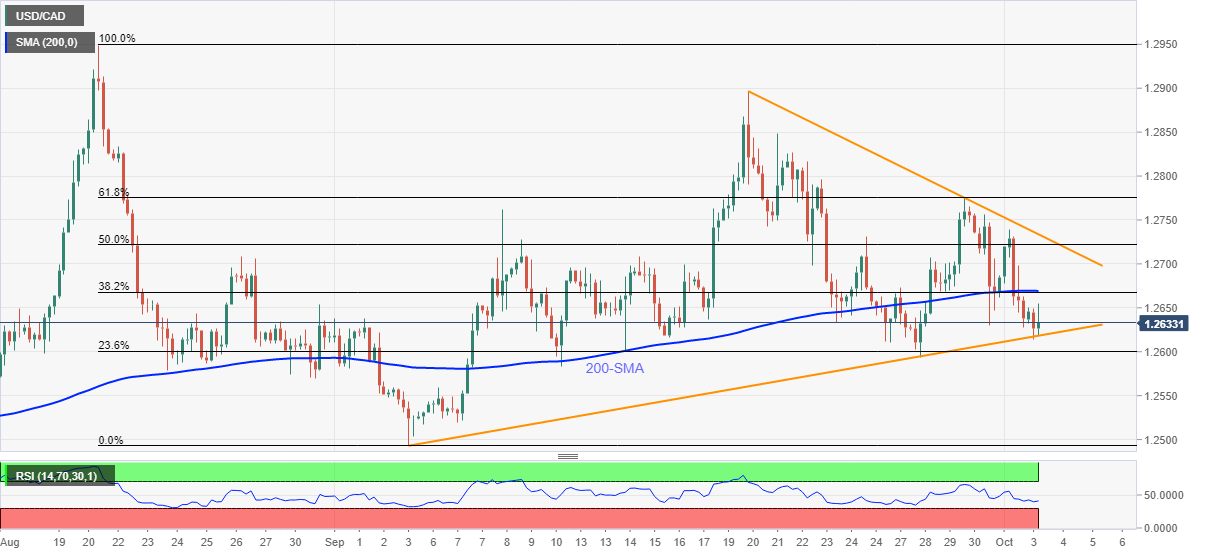
  • Monthly support line, challenges bears, bulls seek 200-SMA, 38.2% Fibo. breakout for fresh entry.

USD/CAD licks its wounds around 1.2630, down 0.10% intraday, ahead of Monday’s European session.

In doing so, the Loonie pair stays negative for the third consecutive day but an ascending support line from early September defends buyers.

However, a confluence of the 200-SMA and 38.2% Fibonacci retracement (Fibo.) of the late August to early September downside, near 1.2670, questions the pair’s immediate upside.

Also acting as an upside filter is a downward sloping trend line from September 20, near 1.2735.

Should the quote rise past 1.2735, 61.8% Fibo. level of 1.2775 and the last month’s top surrounding 1.2900 will be in focus.

Alternatively, a downside break of the immediate support line close to 1.2615 will be challenged by the 1.2600 threshold and the weak RSI conditions, not to forget the previous week’s swing low near 1.2590.

In a case where USD/CAD remains pressured past 1.2590, September’s low around 1.2490 should return to the chart.

USD/CAD: Four-hour chart
Trend: Corrective pullback expected

Additional important levels

Overview
Today last price1.2634
Today Daily Change-0.0012
Today Daily Change %-0.09%
Today daily open1.2646
 
Trends
Daily SMA201.2688
Daily SMA501.2625
Daily SMA1001.2459
Daily SMA2001.2519
 
Levels
Previous Daily High1.2739
Previous Daily Low1.2628
Previous Weekly High1.2775
Previous Weekly Low1.2594
Previous Monthly High1.2896
Previous Monthly Low1.2494
Daily Fibonacci 38.2%1.267
Daily Fibonacci 61.8%1.2697
Daily Pivot Point S11.2603
Daily Pivot Point S21.256
Daily Pivot Point S31.2491
Daily Pivot Point R11.2714
Daily Pivot Point R21.2783
Daily Pivot Point R31.2826

Author

Anil Panchal

Anil Panchal

FXStreet

Anil Panchal has nearly 15 years of experience in tracking financial markets. With a keen interest in macroeconomics, Anil aptly tracks global news/updates and stays well-informed about the global financial moves and their implications.


More from Anil Panchal
Share:

Editor's Picks

AUD/USD falls to near 0.7100 after slipping below 50-day EMA

AUD/USD depreciates after registering minor gains in the previous day, trading around 0.7120 during the Asian hours. The technical analysis of the daily chart shows the pair consolidating sideways within a rectangle pattern, as neither bulls nor bears gain control. The AUD/USD pair is holding a slight bearish tone however as it sits beneath both the nine-day and 50-day EMAs.

160.00: USD/JPY back near intervention territory after upbeat US jobs report

US Nonfarm Payrolls beat expectations by a wide margin in May, with 172K jobs added. The US Dollar rebounds after the release, helping USD/JPY recover from its intraday lows. Warnings from Japanese authorities continue to limit upside potential near the 160.00 threshold.

Gold weakens to three-month lows near $4,300

Gold faces increasing selling interest and approaches the area of three-month lows near the $4,300 mark per troy ounce on Friday. The precious metal’s decline comes as traders assess the stronger-than-expected NFP, while the bid bias in the Greenback and higher US Treasury yields also collaborate with the retracement.

Cardano hits five-year low even as Hoskinson clarifies "break" isn't an exit

Cardano (ADA) price is down 10% at press time on Friday, extending losses over 30% so far this week amid Charles Hoskinson's clarification that "break" isn't an exit.

Week ahead – Fed countdown begins amid US inflation data and geopolitical risks

Fed Chair Warsh’s first meeting approaches as key US inflation data could reshape expectations. Oil prices remain elevated as US-Iran talks continue; tariffs also return to the spotlight. ECB is expected to hike; will it be a one-off move or is July live?

The US economy defies the rules: 100 days into the Oil shock and the recession signal is still missing

More than three months after the start of the Iran war and the resulting disruption to global energy markets, the US economy continues to display remarkable resilience. The conflict has triggered a sharp rise in Oil prices, reignited inflationary pressures and fueled widespread concerns about a potential economic slowdown.