US stocks dive on Monday as CEOs mull AI 'slowdown', soaring Oil and Fed hike
- AI stocks lead the sell-off on Monday as CEOs call for oversight.
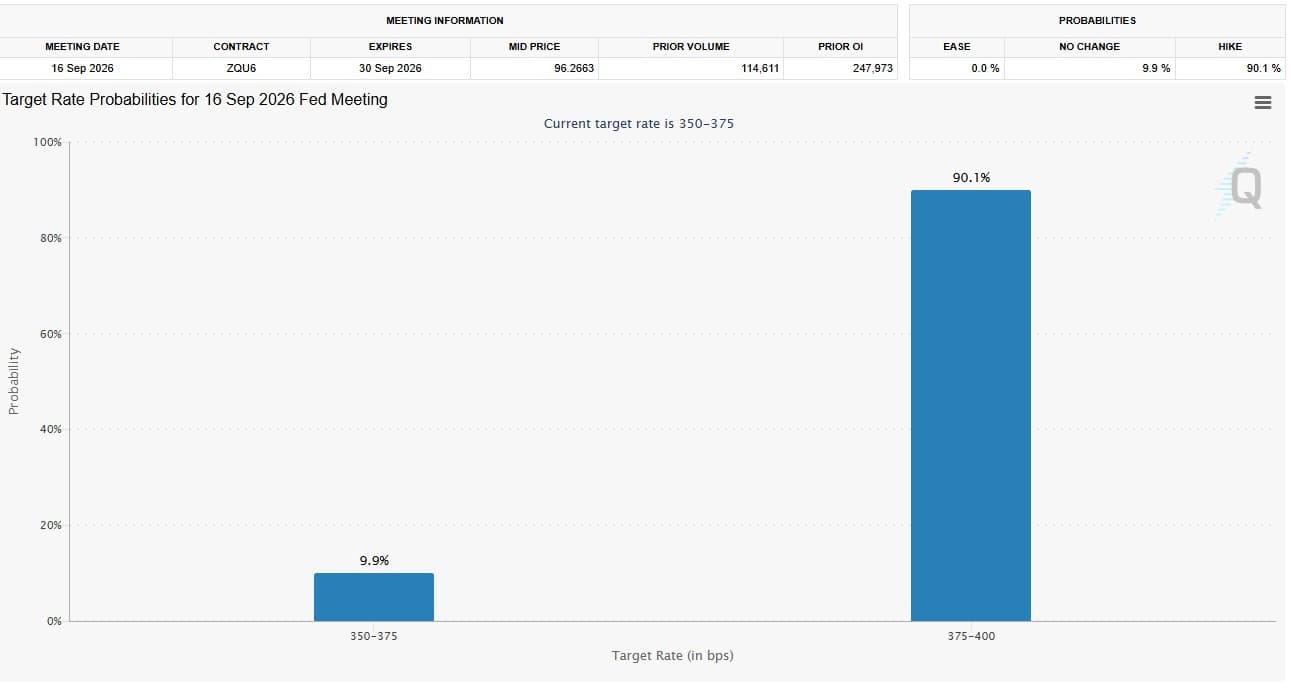
- Odds of the Fed hiking interest rates on Wednesday jumped to 90%.
- Oil prices in the US jump over 3% following Ansar Allah's weekend battlefield success.

The US stock market is taking a step back on Monday as investors retreat in light of a multitude of scary headwinds.
Over the weekend, the leading CEOs of US AI shops agreed that progress on AI models should be slowed down in order to introduce safeguards to frontier models — an event that threatens to curtail the growth outlook for many leading AI industry suppliers. Simultaneously, Oil prices rose as much as 4% at the start of this week after Ansar Allah in Yemen produced battlefield gains against Saudi Arabia that threaten to halt over 4 million barrels a day of Crude output. Third, odds of the Federal Reserve (Fed) raising interest rates on Wednesday have risen from 60% a week ago to 90% on Monday.
At the time of writing, the NASDAQ Composite has declined 1.2%, the S&P 500 has given up 0.8%, and the Dow Jones Industrial Average (DJIA) is off 0.5%.
There are plenty of reasons to sell stocks: First up, Oil
The stock market has absolutely seen worse days from a sell-off standpoint, but the number of reasons to be bearish is unusually high.
Oil (WTI) has risen between 3%-4% on Monday to sit near $100/barrel as Ansar Allah pushed Saudi forces off the coast of Yemen over the weekend. The Yemeni rebels took over the Yemeni city of Mocha on the Red Sea Coast, which will allow them to put heavier pressure on the Bab al-Mandeb strait, where a significant portion of the global Oil trade transits.
Additionally, the rebels bombed Saudi Arabia's East-West pipeline that could take weeks to repair. That pipeline normally carries about 4.5 million barrels a day to tanker customers on the Red Sea coast in Saudi Arabia, just over the border from Yemen. The weekend tumult means that pressure from Iran over the Strait of Hormuz has risen and could force further pressure on global Oil output in the months to come.
As it happened, Saudi forces and those loyal to the internationally recognized government of Yemen retreated from the battlefield, leaving behind hundreds of millions of Dollars worth of US military hardware. This leads many geopolitical experts to expect that Ansar Allah will only grow more confident and likely attack more significant Saudi Oil infrastructure.
Saudi Crown Prince and Prime Minister Mohammed bin Salman met Admiral Brad Cooper, the head of US Central Command, in Jeddah on Monday. According to Axios, the Crown Prince asked the US to bomb Ansar Allah positions in Yemen last week, but the Trump administration rebuffed him. Monday's meeting cements the idea that the US and its Saudi ally could broaden the war that is currently focused on Iran.
Higher Oil prices are generally bearish for stock prices as consumers shift spending away from other purchases toward gasoline and diesel. They can raise inflation rates in the short term and can even lead to economic recessions on occasion.
AI slowdown? Trump says 'no'
Anthropic CEO Dario Amodei released a blog post on Saturday that could be the start of a broad deceleration in AI investment. Amodei claimed that AI progress is so exponential that the industry needs to allow guardrails and possibly government oversight of frontier models in order to protect society from possible catastrophe.
“If left to proceed without guardrails, it risks advancing beyond our capacity to understand or govern it, and must therefore be approached with extreme caution — if pursued at all," wrote Amodei.
The surprising thing is that both xAI boss Elon Musk and OpenAI CEO Sam Altman both claimed to agree with Amodei's sentiment.
While it wasn't specified whether government officials would be called in to provide oversight of frontier AI models, Amodei said there needed to be a "speed limit" for progress.
Investors took that to mean a reduced pace of investment, and shares of the leading AI data center supplier sold off. Memory chip suppliers Sandisk (SNDK) and Micron (MU) both gave up 7% at the open, while Nvidia (NVDA) close to 3% and Coherent (COHR) lost 10%.
But when President Donald Trump was asked about the need to pullback from the relentless pace of AI investment, he said that only heavy investment could sustain the US' lead over China.
Odds of Fed hike rise to 90%
The most immediate concern for equity bulls has to be the much higher odds of a rate hike. The Federal Open Market Committee meets on Tuesday and Wednesday this week, and the market now expects a 25-basis-point rate hike.
The odds were closer to 60% at the start of September after Fed Governor Christopher Waller said that he was leaning toward a hold. He is considered the tying vote. But the CME Group's FedWatch Tool shows that the market is betting heavily on a rate hike after last week's US inflation releases. Last Thursday, the Producer Price Index (PPI) showed that annual wholesale inflation was well above 5% in August, and Friday's Consumer Price Index (CPI) showed that core inflation was higher than consensus on a monthly level.
A hike on Wednesday is now being priced into stocks as investors foresee higher interest rates encroaching on future profit margins.
Author

Clay Webster
FXStreet
Clay Webster grew up in the US outside Buffalo, New York and Lancaster, Pennsylvania. He began investing after college following the 2008 financial crisis.

















