|

US inflation expectations drop below 2 percent for the first time since Dec. 29, 2017

  • US inflation expectations drop below the Fed's target of 2 percent.
  • Market-based measures are sensitive to oil price movements.
  • Fed tends to look past the volatile energy component of inflation and focus on core values.

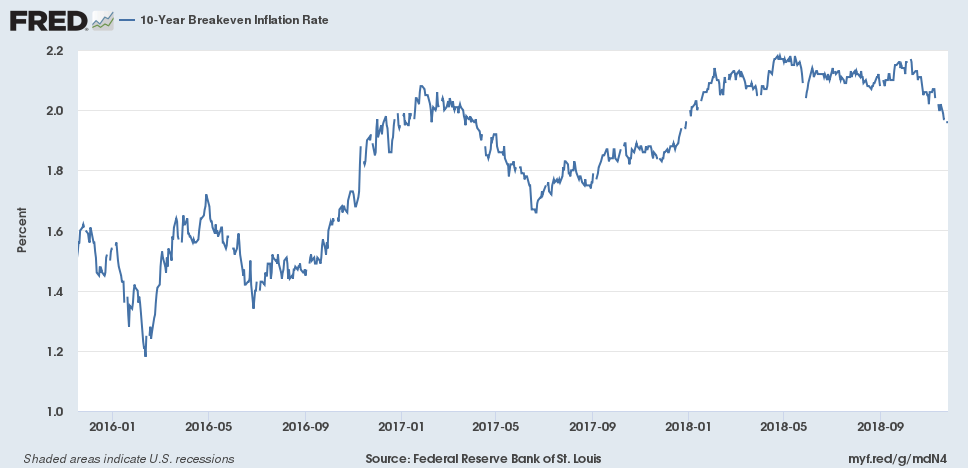
The US inflation expectations have dropped below the Fed's target of 2 percent for the first time in 11 months.

The 10-year breakeven inflation rate - the difference between the yield on the US 10-year treasury note and the 10-year treasury inflation protected securities - fell to 1.96 percent, its lowest level since Dec. 29, 2017.

That has prompted many to scale back expectations of an extended Fed tightening cycle. St. Louis Fed President James Bullard took note of the drop in the breakeven rate last week and said there is need to slow down rate hikes.

The market-based measures of inflation, however, closely following the action in oil prices and go against the Fed's policy of focusing on core values.

Simply put, the Fed may not abandon the gradual tightening path just because market-based measures of inflation expectations have dropped below 2 percent.
Author

Omkar Godbole

Omkar Godbole

FXStreet Contributor

Omkar Godbole, editor and analyst, joined FXStreet after four years as a research analyst at several Indian brokerage companies.


More from Omkar Godbole
Share:

Editor's Picks

GBP/USD edges lower below 1.3650, with eyes on US PCE data

GBP/USD trades with a negative bias below 1.3650 in the European session on Wednesday, eroding a part of the previous day's strong gains. The pair, however, remains within striking distance of a six-month top, set last Friday, as traders keenly await the release of the US Personal Consumption Expenditures (PCE) Price Index data for a fresh impetus.

EUR/USD holds lower ground near 1.1650 ahead of key US data

EUR/USD is holding lower ground toward 1.1650 in Wednesday's European session. The US Dollar is recovering modestly amid profit-taking and Middle East uncertainty. US inflation, tracked by the PCE, and another revision of Q2 GDP data should keep investors entertained on Wednesday.

Gold remains depressed below $4,650 on firmer USD; looks to US PCE for Fed rate outlook

Gold sticks to modest losses below $4,650 heading into the European session, though it lacks bearish conviction and remains confined within the previous day's broader range. The US Dollar regains positive traction amid some repositioning ahead of the US Personal Consumption Expenditures Price Index and is seen as weighing on the commodity. Adding to this, Federal Reserve Chair Kevin Warsh's remarks at the Jackson Hole Symposium on Friday might offer more cues about the interest rate path.

Dogecoin, Shiba Inu, Pepe: Profit-taking cools last week’s rally

Meme coins, including Dogecoin (DOGE), Shiba Inu (SHIB), and Pepe (PEPE), are losing their bullish momentum after last week’s double-digit gains. Facing downside pressure amid profit-taking, DOGE and PEPE risk further decline while SHIB holds at a support level.

America’s self‑inflicted trade wound
I’m conflicted about the trade war that the U.S. has started with Canada. Let’s be clear: any representation that Canada has been taking unfair advantage of the U.S. or that they have been treating us badly for years is a bogus characterization. In reality, the shoe is on the other foot. It’s the U.S. that has been behaving badly.
Canada hits US goods with tariffs; The rate market sees a problem
On September 8, Canada begins charging its own importers 15%, 25% and 50% on roughly 700 lines of American goods. The measure is billed as dollar for dollar, and on the arithmetic of covered trade it is. What it is not is a tax on the United States.














