US equities mix on Tuesday after NASDAQ backslides, DJIA pings new all-time high
- US stocks spread heading into the midweek as investors brace for Fed rate call.
- Tech stocks that initially led the latest risk rally are hesitating ahead of earnings.
- Fed set to hold rates on Wednesday, traders looking for hints about March rate cut.

US equity indexes spread on Tuesday, with the Standard & Poor’s 500 (SP500) and the Dow Jones Industrial Average (DJIA) closing in opposite directions after the DJIA clipped into a new all-time high and the SP500 closed softly lower as the tech sector drags ahead of key earnings reports and traders bracing for another rate call from the Federal Reserve (Fed) on Wednesday as US Nonfarm Payrolls (NFP) labor figures loom over the horizon on Friday.
The tech sector led US equities by the nose into all-time highs across US indexes in the recent rally, fueled in part by earnings expectations on the back of developments in the AI spheres, as investors bet big on demand for products from chipmakers to fuel tech investment in the burgeoning space. Recent earnings have started to show cracks however, with major companies like Tesla, Alphabet, and Apple missing broad-market growth expectations and adding dark clouds to the market’s previously-rosy outlook on the prospect of forever growth in the tech sector.
Fed Preview: Forecasts from 10 major banks
The Fed will be presenting its latest rate call and monetary policy statement to markets on Wednesday at 19:00 GMT. Federal Reserve Chairman Jerome Powell is broadly expected to keep rates on hold at the end of the Fed’s two-day deliberations as investors continue to get pushed back on rate cut hopes. In December, money markets had priced in a nearly 90% chance of getting a first rate cut from the Fed as soon as March, but equity markets hungry for cheaper lending and borrowing costs have run up against the hard wall of a stubbornly-resilient US domestic economy with continuing tightness in the labor market and inflation that remains a threat despite continuing to ease toward policymaker targets.
According to the CME’s FedWatch Tool, rate swaps are pricing in a 56% chance of no rate cut from the Fed in March, and investors have pivoted to focus on May’s outlook, where money markets are pricing nearly a 70% chance of a cut.
The Dow Jones Industrial Average ended Tuesday at $38,467.31, ending in the green for a fourth straight trading session and gaining 0.35% on the day, gaining 133.86 points.
On the downside, the SP500 ended the day softly back, declining almost 3 points to end the day down 0.06% at $4,924.97. The NASDAQ Composite index also shed weight on Tuesday, declining 0.76% and shedding 118.15 points to close at $15,509.90.
NASDAQ 100 technical outlook
The NASDAQ 100 large-cap equity index lost nearly a full percent on Tuesday peak-to-trough, falling from the day’s early high of $17,612.50 to a near-term low of $17,442.31. The major index shed 0.97% before a slim recovery to end the day down 133.82 points or 0.76% at $17,487.68.
The NASDAQ 100 set a fresh all-time high last week at $17,668.73 but the major index has struggled to develop bullish legs over the key figure, closing at a record high of $17,596.12 on Monday but unable to etch in fresh highs above last week’s peak.
The NASDAQ large-cap index is on pace to close deep in the green for a third straight month and is currently trading up nearly 25% from last October’s bottom near the $14,000.00 major price handle.
NASDAQ 100 daily chart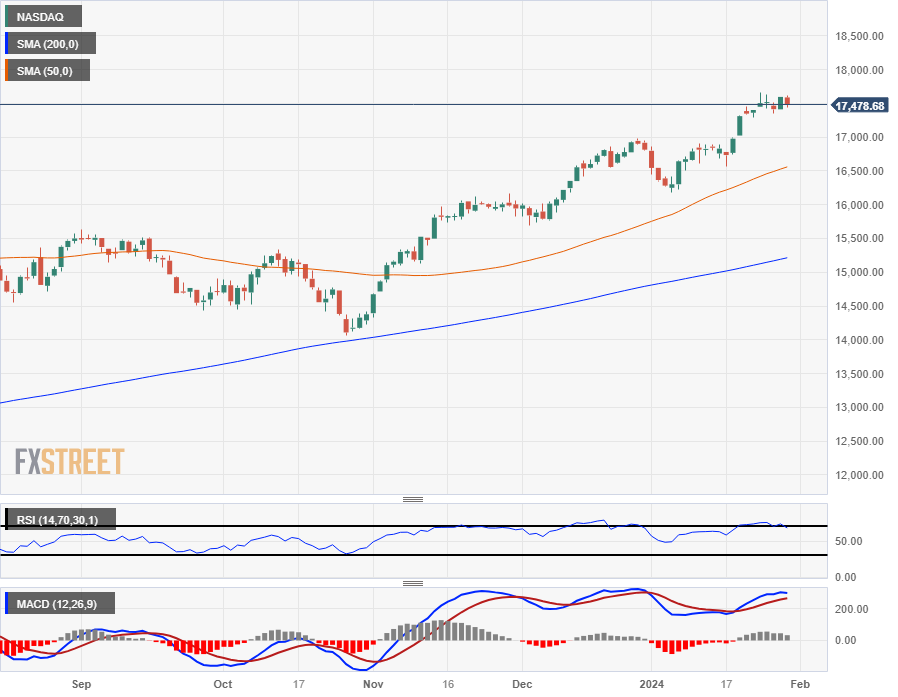
Author

Joshua Gibson
FXStreet
Joshua joins the FXStreet team as an Economics and Finance double major from Vancouver Island University with twelve years' experience as an independent trader focusing on technical analysis.

















