US Dollar Index Price Forecast: Extends recovery above 20-day EMA
- The US Dollar gains significantly to near 99.46 on hopes for Trump developing appetite for higher interest rates.
- The Fed is highly anticipated to hike interest rates on Wednesday.
- Saudi's major oil pipeline shutdown on Friday has prompted prices.

The US Dollar (USD) starts the Federal Reserve’s (Fed) monetary policy week on a strong note, which is scheduled for Wednesday. In the European trading session, the US Dollar Index (DXY), which gauges the Greenback’s value against six major currencies, trades 0.37% higher to near 99.46.
US Dollar Price Today
The table below shows the percentage change of US Dollar (USD) against listed major currencies today. US Dollar was the strongest against the New Zealand Dollar.
| USD | EUR | GBP | JPY | CAD | AUD | NZD | CHF | |
|---|---|---|---|---|---|---|---|---|
| USD | 0.37% | 0.20% | 0.52% | 0.03% | 0.42% | 0.58% | 0.36% | |
| EUR | -0.37% | -0.13% | 0.11% | -0.36% | 0.03% | 0.21% | -0.01% | |
| GBP | -0.20% | 0.13% | 0.27% | -0.19% | 0.19% | 0.36% | 0.07% | |
| JPY | -0.52% | -0.11% | -0.27% | -0.48% | -0.08% | 0.05% | -0.20% | |
| CAD | -0.03% | 0.36% | 0.19% | 0.48% | 0.37% | 0.52% | 0.26% | |
| AUD | -0.42% | -0.03% | -0.19% | 0.08% | -0.37% | 0.17% | -0.14% | |
| NZD | -0.58% | -0.21% | -0.36% | -0.05% | -0.52% | -0.17% | -0.29% | |
| CHF | -0.36% | 0.00% | -0.07% | 0.20% | -0.26% | 0.14% | 0.29% |
The heat map shows percentage changes of major currencies against each other. The base currency is picked from the left column, while the quote currency is picked from the top row. For example, if you pick the US Dollar from the left column and move along the horizontal line to the Japanese Yen, the percentage change displayed in the box will represent USD (base)/JPY (quote).
It seems a number of tailwinds, from a fresh increase in hawkish Federal Reserve (Fed) interest rate prospects to surging oil prices, are supporting a significant increase in the US Dollar. However, neutral comments from United States (US) President Donald Trump regarding the Fed’s monetary policy decision on Wednesday appear to be the key reason behind the jump.
Fed rate expectations climb on higher US monthly CPI data
Analysts at MUFG/BTMU note that “US August CPI inflation came in higher than expected,” prompting “a repricing higher of Fed fund rate hike expectations by the market,“ with investors now "pricing a 88% probability of a hike in September, together with a terminal rate in 2027 of 4.53% (~3.6 hikes), up from 4.29% earlier last week (~2.7 hikes)."
Brent extends gains as Middle East supply risks escalate
Analysts at Deutsche Bank highlight that the latest move in Brent comes “following the precautionary shutdown of a major Saudi pipeline late on Friday following recent attacks, and the postponement of today's planned meeting between Iran and other Gulf states to discuss the creation of a temporary shipping corridor through the Strait of Hormuz.” They note that these developments have reinforced market concerns around regional supply security and key shipping routes.
Technically, higher oil prices de-anchor global inflation expectations, a scenario that prompts expectations of interest rate hikes by central banks. The US Dollar outperformed its peers when oil prices rallied at the onset of the Middle East war.
However, the real reason behind the US Dollar’s strong upside move appears to be the absence of demand for interest rate cuts from US President Trump while speaking to reporters at the Irish Open golf tournament.
Trump said he did not know whether Fed policymakers will raise interest rates at their meeting this week, but he noted the US "should be paying the lowest interest rate in the world" no matter what the Federal Reserve's data indicates about inflation and the economy, Business Standard reported.
This appears to be a serious shift in the president’s view on borrowing costs if compared with his comments during former Fed Chairman Jerome Powell's term, when Trump criticized him several times and also warned to fire him for not reducing interest rates.
The adaptation of a neutral view by Trump on interest rates also improves the central bank’s credibility, which was hurt badly as he strongly stressed on lower interest rates.
US Dollar Index Technical Analysis
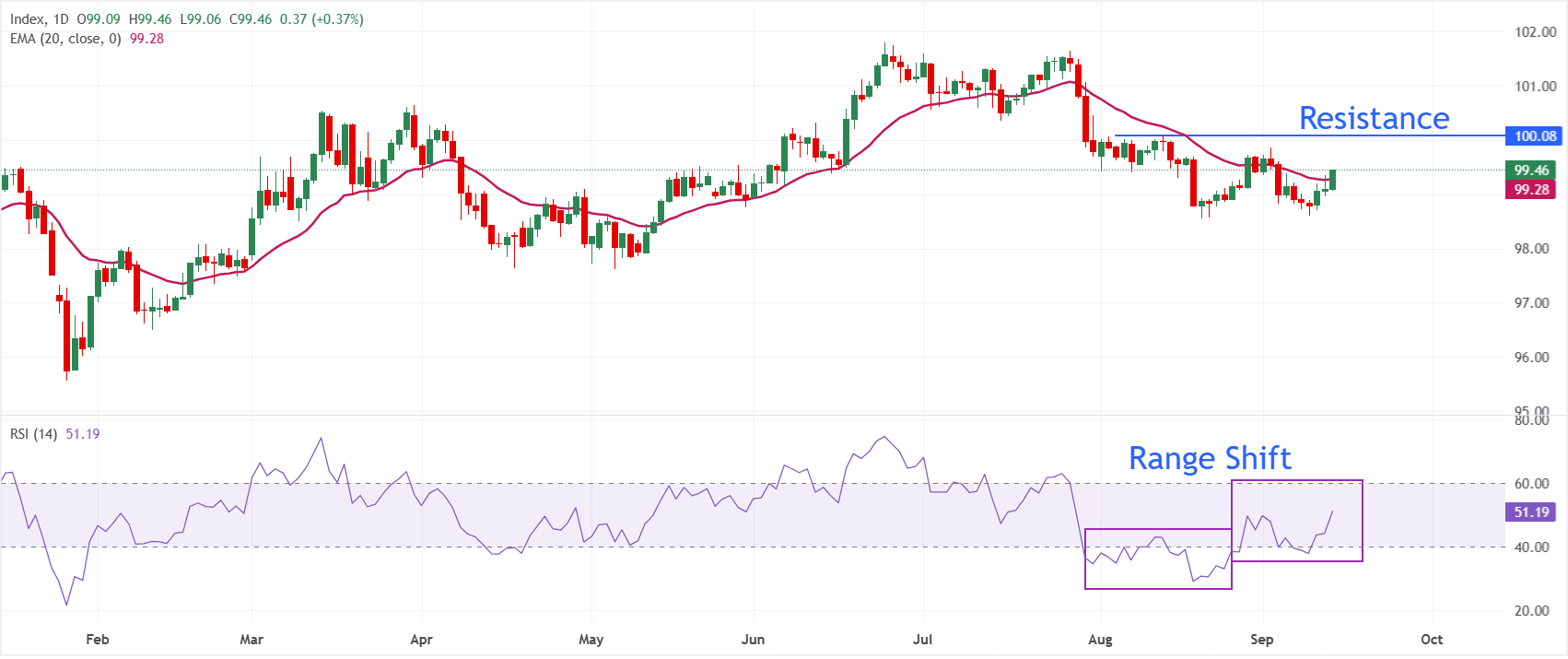
Bias: On the daily chart, US Dollar Index Spot trades at 99.46. The near-term bias turns bullish as price returns above the 20-day Exponential Moving Average (EMA) at 99.28, suggesting emerging underlying demand after the recent recovery from the high-98 area.
Momentum: The Relative Strength Index (14) at 51.19 has shifted back to neutral-positive territory, hinting that downside momentum has faded and that buyers are gradually regaining control.
Support: On the downside, immediate support is seen at the 20-day EMA at 99.28, followed by Friday's low near 99.00. Below 99.00, the US Dollar Index could decline to near the September low at 98.60.
Resistance: Looking up, the index could extend its advance to near the August 13 high around 100.00.
(The technical analysis of this story was written with the help of an AI tool. Know more.)
Economic Indicator
Fed Interest Rate Decision
The Federal Reserve (Fed) deliberates on monetary policy and makes a decision on interest rates at eight pre-scheduled meetings per year. It has two mandates: to keep inflation at 2%, and to maintain full employment. Its main tool for achieving this is by setting interest rates – both at which it lends to banks and banks lend to each other. If it decides to hike rates, the US Dollar (USD) tends to strengthen as it attracts more foreign capital inflows. If it cuts rates, it tends to weaken the USD as capital drains out to countries offering higher returns. If rates are left unchanged, attention turns to the tone of the Federal Open Market Committee (FOMC) statement, and whether it is hawkish (expectant of higher future interest rates), or dovish (expectant of lower future rates).
Read more.Next release: Wed Sep 16, 2026 18:00
Frequency: Irregular
Consensus: 4%
Previous: 3.75%
Source: Federal Reserve
Author

Sagar Dua
FXStreet
Sagar Dua is associated with the financial markets from his college days. Along with pursuing post-graduation in Commerce in 2014, he started his markets training with chart analysis.