US Dollar Index climbs back near its 18-month high as yields rise
- DXY rises back to 102.50, the level of Monday's 18-month high, as yields climb.
- The US 10-year yield touches 5.35%, its highest level since April 2002.

The yield on the US 10-year Treasury note touched 5.35% on Wednesday, its highest since April 2002, and the 30-year bond hit a 24-year high. Brent is back above $100 a barrel after Iran stepped up attacks on tankers in the Strait of Hormuz. Dearer Oil means faster inflation, so bond buyers want a bigger yield. Investors also sold Treasuries ahead of Wednesday's $39 billion sale of new 10-year notes. The Treasury Department will sell new 30-year bonds on Thursday and buy back older ones the same day.
In Europe, investors sold French debt and bought German debt as the safer option, which kept the German 10-year yield near 3.5%. That leaves the US 10-year paying more than 1.8 percentage points above Germany's, and getting that extra return means buying Dollars before buying the bond. The Euro, about 58% of the US Dollar Index, accounts for roughly three-quarters of its climb.
On the charts
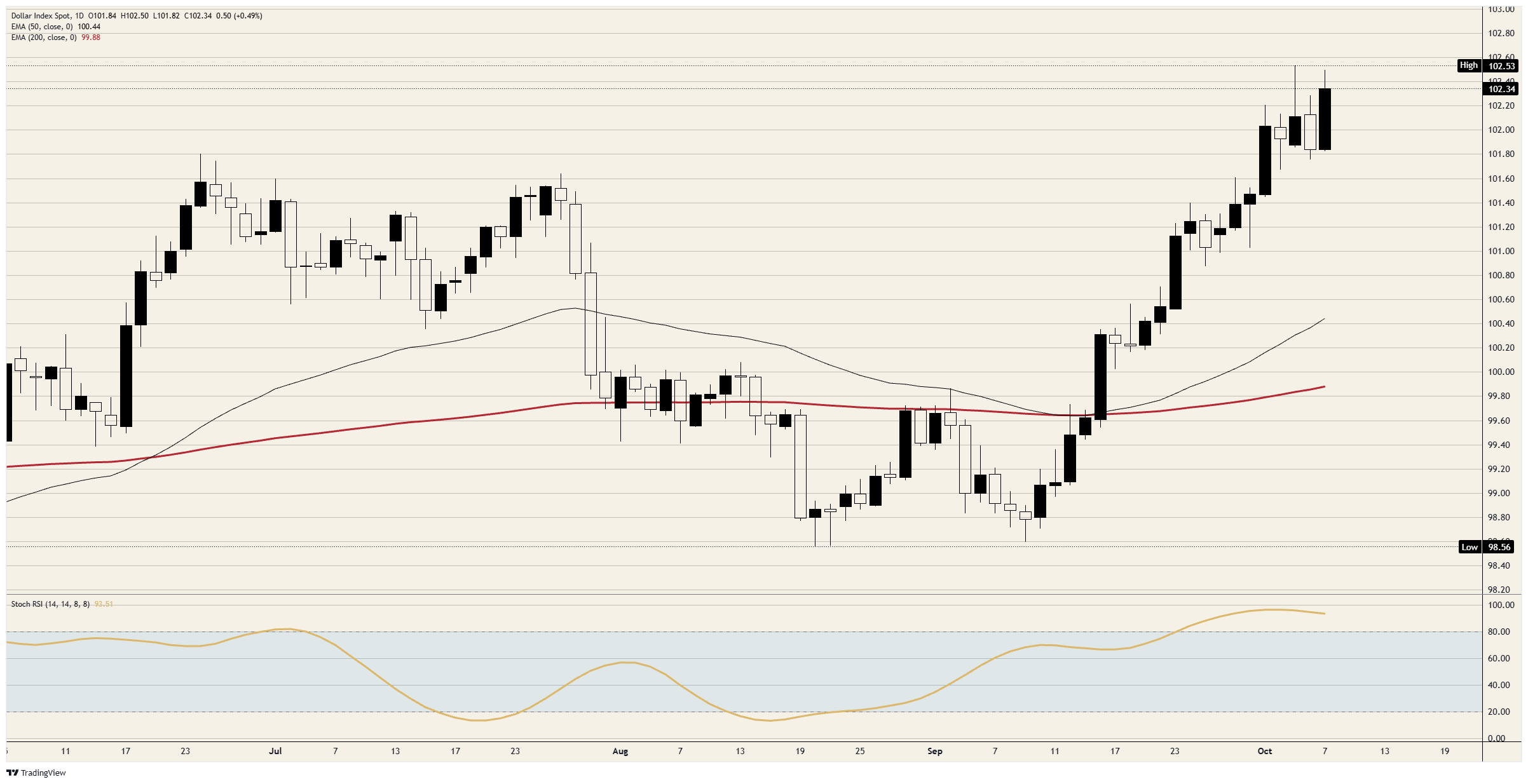
The index rose three weeks running from the September 9 low near 98.60. Wednesday's climb, in several steps from below 102.00, has recovered all of Tuesday's drop to the 101.75 area. It touched 102.50 twice, the level where Monday's rally stalled with the index at its highest since April 2025. It's trading near 102.35 after slipping back from there. The 50-day Exponential Moving Average (EMA) is near 100.50 and rising.
DXY daily chart
US Dollar FAQs
The US Dollar (USD) is the official currency of the United States of America, and the ‘de facto’ currency of a significant number of other countries where it is found in circulation alongside local notes. It is the most heavily traded currency in the world, accounting for over 88% of all global foreign exchange turnover, or an average of $6.6 trillion in transactions per day, according to data from 2022. Following the second world war, the USD took over from the British Pound as the world’s reserve currency. For most of its history, the US Dollar was backed by Gold, until the Bretton Woods Agreement in 1971 when the Gold Standard went away.
The most important single factor impacting on the value of the US Dollar is monetary policy, which is shaped by the Federal Reserve (Fed). The Fed has two mandates: to achieve price stability (control inflation) and foster full employment. Its primary tool to achieve these two goals is by adjusting interest rates. When prices are rising too quickly and inflation is above the Fed’s 2% target, the Fed will raise rates, which helps the USD value. When inflation falls below 2% or the Unemployment Rate is too high, the Fed may lower interest rates, which weighs on the Greenback.
In extreme situations, the Federal Reserve can also print more Dollars and enact quantitative easing (QE). QE is the process by which the Fed substantially increases the flow of credit in a stuck financial system. It is a non-standard policy measure used when credit has dried up because banks will not lend to each other (out of the fear of counterparty default). It is a last resort when simply lowering interest rates is unlikely to achieve the necessary result. It was the Fed’s weapon of choice to combat the credit crunch that occurred during the Great Financial Crisis in 2008. It involves the Fed printing more Dollars and using them to buy US government bonds predominantly from financial institutions. QE usually leads to a weaker US Dollar.
Quantitative tightening (QT) is the reverse process whereby the Federal Reserve stops buying bonds from financial institutions and does not reinvest the principal from the bonds it holds maturing in new purchases. It is usually positive for the US Dollar.
Author

Joshua Gibson
FXStreet
Joshua joins the FXStreet team as an Economics and Finance double major from Vancouver Island University with twelve years' experience as an independent trader focusing on technical analysis.