United States Dollar Index rises as strong NFP revives Fed hike bets
- DXY rebounds as August NFP crushes expectations with 162K jobs.
- Strong labor market lifts September Fed hike odds to 63%.
- Next week’s CPI and PPI could confirm tightening risks.

The United States Dollar Index (DXY) rises some 0.17% on Friday following a stellar Nonfarm Payrolls (NFP) report, with the economy creating nearly three times as many jobs as expected by most economists, as reported by the Bureau of Labor Statistics (BLS). At the time of writing, the DXY trades at 99.17, after bouncing off a daily low of 98.91.
DXY gains after strong jobs data lift September hike expectations
Data from the US showed the economy added more people to the workforce than expected. Over 162K Americans entered the workforce in August, well above estimates of 56K and crushing July’s upwardly revised report from -23K to 21K. The same report showed the Unemployment Rate stood at 4.1%, beneath Fed officials' estimates of 4.5% towards the end of the year.
Immediately after the data, DXY jumped towards the high of the day at 99.39, before trimming some of its gains. US Treasury yields followed suit, but the move faded.
A stronger labor market increased the chances of a Fed rate hike at the September 16 meeting. The swaps market shows a 63% probability of a 25-bps increase in the Fed funds rate, up from 54% a day ago, according to Prime Terminal.
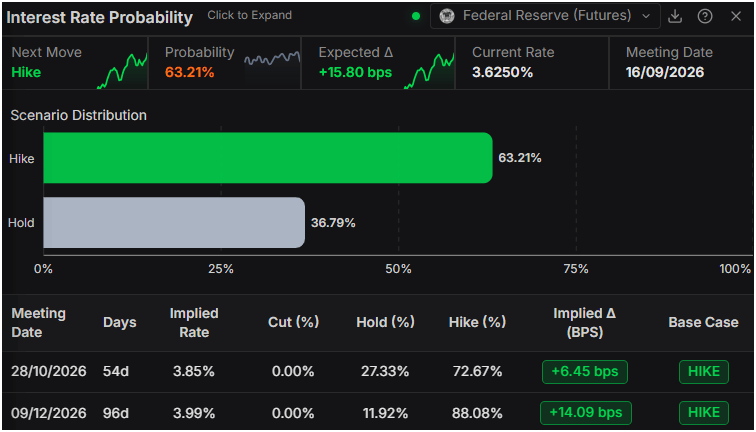
Now with US jobs data in the rearview mirror, traders are set for next week’s inflation reports, first on the producer and then on the consumer side. If both show the disinflation process is not evolving, this could warrant a rate hike.
On Thursday, Fed Governor Christopher Waller stated that the Fed is in no rush to raise rates if inflation cools down. However, a bad print next week could keep the next Federal Open Market Committee meeting open.
US Dollar Index Price Forecast: Technical outlook
In the daily chart, Dollar Index Spot trades at 99.09. The near-term tone is bearish as price holds below the clustered 50-, 100- and 200-day simple moving averages around 100.22 and also beneath the previously supportive primary uptrend line now referenced near 100.15, while a descending trend line from 101.80 keeps the broader recovery attempt capped around 101.26. The Relative Strength Index (14) at about 42 sits below the midline, hinting at lingering downside pressure rather than an imminent bullish reversal.
On the topside, initial resistance is seen at the broken trend-line region around 100.15, followed closely by the dense simple moving average cluster near 100.22, with the downtrend reference level at 101.26 acting as a more distant cap if a bounce extends. On the downside, the first notable support is the secondary rising trend line projecting near 98.72, where failure would expose lower levels in the broader range and reinforce the prevailing bearish bias.
(The technical analysis of this story was written with the help of an AI tool. Know more.)
Author

Christian Borjon Valencia
FXStreet
Markets analyst, news editor, and trading instructor with over 14 years of experience across FX, commodities, US equity indices, and global macro markets.