United States Dollar Index holds onto gains above 99 ahead of US CPI data
- The US Dollar trades firmly above 99.00 ahead of the US CPI data for August.
- The US headline CPI is seen remaining unchanged at 3.4% YoY.
- Stronger-than-expected US PPI growth has prompted Fed interest rate hike expectations.

The US Dollar (USD) clings to its Thursday gains in early session on Friday, driven by faster-than-expected growth in the United States (US) Producer Price Index (PPI) data for August.
At press time, the US Dollar Index (DXY), which gauges the Greenback’s value against six major currencies, trades marginally higher at around 99.12.
On Thursday, the US PPI report showed that headline producer inflation accelerated to 5.4% Year-on-Year (YoY) from 4.8% in July. The headline inflation at the wholesale level was expected to arrive at 5.3%. The core PPI – which excludes volatile food and energy items – grew at a faster pace of 4.6% YoY, as expected, compared to the previous reading of 4.3%.
Higher-than-projected US PPI figures have prompted hawkish Federal Reserve (Fed) bets. The CME FedWatch tool shows that the odds of the Fed raising interest rates at the policy meeting next week have increased to 72.4% from 61.2% seen before the data release.
Later in the day, investors will pay close attention to the US Consumer Price Index (CPI) data for August, which will be published at 12:30 GMT.
US inflation risks seen tilted higher as TD flags tariff-related uncertainty
According to economists at TD Securities, August inflation likely showed only modest further progress. They “project that core CPI rose 2.3% on a y/y basis, down 10 bps vs July, while headline inflation likely stayed unchanged at 3.4% y/y.” However, they caution that “risks to our forecasts” are “skewed to the upside” given their assumption of “a number of large price declines in tariff-exposed goods categories,” leaving some uncertainty around the near-term disinflation path.
US Dollar Index Technical Analysis
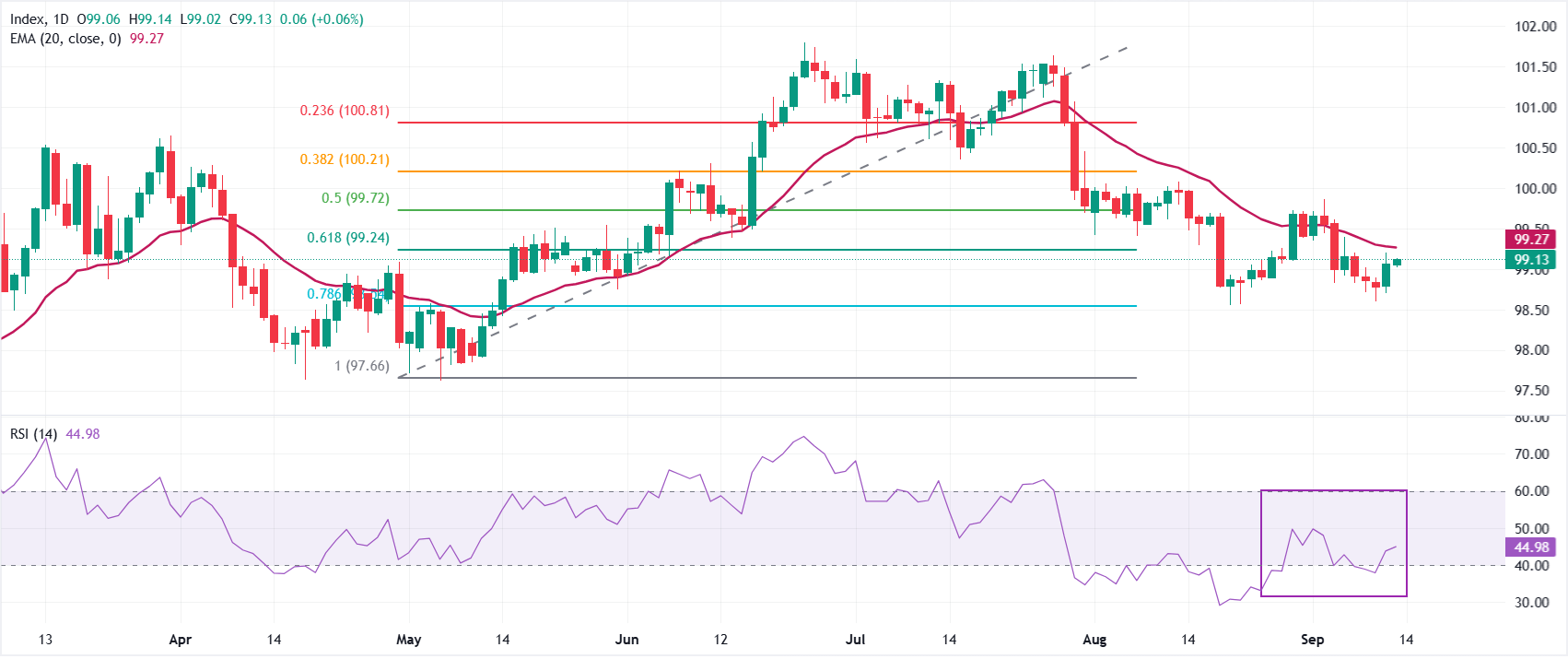
In the daily chart, Dollar Index Spot trades at 99.13. The near-term bias stays bearish as price holds beneath the 20-period exponential moving average (EMA) at 99.27 and below the key 50% Fibonacci retracement at 99.72, keeping recent rebounds capped within a broader corrective phase.
The Relative Strength Index (14) has recovered toward the mid-40s, hinting at easing downside momentum, but it still falls short of signaling a decisive bullish shift while the index trades under these overhead levels.
On the topside, initial resistance is aligned with the 61.8% Fibonacci retracement near 99.24 and the 20-period EMA at 99.27, with further barriers at the 50% retracement at 99.72 and then the 38.2% level at 100.21; a sustained break above this band would be needed to challenge the 23.6% retracement at 100.81. On the downside, support emerges at the 78.6% retracement around 98.54, ahead of the 100% Fibonacci anchor at 97.66, where a failure would expose a deeper bearish extension.
(The technical analysis of this story was written with the help of an AI tool. Know more.)
Economic Indicator
Producer Price Index (YoY)
The Producer Price Index released by the Bureau of Labor statistics, Department of Labor measures the average changes in prices in primary markets of the US by producers of commodities in all states of processing. Changes in the PPI are widely followed as an indicator of commodity inflation. Generally speaking, a high reading is seen as positive (or bullish) for the USD, whereas a low reading is seen as negative (or bearish).
Read more.Last release: Thu Sep 10, 2026 12:30
Frequency: Monthly
Actual: 5.4%
Consensus: 5.3%
Previous: 4.7%
Source: US Bureau of Labor Statistics
Author

Sagar Dua
FXStreet
Sagar Dua is associated with the financial markets from his college days. Along with pursuing post-graduation in Commerce in 2014, he started his markets training with chart analysis.