The tariff economy returns: Global e-commerce enters a political era (AMZN vs BABA)


Global e-commerce grew up in a comfortable world of cheap shipping, frictionless customs clearance, and predictable consumer demand. That setup has dissolved. By mid-2026, trade policy had become one of the most influential forces shaping international retail margins. Tariffs, stricter border checks, and protective industrial policies are rewriting business models faster than many companies can adapt.
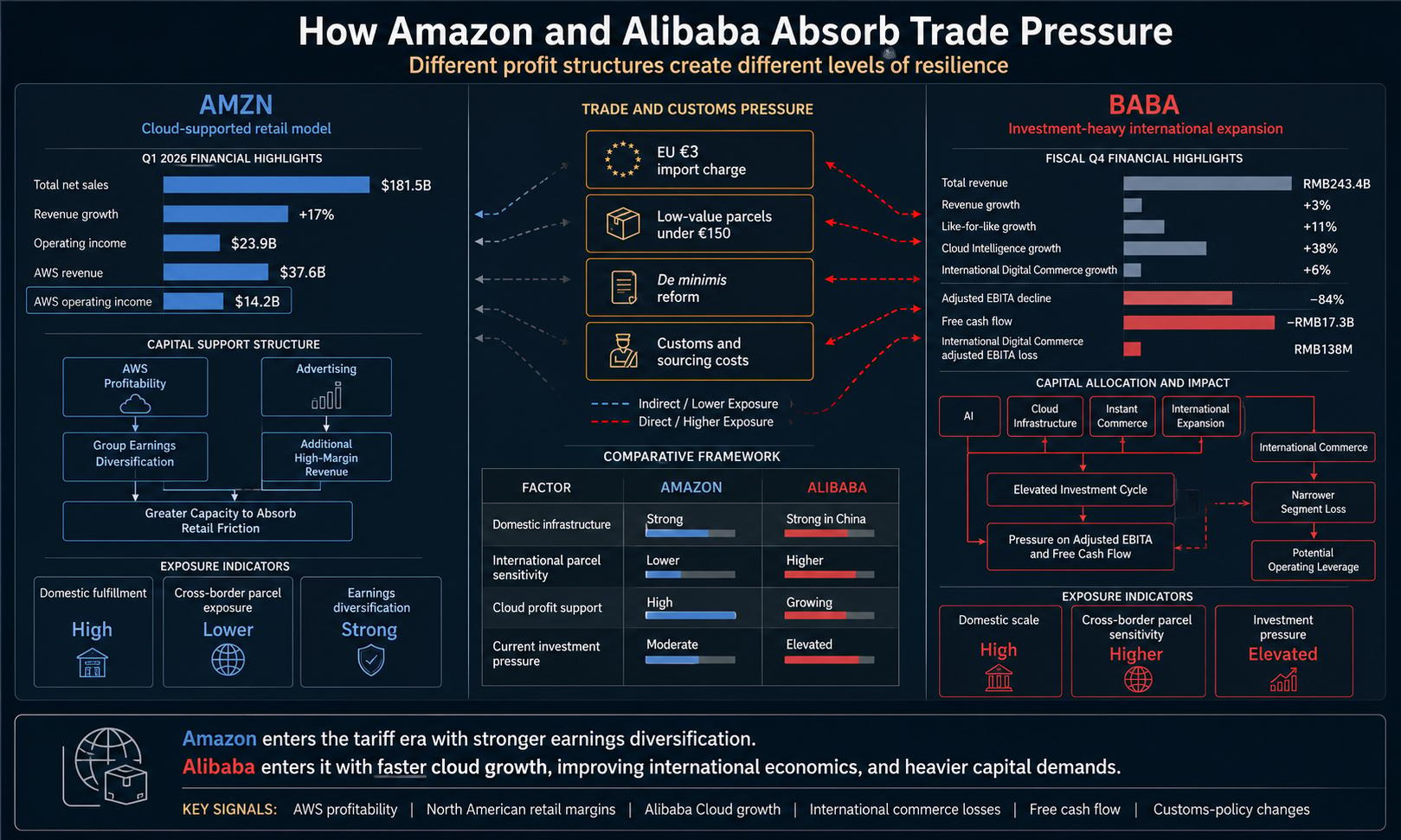
The friction spreads far beyond the typical trade disputes between Washington and Beijing. On July 1, 2026, the European Union rolled out a flat €3 import fee on individual product categories in low-value parcels under €150, directly affecting platforms shipping low-cost goods from China. The measure is designed to reduce the competitive advantage created under the previous de minimis exemption that helped fuel discount marketplaces for years, according to Reuters. This move shows that the systemic tariff impact on e-commerce has turned into a global regulatory shift rather than a localized squabble.
Corporate exposure to political shifts
Traditional stock evaluations that focus heavily on price-to-earnings ratios fail to capture this new environment. Today, a useful AMZN/BABA comparison functions as a lesson in geopolitical exposure rather than simple retail accounting.
Amazon operates firmly inside the U.S. consumer market, where order values run high. While its third-party merchant base pulls inventory from global factories, Amazon offsets pressure on its retail business through highly profitable operations, namely AWS and its massive advertising network. These businesses provide earnings diversification even when retail margins come under pressure.
Alibaba faces a tougher operational setup. Its domestic Chinese business provides scale, but future growth increasingly depends on international expansion through overseas platforms and high-speed logistics. Tightening border rules and export restrictions raise costs for export merchants and complicate international expansion. This structural reality alters how capital allocators evaluate AMZN vs BABA, turning the corporate rivalry into a proxy for broader geopolitical tension.
Financial divergence under pressure
Traders evaluating recent earnings statements must separate core operational execution from the broader impact of trade policy and supply-chain changes. The raw numbers show exactly how each company absorbs these macro pressures.
Amazon’s Q1 2026 financial report showed massive scale. Net sales hit $181.5 billion, up 17% year over year. Operating income reached $23.9 billion, driven largely by AWS, which grew revenue 28% to $37.6 billion. The cloud business brought in $14.2 billion in operating income, functioning as the company's financial ballast. Traders can review the full breakdown via Amazon Investor Relations.
Alibaba’s fiscal fourth-quarter results painted a much more complicated picture. Total revenue grew 3% year over year to RMB243.4 billion, which works out to an 11% increase on a like-for-like basis after stripping out Sun Art and Intime. Cloud Intelligence revenue rose 38%, while the International Digital Commerce division narrowed its adjusted EBITA loss to RMB138 million. Alibaba is taking a different gamble by investing aggressively across AI, cloud infrastructure, instant commerce, and international expansion. During this period of elevated investment, group adjusted EBITA declined 84%, and free cash flow turned into a negative RMB17.3 billion outflow. These metrics are detailed on Alibaba Investor Relations.
This deep gap in free cash flow helps explain why Baba vs AMZN stock trajectories rely on structural traits rather than simple market multiples. Amazon funds its retail experiments with cloud profits, while Alibaba deploys substantial capital to strengthen its international position.
Policy as a structural market driver
The widening performance gap between US vs. China e-commerce stocks increasingly reflects customs policy, supply-chain diversification, industrial strategy, and cross-border regulation alongside traditional business fundamentals. Relying on consumer demand alone no longer provides a complete picture when trade policy can reshape operating costs and supply chains.
Trading cross-border commerce stocks now involves understanding freight networks, customs rules, and regulatory frameworks alongside company fundamentals. The EU’s new flat fee illustrates that policy risks hit platforms unevenly. Platforms shipping individual low-value parcels directly from China face a clearer near-term burden than retailers operating primarily through regional warehouse networks.
The trader's playbook
Evaluating Amazon vs. Alibaba stock moves over the next two quarters requires looking past top-line revenue.
First, track the regulatory front lines. Watch for adjustments to U.S. de minimis thresholds or additional European customs measures, as these decisions can quickly change shipping economics. Second, monitor segment performance. AWS profitability shows how effectively Amazon can offset pressure on its retail operations, while international commerce losses reveal whether Alibaba’s global expansion can achieve sustainable scale.
The field of e-commerce platform competition has moved beyond simple price matching and increasingly includes regulatory compliance and supply-chain positioning. Long-term growth may increasingly favor companies that position their fulfillment networks closer to end customers.
A broader global retail stock comparison suggests that capital may increasingly favor companies with stronger domestic infrastructure. The reality for anyone trying to trade Amazon vs. Alibaba is that logistics, customs policy, and supply-chain resilience have become as important as consumer demand when evaluating long-term performance.
Comparing Baba vs AMZN serves as a practical test of supply-chain resilience. Incorporating this macroeconomic perspective into Versus Trade AMZN/BABA analysis can help investors identify which business model is better positioned to navigate an increasingly fragmented global trading environment.
Author